

Construction legal cases demand careful planning and strong documentation from the start. Disputes over contracts, delays, or defective work can drain resources and derail projects if not handled properly.
We at The Law Offices of Alan J. Carnegies, APC serve clients throughout Los Angeles County, California who face construction conflicts. This guide walks you through the essential steps to protect your interests and achieve the best possible outcome.
What Construction Disputes Actually Look Like in Los Angeles County
The Three Problems That Destroy Projects
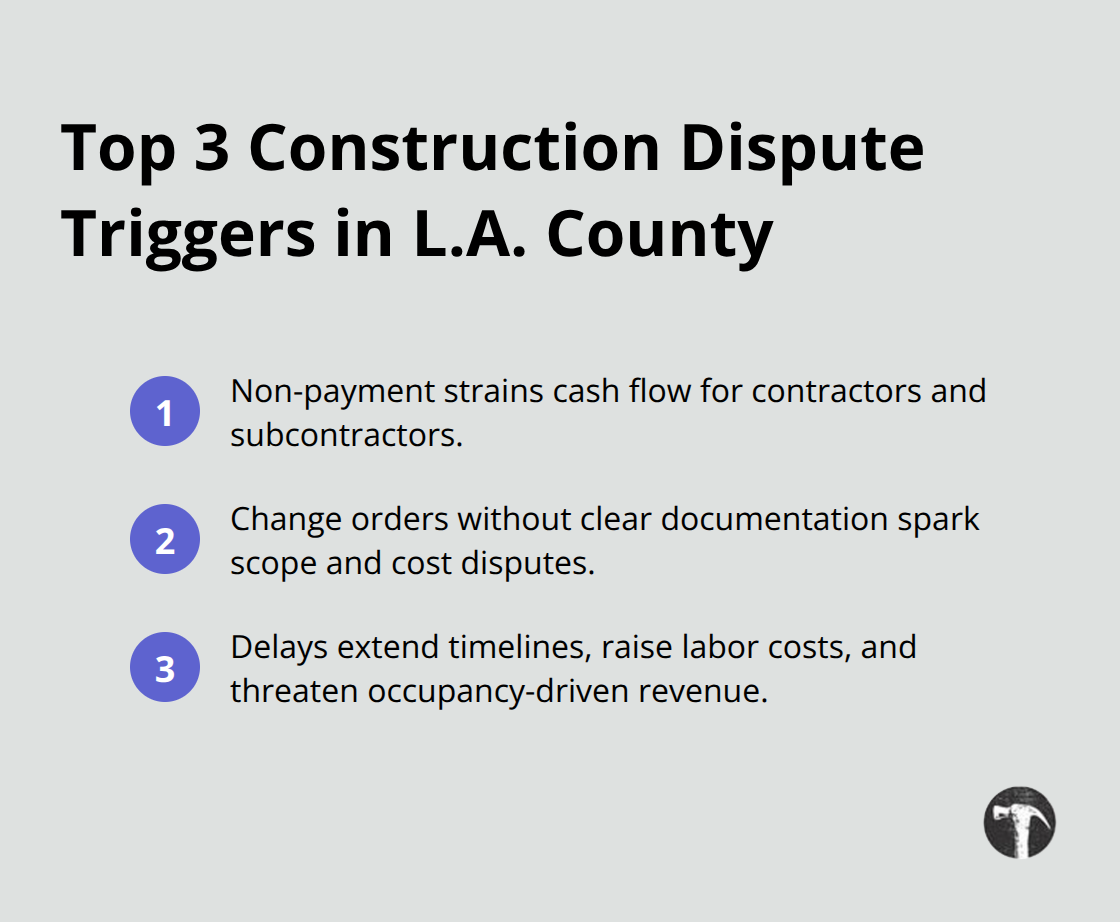
Construction disputes in Los Angeles County center on three problems that destroy project timelines and cash flow: non-payment, change orders, and delays. Non-payment hits contractors and subcontractors hardest because it creates immediate cash shortages that ripple through operations. Change orders breed conflict when scope creep happens without clear documentation or cost agreement, leaving parties fighting over what was actually promised. Project delays compound these issues by extending timelines, inflating labor costs, and pushing completion dates past occupancy deadlines that owners depend on for revenue. These three categories account for the vast majority of construction litigation, and they are preventable with the right approach from the beginning.
Why Construction Law Stands Apart
Construction law stands apart from other practice areas because it combines contract interpretation with real-world project management and technical knowledge of construction practices. A breach of a written construction contract in California carries a four-year statute of limitations, while mechanics liens operate under a completely different timeline with a 90-day foreclosure deadline from the last day of work, making timing critical for protecting your rights. If you miss that 90-day window, your lien becomes unenforceable and the property owner can remove it from the title, erasing your leverage entirely.
Material Costs and Escalation Clauses
Material price increases driven by tariffs and supply chain disruptions have made escalation clauses tied to verifiable indices like the Producer Price Index essential for protecting profit margins on longer projects. Owners prioritize strict substantial completion dates with liquidated damages clauses to protect occupancy revenue, while general contractors need time-extension language for uncontrollable events like owner changes, weather delays, or permitting holdups to avoid absorbing extra costs.
Risk Allocation Across Project Participants
Subcontractors face downstream risk shifting and need milestone-based payment schedules with protections if upstream disputes delay their payments. These competing interests create complexity that requires understanding both the contract language and the practical realities of how construction work actually happens on site. Each party’s position in the project hierarchy shapes what protections matter most-and what disputes will likely emerge when things go wrong.
Building Your Evidence Foundation
Construction disputes live or die on documentation. Weak records mean weak leverage, and weak leverage means accepting unfavorable settlements or losing in arbitration. The construction projects in Los Angeles County that end up in litigation almost always involve parties who failed to document their work, agreements, or performance contemporaneously. Start collecting evidence before problems emerge, not after.
Contracts, Change Orders, and Written Agreements
Contracts form the backbone of any construction case, but most parties sign documents without understanding their mechanics lien deadlines, dispute resolution procedures, or payment term variations. California law allows written construction contracts a four-year statute of limitations, but mechanics liens operate on a completely different clock with that critical 90-day foreclosure window. When you sign a contract, photograph every page and store copies in at least two locations because originals get lost or damaged on job sites.
Change orders demand the same rigor-you must get them in writing with itemized costs and schedule impacts attached. Never rely on verbal agreements or email threads that lack clear approval. These written records protect you when disputes arise and prevent the other party from claiming they never agreed to scope changes or cost adjustments.
Site Records and Photographic Evidence
Weekly progress meeting minutes become your most valuable asset during disputes because they show what each party knew and when they knew it. You should photograph or video the job site weekly, date-stamp everything, and note the current stage against the baseline schedule. If delays occur, you must document the cause-owner changes, permitting holds, weather events, or supply chain gaps-with supporting evidence like permit records, weather reports, or supplier correspondence.
Keep timesheets and material receipts organized by week and phase because these establish your actual costs and hours. If a subcontractor’s work affects your timeline or budget, you should document the impact with before-and-after schedule comparisons tied to specific dates. Store all project records digitally with backup copies; construction sites are harsh environments and paper documents deteriorate quickly.
Qualified Witnesses and Inspector Reports
Expert witnesses and inspectors validate your documentary evidence and convert technical construction facts into testimony that judges and arbitrators understand. You should not wait until a dispute arises to identify qualified witnesses because the best ones fill their schedules months in advance. Construction defect cases require licensed inspectors who can testify about substandard materials or workmanship, and delay disputes need scheduling professionals who can analyze the baseline schedule and quantify the impact of alleged delays.
When you engage an inspector or witness, you must provide them with your complete documentary record-contracts, change orders, schedules, photographs, and meeting minutes-so they have context before forming opinions. Their reports should reference specific dates, measurements, and contract sections rather than vague conclusions. Hourly rates for qualified construction inspectors in Los Angeles County typically range from $150 to $300 per hour, and scheduling experts charge similar amounts, so you should budget for this cost early.
Preserving Physical Evidence
If you cannot afford expert testimony, your documentary evidence must be extraordinarily strong because judges and arbitrators rely heavily on qualified opinions in technical disputes. You must preserve the chain of custody for physical evidence like defective materials or failed components by photographing items in place, removing them carefully, storing them in labeled containers, and documenting who handled them and when. This prevents the other party from claiming evidence was tampered with or staged.
Organized records from day one eliminate the scramble to reconstruct facts when disputes emerge. Once you have built this evidence foundation, you face critical decisions about how to resolve the dispute-whether through negotiation, mediation, or formal litigation.
Resolving Construction Disputes Before They Consume Your Resources
Your evidence is solid, your documentation is organized, and now you face the most consequential decision in any construction dispute: whether to negotiate, mediate, pursue arbitration, or fight in court. This choice shapes your timeline, costs, and relationship with the other party long after the dispute ends. Most construction disputes in Los Angeles County never reach trial because parties run out of money, patience, or both before a judge renders a decision. The parties who succeed are those who understand their leverage, know when to push and when to settle, and recognize that the cheapest resolution is often the one negotiated early before legal fees spiral.
Start with Direct Negotiation
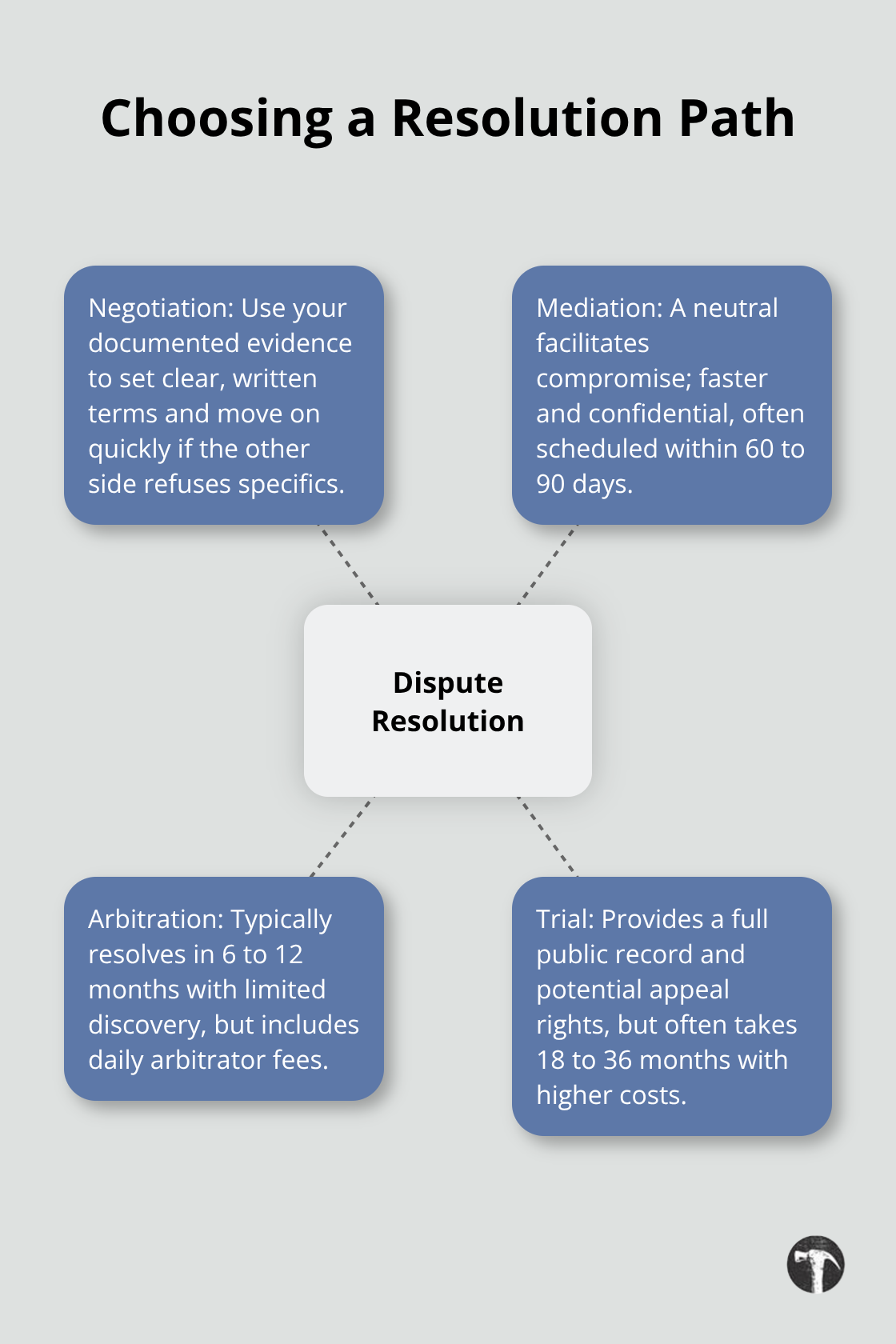
Negotiation should happen immediately when a dispute emerges because the other party’s position hardens over time as they invest in their own legal fees and become emotionally committed to their stance. If you have documented the dispute thoroughly-with meeting minutes showing what was promised, photographs proving what was delivered, and cost records establishing your damages-you possess leverage that diminishes as litigation drags on and memories fade. Direct conversation between principals often reveals that both parties misunderstood the contract or that a simple cash adjustment resolves the conflict without lawyers. However, negotiation only works if you set clear boundaries and refuse to accept vague promises about future payment or performance. Construction projects run on cash flow, and a verbal commitment to pay next month means nothing when next month arrives with no payment. Demand specific terms: exact dollar amounts, payment dates with no conditions, and written confirmation signed by someone with authority to bind their company. If the other party refuses to put terms in writing, they have signaled that negotiation will fail and you should move to mediation immediately.
Mediation Offers Speed and Confidentiality
Mediation in Los Angeles County construction disputes typically costs $2,000 to $5,000 in mediator fees split between parties, compared to $15,000 to $50,000 in attorney fees for a single week of litigation preparation. A neutral mediator listens to both sides, identifies common ground, and proposes settlement ranges that neither party would accept from the other directly. Mediation works best when both parties have strong evidence supporting their position because neither side can dismiss the mediator’s reality check. If your documentary record is weak or the other party’s position is unreasonable, mediation becomes theater-the mediator cannot force a settlement and will simply confirm what you already know: this dispute requires arbitration or trial. Many construction contracts in California include mandatory mediation clauses that require parties to attempt resolution through a mediator before filing for arbitration or litigation, so you should review your contract to determine if you are obligated to mediate. Mediation also preserves confidentiality, meaning settlement discussions cannot be used as evidence later if the dispute escalates, which protects both parties from having their negotiating positions weaponized in court. Schedule mediation within 60 to 90 days of the dispute surfacing, before legal fees consume the settlement amount and before key witnesses’ memories deteriorate.
Arbitration Versus Trial: Speed Against Certainty
Arbitration and trial represent fundamentally different paths forward, and your choice depends on contract language, the complexity of your dispute, and your tolerance for cost and timeline uncertainty. Arbitration under California construction contracts typically moves faster than litigation-often resolving within 6 to 12 months compared to 18 to 36 months for trial-because discovery is limited and arbitrators control the hearing schedule without court calendar delays. However, arbitration is not cheap; arbitrator fees alone run $5,000 to $15,000 per day, and both parties pay equally unless the contract specifies otherwise. Public construction contracts in California allow arbitration under Public Contract Code provisions that require arbitrators to issue written findings of fact and conclusions of law, giving you a record of how the arbitrator evaluated your evidence. Trial offers the advantage of a full public record and the possibility of appeal, but court proceedings involve extensive discovery, motion practice, and scheduling delays that inflate costs beyond arbitration. If your dispute involves less than $100,000 in damages, arbitration rarely makes financial sense because arbitrator fees will consume 20 to 30 percent of your recovery. If your dispute involves $500,000 or more, arbitration becomes attractive because the speed advantage offsets the arbitrator fee cost.
Protecting Your Evidence During Formal Proceedings
Document preservation becomes critical once you decide to pursue formal dispute resolution because the other party will demand access to all communications, photographs, schedules, and meeting minutes related to the dispute. Do not delete emails, alter photographs, or reorganize files in ways that appear to hide evidence because discovery violations can result in sanctions, attorney fee awards, or dismissal of your claims. California courts and arbitrators view document destruction as consciousness of guilt, and judges routinely award damages to the other side for spoliation. Prepare your documents for production by organizing them chronologically and by category-contracts, change orders, correspondence, photographs, schedules-so the other party cannot claim you withheld responsive materials. If you discover documents that hurt your position, your attorney must still produce them; hiding adverse evidence violates California discovery rules and ethical obligations. The parties who lose disputes are often those who concealed damaging information rather than those whose evidence was genuinely weak.
Understanding Costs and Timelines
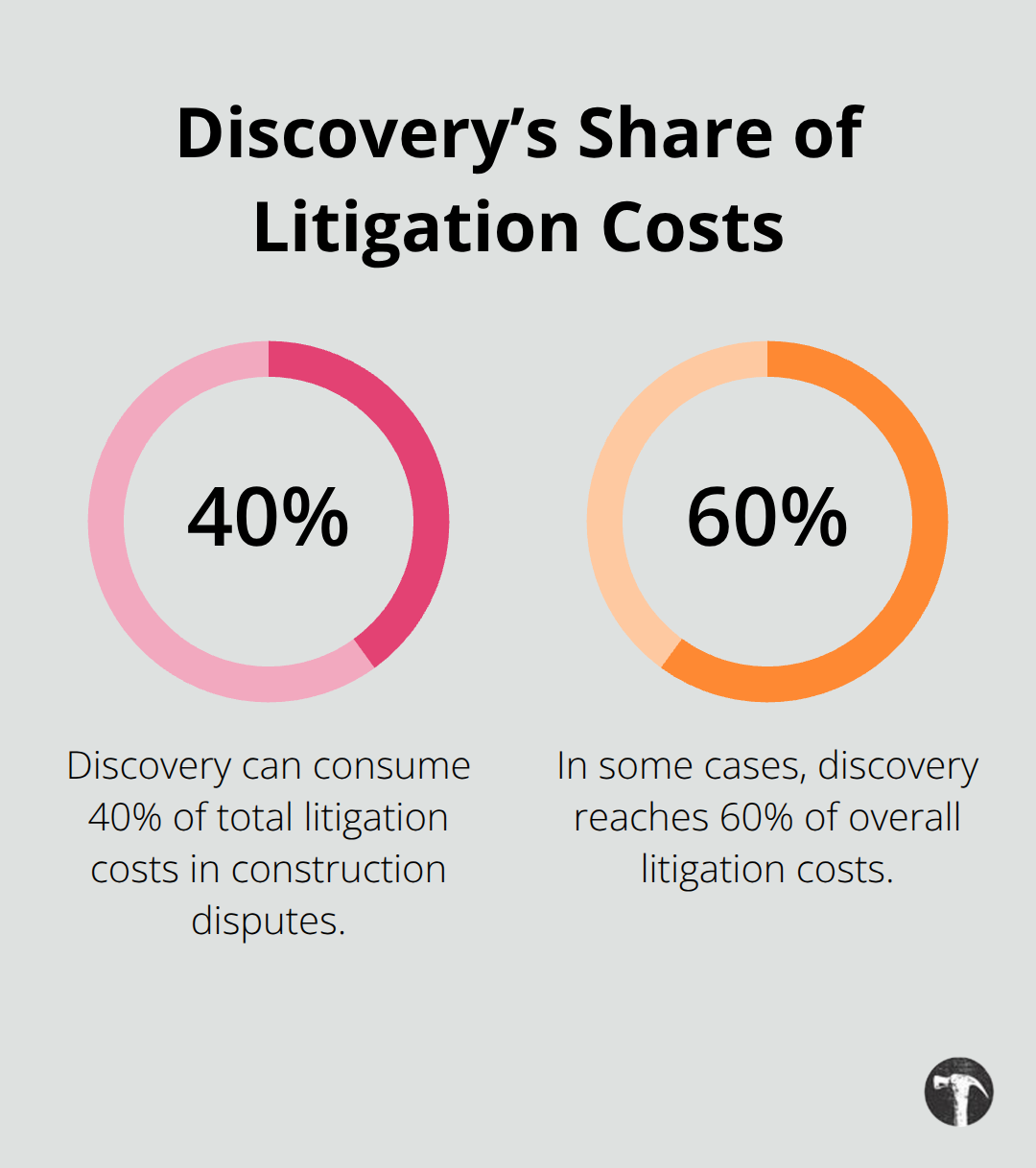
Cost projections for construction litigation vary dramatically based on dispute complexity and whether the case settles before trial. A straightforward non-payment dispute involving a single subcontractor might cost $10,000 to $25,000 to resolve through mediation and settlement. A complex delay dispute involving multiple parties, scheduling analysis, and expert testimony could cost $75,000 to $150,000 for arbitration, or $200,000 to $500,000 if it proceeds to trial with multiple weeks of hearing testimony. These costs accumulate in increments: initial consultation and case evaluation run $2,000 to $5,000; contract review and demand letter preparation cost $3,000 to $8,000; mediation preparation and participation add $5,000 to $12,000; arbitration or trial preparation multiplies costs exponentially as your attorney prepares witness testimony, expert reports, and legal briefs. The single greatest cost control measure is settling the dispute before discovery concludes because discovery-the process of exchanging documents and taking depositions-consumes 40 to 60 percent of litigation costs. If you can negotiate settlement or reach resolution through mediation before the other party begins extensive discovery, you cut your total costs roughly in half.
Timeline expectations depend on whether you pursue negotiation, mediation, arbitration, or trial. Direct negotiation should conclude within 30 to 60 days or you should abandon it for mediation. Mediation typically schedules within 60 to 90 days and concludes within a single day or two-day session. Arbitration from filing to final award takes 9 to 18 months depending on hearing complexity and arbitrator availability. Trial preparation extends timelines to 24 to 36 months because courts prioritize criminal cases and require months of advance scheduling notice before trial dates become available. If cash flow is critical to your business-which it is for most contractors and subcontractors-the timeline matters as much as the outcome because a settlement in month three worth $50,000 is far more valuable than a judgment in month 30 worth $60,000. The construction projects that fail are those where parties become so committed to litigation that they ignore the reality that delayed resolution destroys the business faster than accepting an unfavorable settlement today.
Final Thoughts
Construction legal cases succeed when you act decisively from the moment a dispute emerges. The parties who protect their interests document everything contemporaneously, understand their contract’s mechanics lien deadlines and dispute resolution procedures, and recognize that early settlement almost always costs less than prolonged litigation. Your evidence foundation determines your leverage, and your leverage determines whether you negotiate from strength or accept unfavorable terms because you ran out of resources.
The three-problem framework-non-payment, change orders, and delays-accounts for virtually all construction disputes in Los Angeles County, and each requires different documentation and resolution strategies. Start with direct negotiation if the other party will engage in good faith, move to mediation within 60 to 90 days if negotiation stalls, and pursue arbitration or trial only when settlement becomes impossible. A $50,000 settlement in month three outperforms a $60,000 judgment in month 30 because your business cannot survive the delay.
We at The Law Offices of Alan J. Carnegies, APC represent property owners, contractors, and other parties throughout Los Angeles County in construction disputes involving mechanic’s liens and construction defects. Contact us today to discuss your dispute and develop a strategy that protects your cash flow and timeline.