

A lis pendens in Calabasas, California can stop a property transaction in its tracks. Whether you recorded one to protect your claim to a home, a commercial building, or an easement, or you just discovered that someone recorded one against property you own, this single document can shape the leverage on both sides of a real estate dispute. Knowing how a notice of pending action actually works, and how it can be challenged, gives you real control over what happens next.
We at The Law Offices of Alan J. Carnegies, APC help property owners, buyers, investors, and businesses throughout Los Angeles County navigate real estate litigation, including disputes where a lis pendens has been recorded. This guide explains what a lis pendens is, how it is properly recorded, and how an improper one can be removed, so you can move forward with confidence.
What a Lis Pendens Actually Is in California
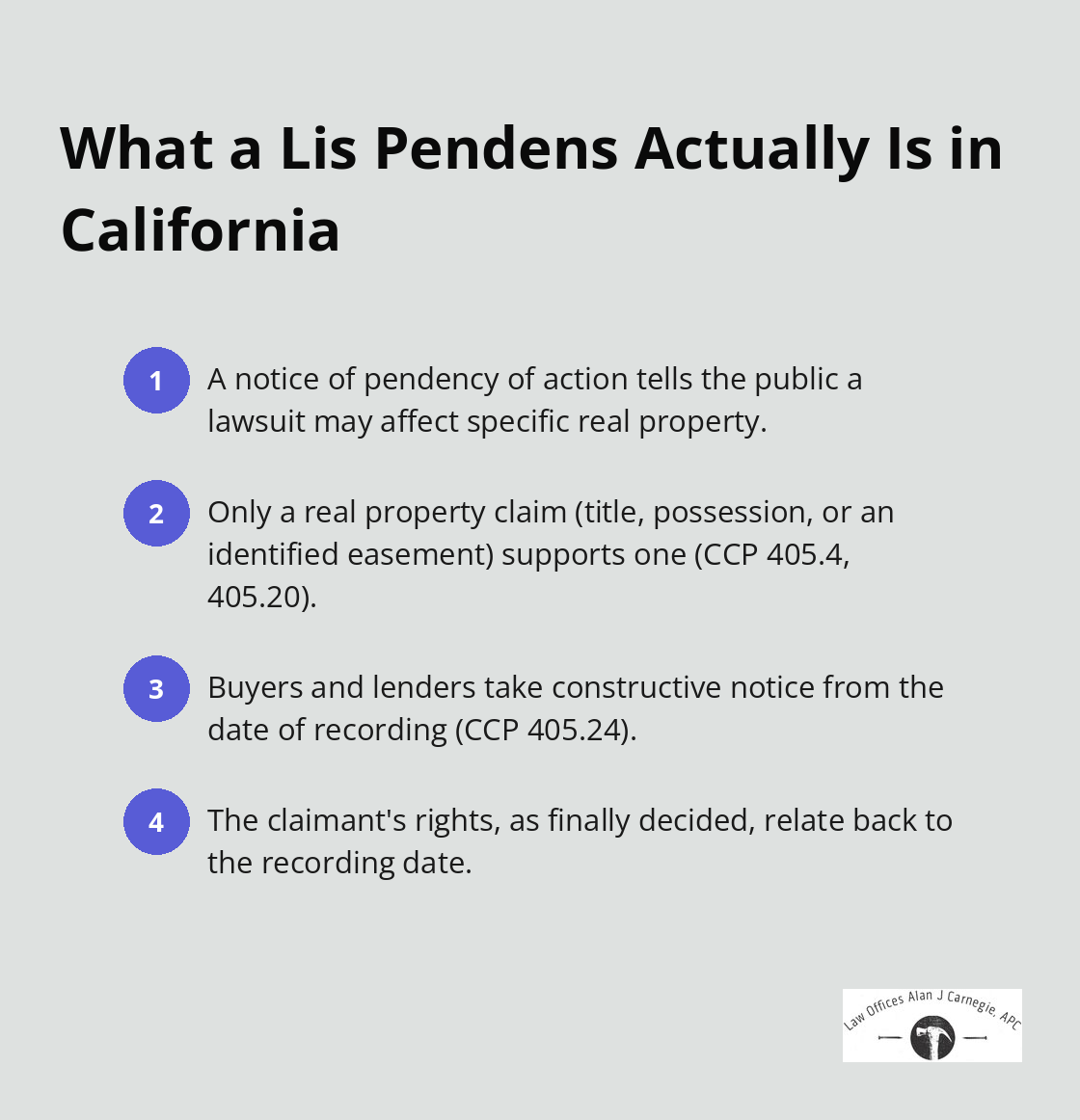
“Lis pendens” is a Latin phrase meaning a pending lawsuit. California’s statutes use the term “notice of pendency of action,” and the rules appear in Title 4.5 of the Code of Civil Procedure, beginning with section 405. The notice does not decide who owns the property. Instead, it tells the world that a lawsuit has been filed that may affect title to or possession of a specific parcel, and that anyone who acquires an interest in that property does so subject to the outcome of the case.
Only a Real Property Claim Supports a Notice
A lis pendens is not available in every lawsuit that happens to involve a property owner. Code of Civil Procedure section 405.20 provides that a party to an action who asserts a real property claim may record a notice of pendency of action in which that real property claim is alleged. Section 405.4 defines a “real property claim” as the cause or causes of action in a pleading which would, if meritorious, affect title to, or the right to possession of, specific real property, or the use of an easement identified in the pleading. A quiet title action, a claim to enforce a purchase agreement for a particular home, a partition case, or a dispute over a recorded easement may qualify. A lawsuit that only seeks money, even if the defendant happens to own real estate, generally does not.
How the Notice Affects Buyers and Lenders
The real power of a lis pendens comes from its effect on everyone who deals with the property after it is recorded. Under section 405.24, from the time of recording the notice, a purchaser, encumbrancer, or other transferee of the real property described in the notice shall be deemed to have constructive notice of the pendency of the action as it relates to the property. The same section provides that the claimant’s rights in the property, as ultimately determined in the case, relate back to the date the notice was recorded. In practice, this is why many buyers, lenders, and title companies are reluctant to move forward on a property with a pending notice until the dispute is resolved or the notice is removed.
Why a Lis Pendens Matters in Calabasas Real Estate Disputes
Property in Calabasas and the surrounding communities of the Santa Monica Mountains and the San Fernando Valley is often a family’s or business’s most important asset, and disputes over that property can involve co-owners, family members, business partners, buyers who believe a seller backed out of a deal, or neighbors fighting over access rights. In each of these situations, a properly recorded lis pendens can keep the property from being sold or refinanced out from under a legitimate claim. At the same time, an improper notice can freeze an owner’s property without justification, which is why California law includes procedures for both recording and removing one.
How a Lis Pendens Is Properly Recorded
Because a lis pendens has such strong practical effects, the Code of Civil Procedure sets out specific steps that must be followed. Skipping one of them can leave the notice void as to the people it was supposed to bind, so claimants should treat these requirements with care.
Who May Sign the Notice
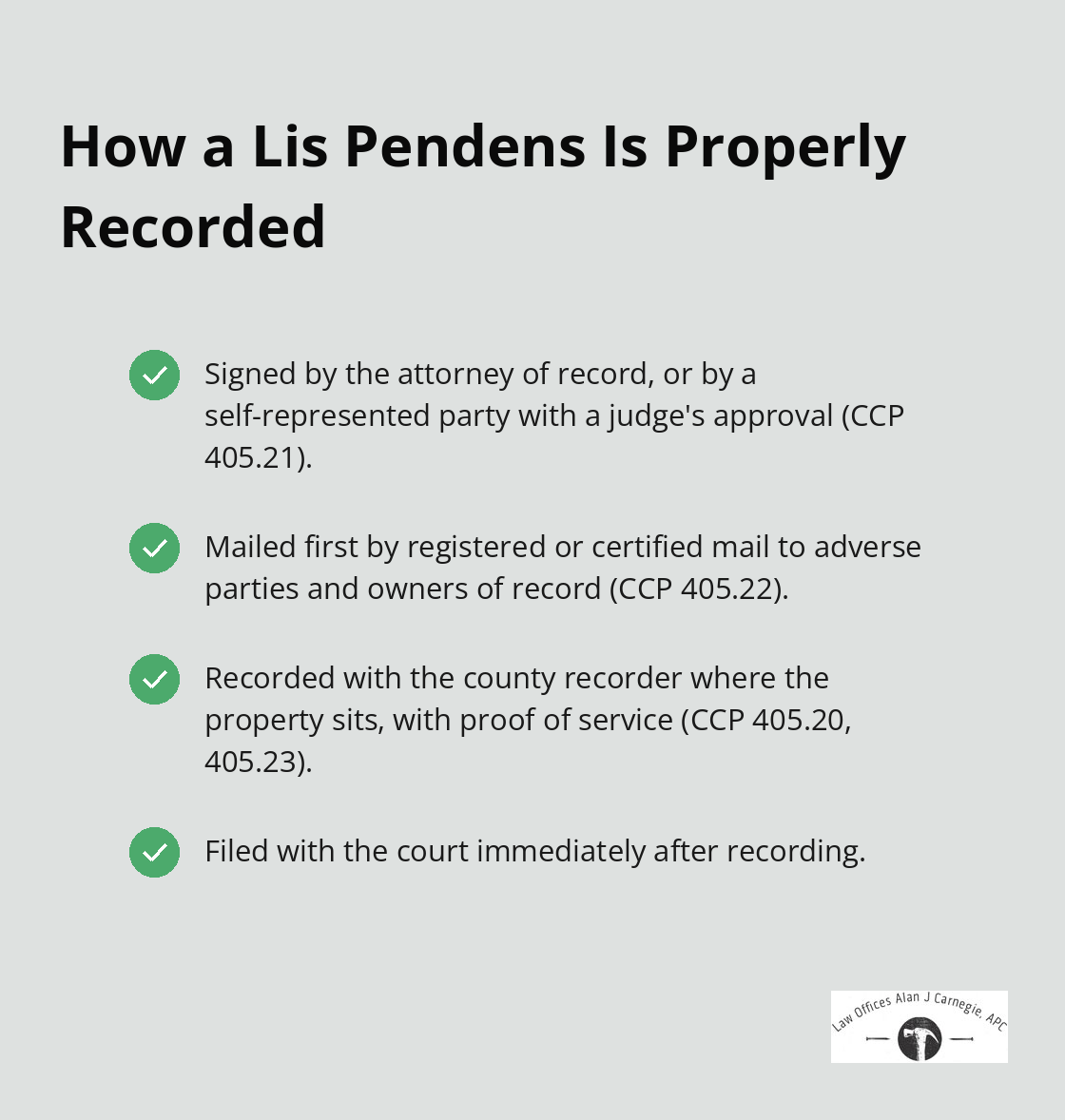
California limits who can put a lis pendens into the public record. Section 405.21 provides that an attorney of record in the action may sign a notice of pendency of action, and that a judge of the court in which the action is pending may, upon request of a party, approve a notice. A notice shall not be recorded unless it has been signed by the attorney of record, or it is signed by a party acting in propria persona and approved by a judge, or the action falls within a narrow category covered by section 405.6. This signature requirement is an important safeguard against notices recorded without a real basis.
Mailing Before Recording
Notice to the other side must come first. Under section 405.22, the claimant shall, prior to recordation of the notice, cause a copy of the notice to be mailed by registered or certified mail, return receipt requested, to all known addresses of the parties to whom the real property claim is adverse and to all owners of record of the property as shown by the latest county assessment roll. Immediately following recordation, a copy of the notice must also be filed with the court in which the action is pending, and service must be made in the same manner on each adverse party later joined in the case.
Recording and Proof of Service
Section 405.20 states that the notice may be recorded in the office of the recorder of each county in which all or part of the property is situated, and that it must contain the names of all parties to the action and a description of the property affected. For property in Calabasas, that means the Los Angeles County recorder. Section 405.23 adds a strict consequence: a notice of pendency of action shall be void and invalid as to any adverse party or owner of record unless the mailing requirements of section 405.22 are met for that party or owner and a proof of service in the required form has been recorded with the notice.
When a Lis Pendens Can Be Removed
Property owners are not left without options when a lis pendens is recorded against them. California’s expungement procedure allows a court to remove a notice that does not meet the legal standards, and the claimant, not the owner, carries the burden of proof.
The Motion to Expunge
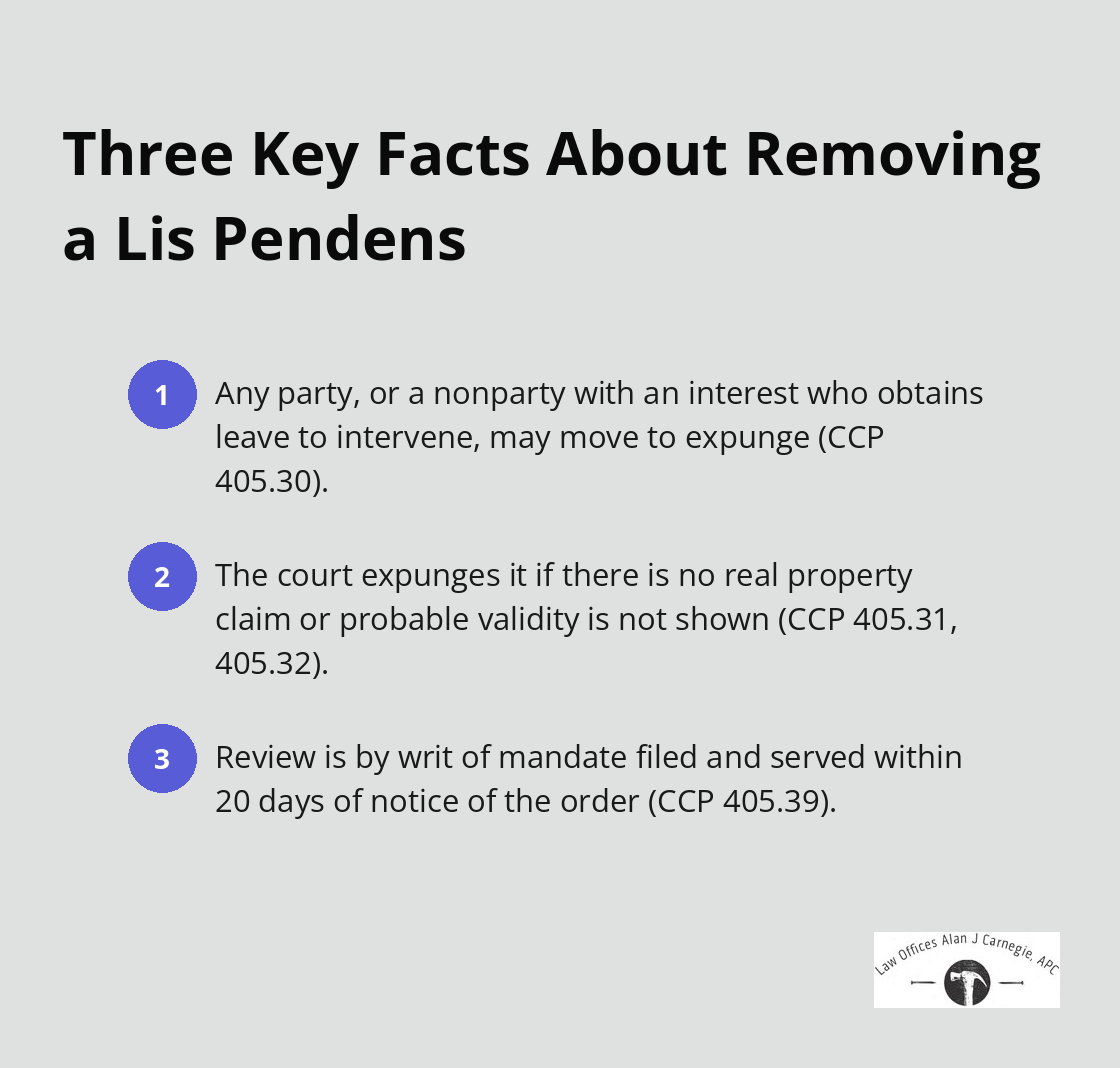
Section 405.30 provides that at any time after a notice of pendency of action has been recorded, any party, or any nonparty with an interest in the property, may apply to the court in which the action is pending to expunge the notice. A nonparty must first obtain leave to intervene. Evidence or declarations may be filed with the motion, and the court may permit oral testimony and order discovery. Importantly, the same section states that the claimant shall have the burden of proof under sections 405.31 and 405.32.
The Two Main Grounds for Expungement
The first ground focuses on the lawsuit itself. Section 405.31 provides that the court shall order the notice expunged if the court finds that the pleading on which the notice is based does not contain a real property claim. The second ground looks at the strength of the claim. Under section 405.32, the court shall order the notice expunged if the court finds that the claimant has not established by a preponderance of the evidence the probable validity of the real property claim. This means a claimant must be ready to show more than an allegation; the claim must be probably valid based on the evidence presented.
Review Deadlines and Re-Recording Limits
The timeline after an expungement ruling moves quickly. Section 405.39 states that orders under this chapter are not appealable, and that a party aggrieved by an order may petition the reviewing court by writ of mandate, which must be filed and served within 20 days of service of written notice of the order, with one possible extension of up to 10 days by the court that issued it. Under section 405.35, an expungement order is not effective and may not be recorded until that writ period has expired, or until any timely writ proceeding is finally adjudicated. And under section 405.36, once a notice has been expunged, the claimant may not record another notice as to the affected property without leave of the court.
Final Thoughts
A lis pendens in Calabasas, California is one of the most powerful tools in real estate litigation, and also one of the most closely regulated. It is available only for a genuine real property claim, it must be signed, mailed, recorded, and filed according to specific statutory steps, and it can be removed when the underlying pleading or evidence falls short. Whether you are protecting your interest in a property or trying to clear your title so a sale or refinance can move forward, understanding these rules shapes the strategy on both sides.
Because the procedures are technical and the deadlines are short, it helps to act early. If you are considering recording a notice, review your claim carefully first. If a notice has been recorded against your property, gather the pleading, the notice, and the proof of service so the next steps can be evaluated quickly. Our overview of title disputes explains how these issues fit into broader ownership conflicts.
If you are facing a real estate dispute involving a lis pendens in Calabasas or anywhere in Los Angeles County, contact The Law Offices of Alan J. Carnegies, APC to discuss your options. We will help you understand where you stand, protect your property interests, and choose the right next step.