

Business conflicts can derail operations, drain resources, and damage relationships that took years to build. Corporate disputes range from partnership disagreements to contract breaches, and each requires a different approach.
At The Law Offices of Alan J. Carnegies, APC, we help businesses throughout Los Angeles County navigate these conflicts with clear strategies. This guide walks you through the types of disputes you might face, how to resolve them, and when to bring in legal support.
What Corporate Disputes Actually Cost Your Business
The Three Most Damaging Dispute Types
Partnership dissolutions, contract breaches, and shareholder conflicts represent the most damaging disputes businesses face in Los Angeles County. Partnership disagreements often stem from misaligned expectations about profit distribution, management roles, or exit strategies. When partners cannot agree on these fundamentals, dissolution becomes inevitable, and without a clear operating agreement, the process turns expensive and lengthy. Contract breaches happen constantly in business-a vendor fails to deliver on time, a client refuses payment, or a supplier provides substandard materials.
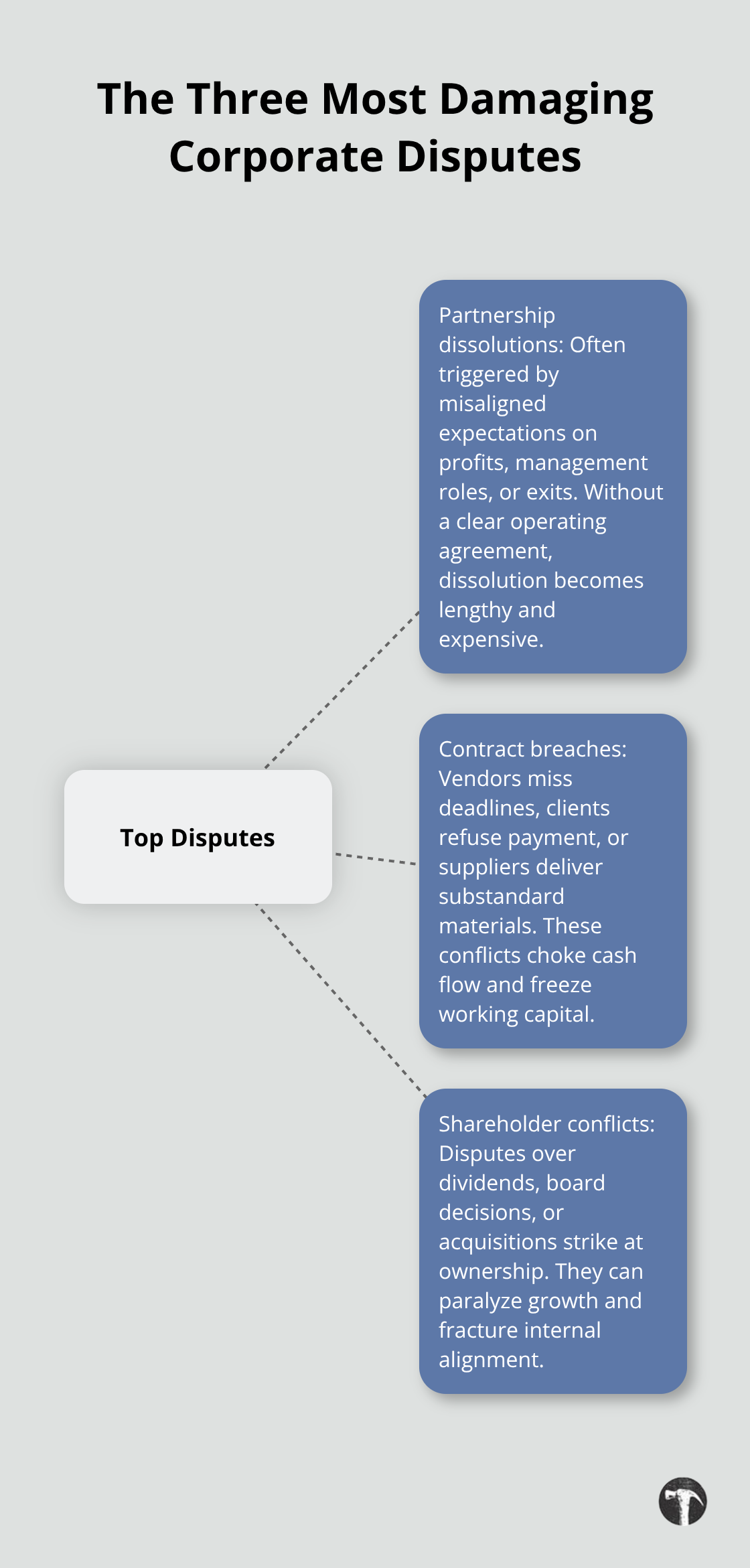
These disputes destroy cash flow and force you to freeze working capital while the conflict drags on. Shareholder conflicts cut deeper because they strike at ownership itself. Disagreements over dividend policy, board decisions, or acquisition strategy can paralyze a company’s growth and create internal factions that damage employee morale and customer confidence.
The Real Financial Toll
The American Arbitration Association processed over 13,000 business-to-business arbitration cases in 2026 with total claims exceeding $21 billion, and the average business claim size reached approximately $6.2 million. Most disputes that reach formal proceedings have already consumed months of management time and attorney fees before resolution even begins. Construction disputes alone stretch 12 to 18 months, while financial services disputes typically take 6 to 9 months. Technology sector disputes average 8 to 12 months. During this period, your team cannot focus on growth, your cash flow deteriorates, and your reputation in the market takes a hit.
Why Speed Matters
The longer you wait to address a partnership disagreement, contract breach, or shareholder conflict, the more expensive and complicated resolution becomes. Acting quickly-within the first 30 days of identifying a dispute-gives you leverage and options that disappear as positions harden and legal costs mount. Early intervention prevents minor disagreements from escalating into full-scale litigation that consumes resources and attention. The window to negotiate favorable terms closes fast once parties dig in and hire counsel to prepare for court. This reality makes your next decision critical: understanding which resolution method fits your situation and timeline.
How to Resolve Business Conflicts in Calabasas, California
Settlement Through Direct Negotiation
Most business disputes never reach a courtroom. According to data from the American Arbitration Association and the International Chamber of Commerce, roughly 65 to 70 percent of disputes settle during proceedings, while 80 to 90 percent resolve through negotiation or mediation before formal proceedings even begin. This means your first move should focus on preserving options and understanding which path fits your timeline and financial reality.
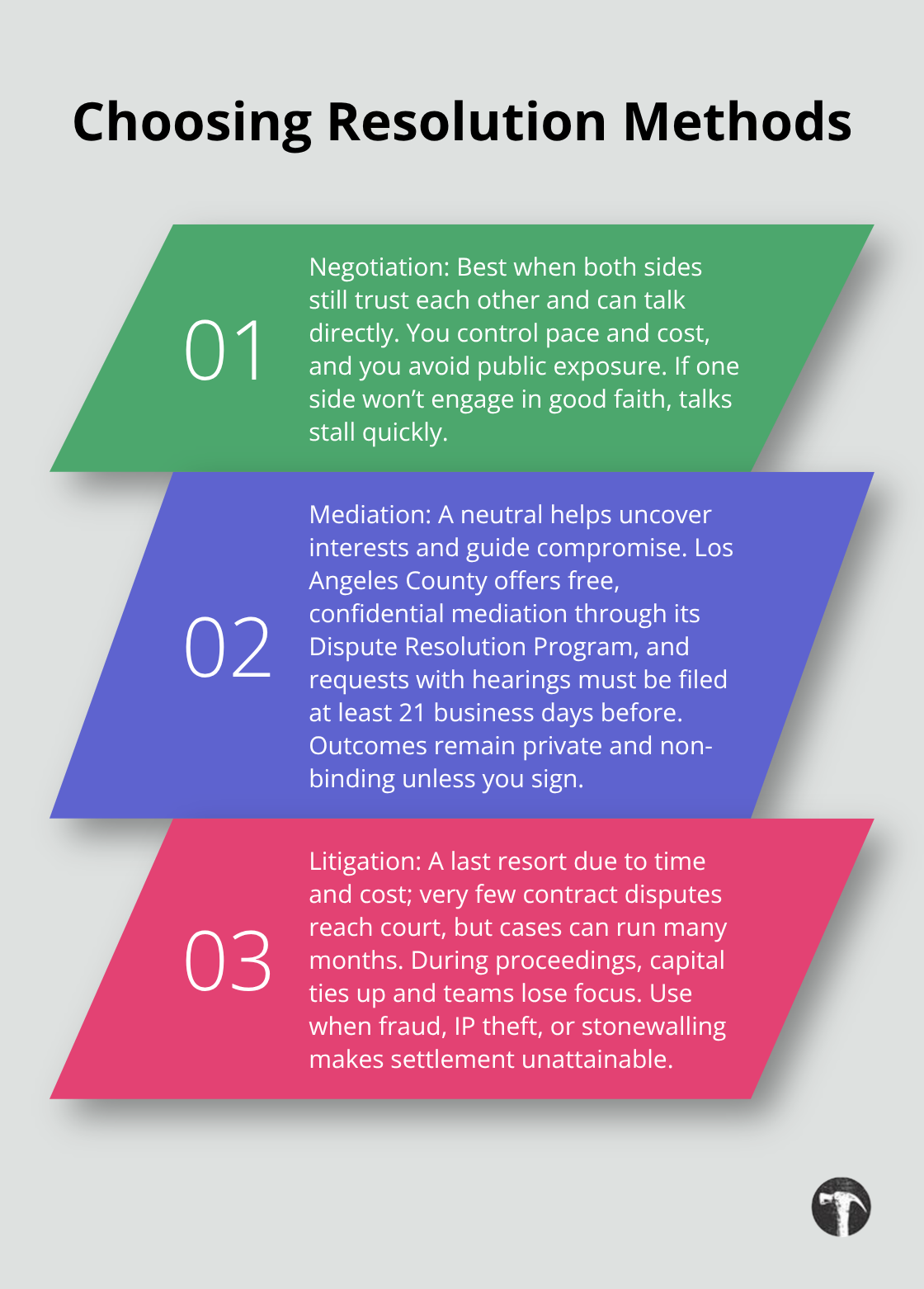
Negotiation works best when both parties still trust each other enough to communicate directly. You control the pace, the costs stay minimal, and you avoid public exposure. The catch: if one party refuses to negotiate in good faith or positions have hardened, negotiation stalls fast.
Mediation as a Bridge to Agreement
Mediation bridges the gap when direct talks fail. A neutral third party helps both sides understand each other’s underlying interests and guides you toward a mutually acceptable solution. Los Angeles County offers free, voluntary, confidential mediation through the Los Angeles County Dispute Resolution Program, accessible via their online Mediation Portal. You can request mediation with or without a pending court hearing, though if you have a hearing scheduled, you must submit your mediation request at least 21 business days before that date.
Mediation sessions remain confidential, and any settlement you reach is private. The process is risk-free and non-binding unless you sign an agreement, so you lose nothing by trying. If mediation fails, you still retain your right to pursue litigation.
When Litigation Becomes Necessary
Litigation should be your last resort, not your first move. Federal court data shows fewer than 2 percent of contract disputes actually reach court, yet litigation consumes time and money at a scale that negotiation and mediation do not. A construction dispute typically stretches 12 to 18 months, while financial services disputes average 6 to 9 months, and technology disputes run 8 to 12 months. During this entire period, your working capital freezes, your team diverts focus to the conflict, and your reputation takes damage.
Some disputes demand litigation because one party refuses any reasonable settlement, intellectual property theft requires court intervention, or fraud allegations need judicial determination. The decision between negotiation, mediation, and litigation hinges on three factors: the likelihood of reaching agreement without formal proceedings, the financial and reputational cost of delay, and whether the other party negotiates in good faith. If good-faith negotiation appears possible and the dispute does not involve fraud or intellectual property theft, start with direct negotiation or mediation. If the other party stonewalls or positions have calcified, litigation may be necessary despite its cost.
Choosing Your Path Forward
The resolution method you select determines not only how much you spend but also how quickly you move forward and whether you preserve business relationships. Disputes involving partnership dissolution, contract breaches, or shareholder conflicts each respond differently to these three approaches. Understanding which method matches your situation-and recognizing when to shift strategies-separates businesses that recover quickly from those that bleed resources for years. Your next step involves identifying the specific red flags that signal when legal representation becomes essential to protect your interests.
When Legal Representation Protects Your Bottom Line
Red Flags That Signal You Need an Attorney
The moment one party stops responding to your calls or refuses to negotiate in good faith, you have entered dangerous territory. Silence from the other side signals that positions have hardened and someone is building a legal case behind the scenes. At this point, waiting another week costs you leverage and increases the likelihood that litigation becomes inevitable. Acting immediately when communication breaks down matters because delay transforms a resolvable dispute into an entrenched conflict.
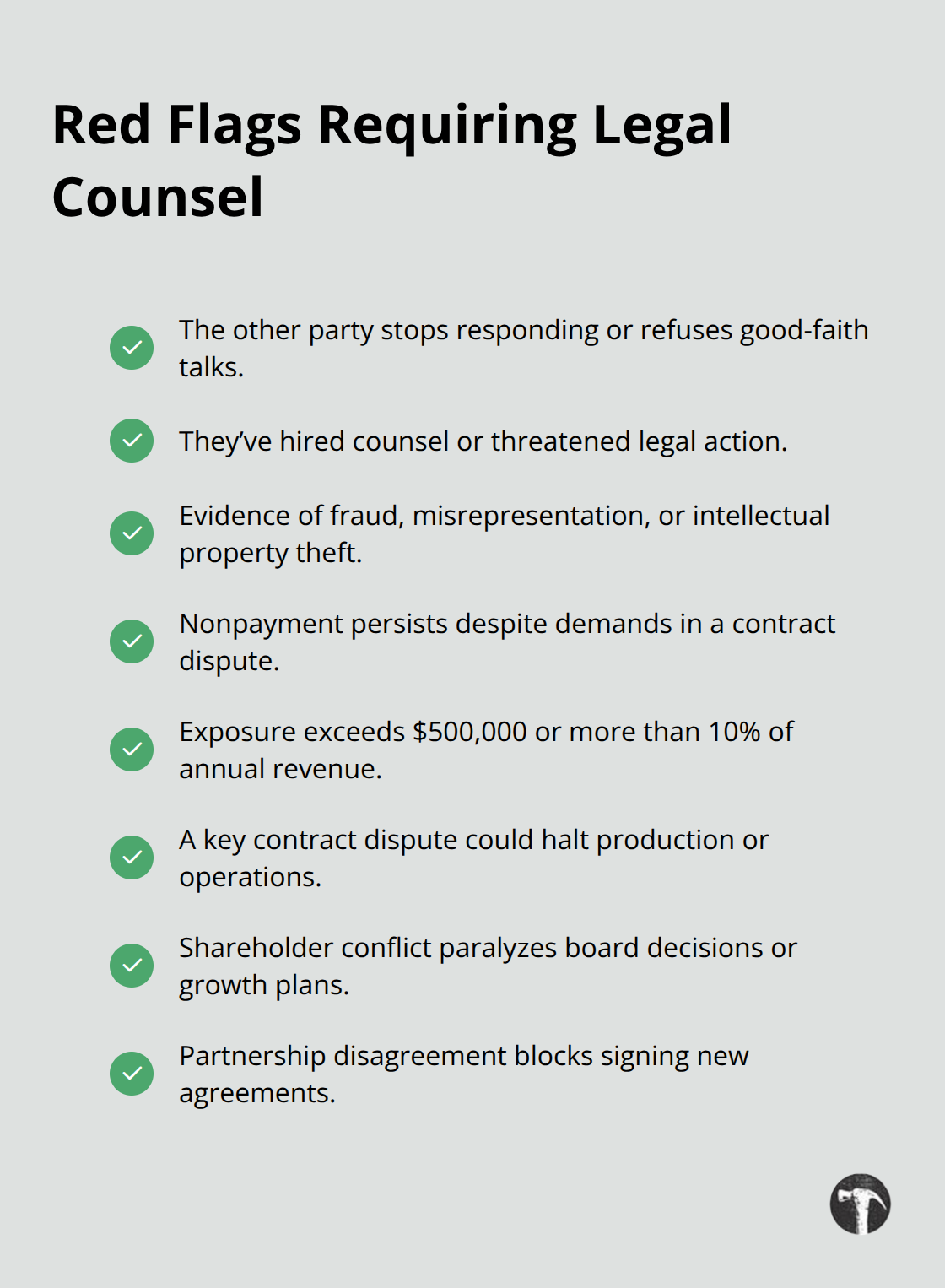
If the other party has already hired counsel or made threats of legal action, your window for favorable settlement closes fast.
The same applies when the dispute involves fraud, misrepresentation, or intellectual property theft. These situations demand immediate legal involvement because negotiation alone cannot undo damage or recover stolen assets. Contract disputes over payment also require early legal intervention; once a vendor or client stops paying and ignores your demands, collection becomes harder with each passing month, and court judgments lose value if the other party lacks assets to recover.
Financial Exposure as a Trigger for Legal Action
Financial exposure drives the second trigger for legal representation. If the disputed amount exceeds $500,000 or represents more than 10 percent of your annual revenue, the cost of hiring an attorney becomes negligible compared to what you stand to lose. The American Arbitration Association reports that average business claims reach $6.2 million, and disputes involving construction, shareholder conflicts, or partnership dissolution frequently exceed this threshold. At these stakes, attorney fees of $25,000 to $75,000 for early legal strategy and negotiation represent insurance, not expense.
Operational Threats Demand Speed
A third trigger emerges when the dispute threatens your operational ability. A key contract dispute that could shut down production, a shareholder conflict that paralyzes board decisions, or a partnership disagreement that leaves you unable to sign new agreements all fall into this category. In these situations, speed matters more than cost, and legal counsel accelerates resolution through formal demand letters, arbitration filings, or litigation preparation that forces the other party to take the conflict seriously. The cost-benefit calculation shifts dramatically when delay itself causes damage; every month without resolution in a partnership dissolution or shareholder conflict compounds the harm through lost opportunity, damaged relationships with clients or investors, and employee uncertainty that drives talent away.
Final Thoughts
Corporate disputes demand action, not patience. The businesses that recover fastest recognize warning signs early and move decisively toward resolution. Whether your conflict involves a partnership disagreement, contract breach, or shareholder tension, the cost of inaction always exceeds the cost of intervention.
If communication remains open and both parties show willingness to find common ground, negotiation or mediation through the Los Angeles County Dispute Resolution Program can resolve your corporate disputes within weeks rather than months. These approaches preserve relationships, maintain confidentiality, and keep costs manageable. If the other party has stopped responding or hired counsel, legal representation becomes essential to protect your interests and force movement toward resolution.
We at The Law Offices of Alan J. Carnegies, APC, help businesses throughout Los Angeles County resolve disputes across partnership conflicts, contract breaches, shareholder disagreements, and construction litigation. Contact us today to discuss your situation and develop a strategy that protects your business while moving you toward resolution quickly.