
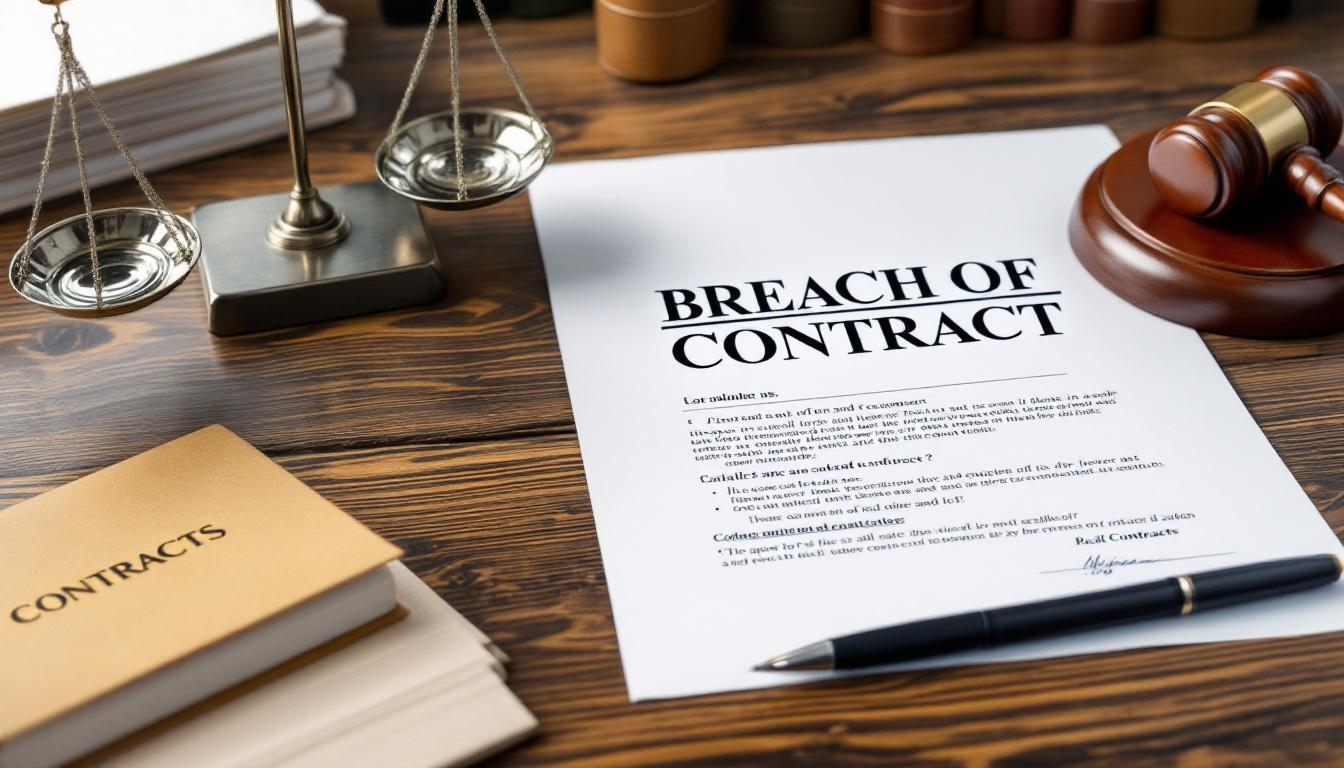
A breach of contract happens when one party fails to fulfill their obligations under a written or verbal agreement. In Los Angeles County, breach of contract legal cases are common across businesses, real estate transactions, and service agreements.
We at The Law Offices of Alan J. Carnegies, APC help clients navigate these disputes and recover what they’re owed. This guide walks you through what constitutes a breach, the steps to take when one occurs, and the legal remedies available to protect your interests.
What Constitutes a Breach of Contract in Calabasas, California
The Six Essential Elements of Proof
California law defines a breach of contract as the failure to perform a legal duty created by an agreement. The Judicial Council’s Civil Jury Instructions (CACI No. 303) establish six essential elements you must prove to win a breach claim. You must show that the contract existed, that you performed your obligations or were excused from doing so, that the other party breached, that you suffered harm, that the breach caused that harm, and that the damages are a natural result of the breach. This framework applies whether your contract is written or oral, though written contracts provide stronger documentation in court.
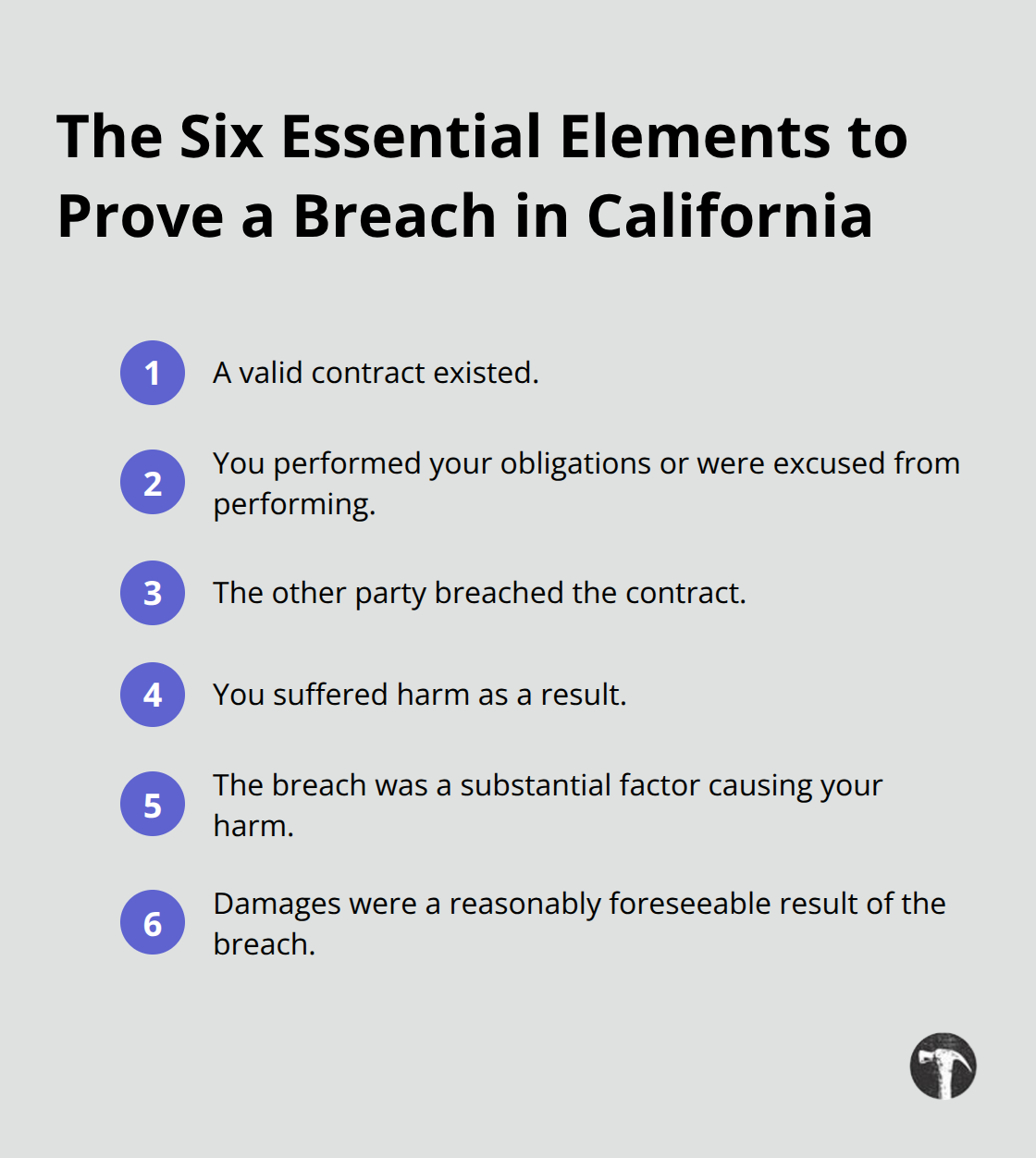
The causation element matters most-the defendant’s failure must be a substantial factor in your damages, as established in US Ecology, Inc. v. State of California (2005). Damages must be reasonably foreseeable, not speculative or remote.
Material Breaches Versus Non-Material Breaches
A material breach destroys the contract’s fundamental purpose and allows you to stop performing your own obligations. The California Court of Appeal in Brown v. Grimes (2011) emphasized that material performance matters-if your own performance was not substantial, your claim fails. A non-material breach involves minor failures that don’t defeat the contract’s core purpose, and courts treat these differently when assessing your remedies. In Los Angeles County, construction disputes frequently involve material breaches when contractors fail to complete work to specification, while service agreements often see non-material breaches when deliverables arrive late but remain usable. Courts examine whether dependent covenants exist in your contract-if one party’s duty depends on the other’s performance, a breach excuses your obligation to perform. The Colaco v. Cavotec SA case (2018) clarified that courts won’t assume covenants are dependent without clear contract language.
Why Breaches Happen in Los Angeles County
Common causes of breaches in Los Angeles County include inadequate project planning in construction, cash flow problems preventing timely payment, scope creep without contract amendments, and misaligned performance expectations between parties. Real estate transactions frequently involve breaches when sellers fail to disclose property defects or buyers cannot secure financing despite contractual obligations. Partnership disputes arise when partners fail to contribute capital or violate non-compete provisions. Understanding these patterns helps you recognize when a breach has occurred and strengthens your position when you pursue legal action. When you identify a breach, your next step is to document the failure and review your contract terms carefully.
Steps to Take When You Discover a Breach
Act quickly after discovering a breach, because California law imposes strict deadlines for filing claims. Written contracts give you four years from the breach date to sue under California Code of Civil Procedure Section 337, while oral contracts allow only two years under Section 339. If you wait too long, you lose your right to recover damages entirely.
Collect and Organize Evidence Immediately
Start by gathering every piece of evidence related to the breach. Collect the original contract, any amendments or modifications, emails, text messages, invoices, payment records, photographs, and communications where the other party acknowledged their obligation. Create a detailed timeline that documents when the breach occurred, what performance was promised, and what actually happened. Take screenshots of digital communications and save them in multiple locations. This documentation becomes your foundation for negotiation or litigation, and courts heavily favor parties with organized, contemporaneous records. The stronger your evidence trail, the more leverage you have in settlement discussions, and the better your position if the case reaches trial.
Review Your Contract’s Language and Terms
Read your contract thoroughly to identify what the other party actually promised to do. Look for specific performance deadlines, quality standards, payment terms, and conditions that must be met before obligations arise. Check whether the contract contains a condition precedent-an event that must occur before either party owes performance. If the other party’s breach depends on a condition that never occurred, your claim weakens significantly. Review any force majeure clauses that excuse performance during unforeseen circumstances like natural disasters or pandemics. Examine whether your contract includes liquidated damages provisions, which specify a predetermined payment amount for breach instead of requiring you to prove actual damages. Courts in California enforce liquidated damages clauses only if they represent a reasonable estimate of anticipated harm, not a penalty. If your contract allows attorney’s fees recovery for the prevailing party, this strengthens your negotiating position because the breaching party faces higher exposure.
Send a Formal Demand Letter
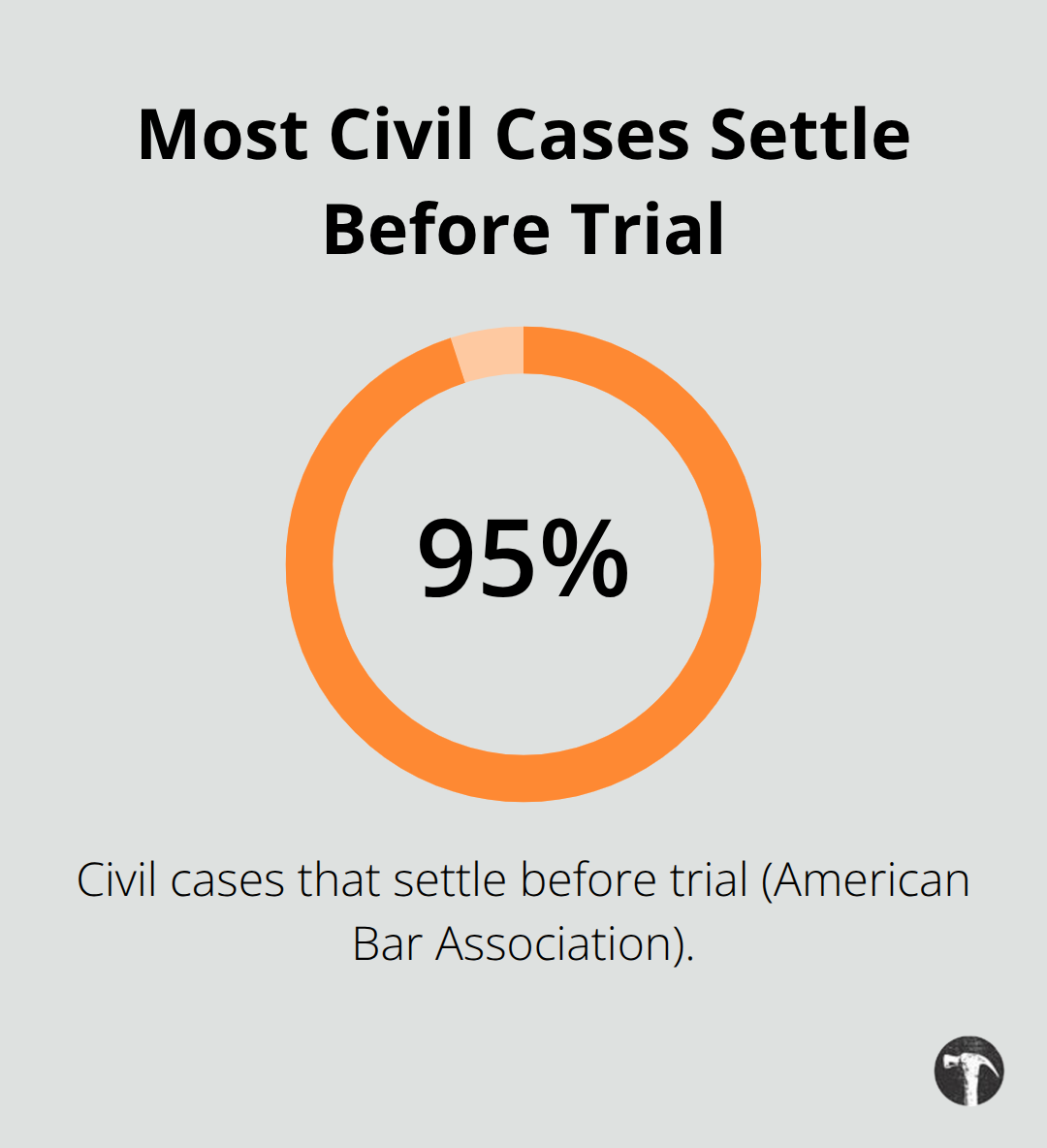
Contact the other party in writing to identify the breach and request corrective action. A formal demand letter clearly states what obligation was breached, how they failed to perform, and what specific performance or compensation you’re requesting. Include a reasonable deadline for response, typically 10 to 30 days depending on the urgency. About 95 percent of civil cases settle before trial according to the American Bar Association, and many disputes resolve through direct communication without litigation costs. Keep your tone professional and factual rather than accusatory, because escalating emotions hardens positions and eliminates settlement opportunities.
Document their response or lack thereof, as this demonstrates good faith efforts to resolve the dispute. If they offer partial performance or acknowledge the breach but dispute damages, you’ve gained valuable information for your next step. This communication phase typically takes two to four weeks and costs nothing beyond your time.
Once you’ve exhausted direct communication and the other party refuses to resolve the matter, you need to understand what legal remedies California law makes available to you.
Legal Remedies Available for Breach of Contract in Calabasas, California
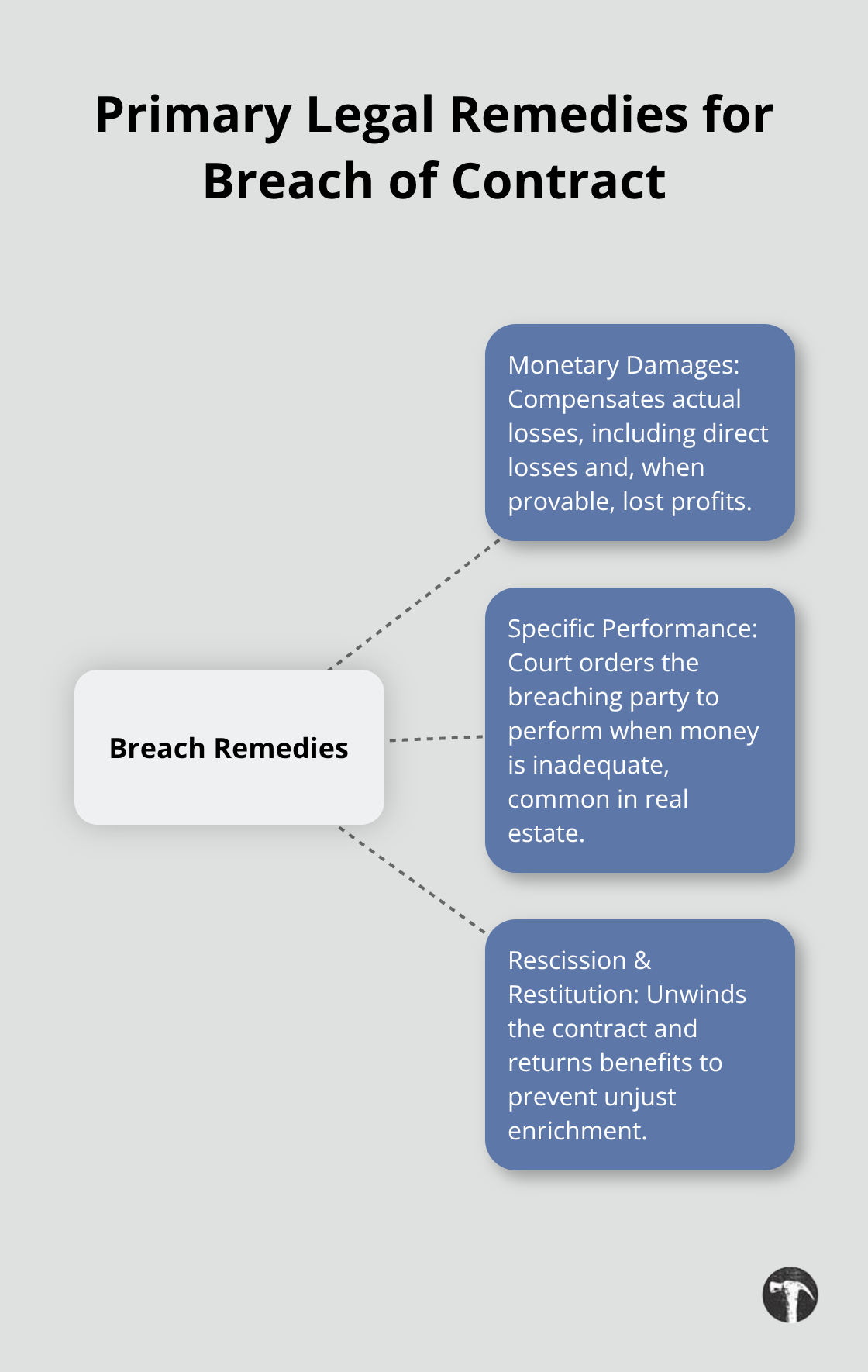
California law provides three primary paths to recover from a breach: monetary damages, specific performance that requires the other party to fulfill their obligations, and rescission that unwinds the contract entirely. The remedy you pursue depends on your contract terms, the type of breach, and what outcome serves your business interests best.
Monetary Damages: The Most Common Recovery Path
Monetary damages represent the most common remedy because they’re straightforward to calculate and enforce. You recover the actual losses caused by the breach, which courts call compensatory damages. If your contract specifies a liquidated damages clause, you receive that predetermined amount instead of proving actual harm, provided courts find it reasonable and not punitive. California courts enforce liquidated damages provisions regularly, treating them as enforceable contract terms when they represent a genuine pre-estimate of anticipated injury rather than a penalty designed to punish the breaching party.
The damages calculation includes direct losses, lost profits if you can prove them with reasonable certainty, and costs you incurred to mitigate your losses. Courts require you to take reasonable steps to reduce your damages after a breach occurs, so if you failed to seek alternative suppliers or buyers, the breaching party can argue you failed to mitigate and reduce your recovery accordingly. Special damages, which are unusual losses specific to your situation, require clear proof of causation and foreseeability. General damages cover standard losses like lost income or contract value.
Most Los Angeles County breach cases resolve through settlement negotiations focused on monetary damages because both parties understand the costs and risks of litigation. The American Bar Association reports that approximately 95 percent of civil cases settle before trial, and many disputes resolve through direct communication without litigation costs.
Specific Performance: Forcing Actual Contract Completion
Specific performance orders the breaching party to actually perform what they promised rather than simply paying money. Courts award specific performance only when monetary damages are inadequate compensation, which happens most often in real estate disputes where the property is unique or irreplaceable. Construction contracts sometimes warrant specific performance when a contractor must complete work to specification because money alone won’t restore the project to its intended state.
If you’re pursuing specific performance, prepare for extended litigation because the other party will argue that damages adequately compensate you, and courts scrutinize whether the remedy truly serves justice. This path typically takes longer and costs more than settling for monetary damages.
Rescission and Restitution: Unwinding the Contract
Rescission completely terminates the contract and returns both parties to their pre-contract positions, used when the breach is so fundamental that continuing the relationship is impossible. Restitution requires the breaching party to return what they received under the contract, preventing them from benefiting from their own wrongdoing. These equitable remedies are less common than damages because they’re more disruptive and courts apply them cautiously.
Final Thoughts
Breach of contract legal cases demand swift action and thorough documentation to protect your position. You now understand the six elements California courts require to prove a breach, the distinction between material and non-material breaches, and the three primary remedies available to recover your losses. Time matters most-written contracts give you four years to sue, while oral contracts allow only two years, and missing these deadlines eliminates your right to recover entirely.
Monetary damages remain your most practical recovery path in most disputes because courts calculate and enforce them straightforwardly. Your contract language determines which remedies apply, so reviewing your agreement carefully before pursuing legal action prevents costly missteps and ensures your legal strategy aligns with your actual business interests rather than simply winning in court.
We at The Law Offices of Alan J. Carnegies, APC represent property owners, business operators, contractors, and other parties across Los Angeles County in breach of contract disputes and related litigation. Contact us today to discuss your situation, and the sooner you act, the stronger your position becomes.