
Construction projects in Calabasas often hit unexpected obstacles. When disagreements arise over costs, timelines, or work quality, contractors and property owners file construction claims to protect their interests.
Understanding what construction claims are and how they work can save you significant time and money. We at The Law Offices of Alan J. Carnegies, APC help clients throughout Los Angeles County navigate these disputes from start to finish.
What Counts as a Construction Claim
Defining a Construction Claim
A construction claim is a formal demand for compensation or relief when disagreements arise during a project. Under AIA A201-2017 Section 15.1.1, which governs many construction contracts, a claim seeks payment, a change in contract time, or other relief tied to the contract terms. Claims also cover disputes between owners and contractors about work quality, delays, extra costs, or changes to the original agreement. The party filing the claim carries the burden of proving it with solid evidence. This means if you’re a contractor seeking payment for extra work or an owner claiming defective workmanship, you need documentation to back up your position.
What Triggers Claims on Calabasas Projects
Calabasas projects frequently generate claims over change orders, scope disputes, and timeline extensions. Contract language defines what triggers a claim and how it should be handled, so reviewing your contract before problems start is smart strategy. Claims arise from contract negotiations, construction defects, warranty disputes over materials or workmanship, mechanic’s liens to secure payment, regulatory compliance issues (including building code violations), and workplace safety complaints. Property owners and contractors both file claims regularly, and the disputes often center on who bears responsibility for cost increases or schedule delays.
Building Your Documentary Evidence
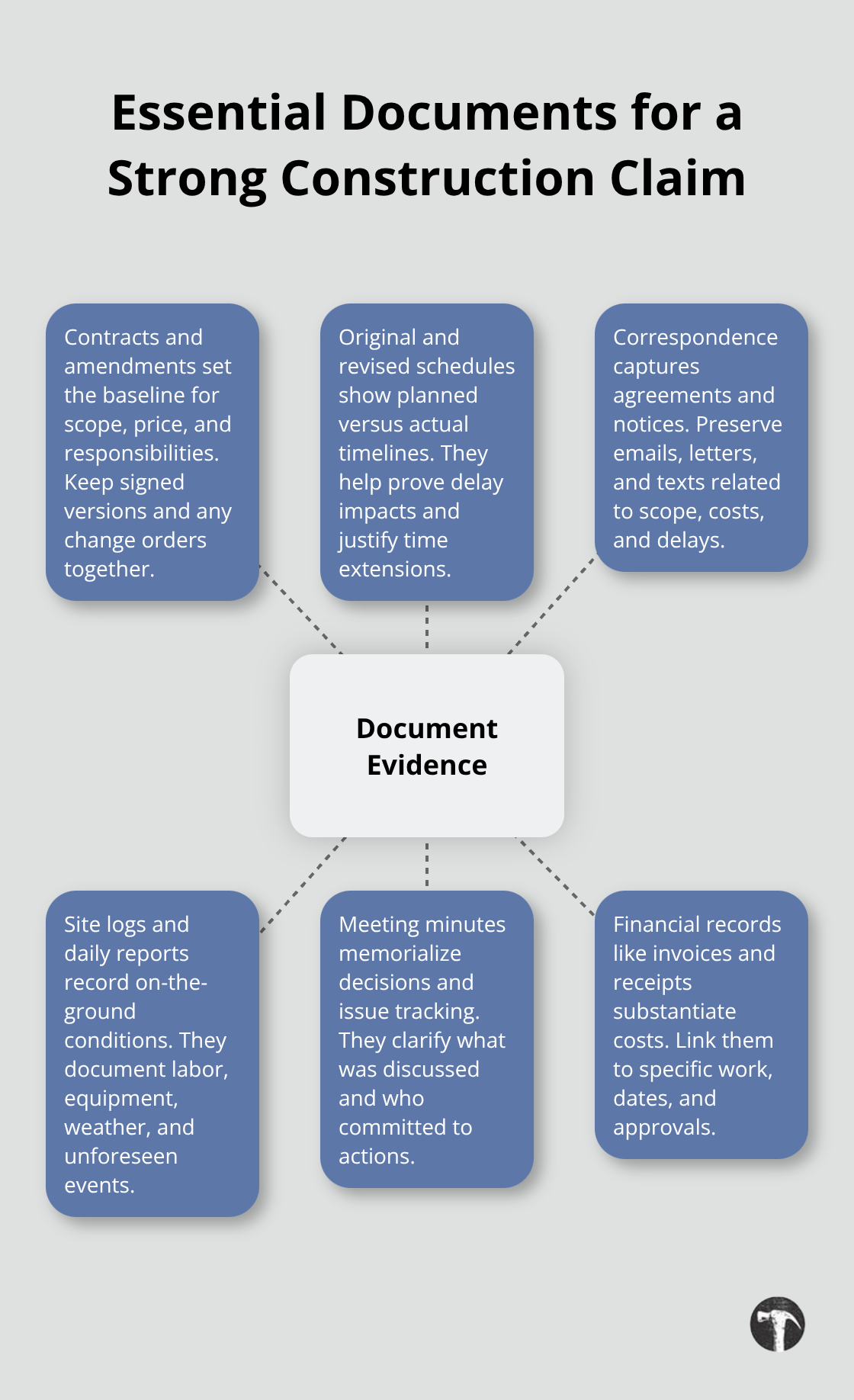
Documentation determines whether your claim survives scrutiny. Construction projects generate massive amounts of paperwork, and contemporaneous documents form the backbone of any successful claim. Start organizing documents before disputes emerge, not after problems surface. Essential categories include the original contract and any amendments, time schedules both original and revised, correspondence between parties, site logs and daily records, meeting minutes, and financial documents like invoices and receipts.
Meeting Deadlines and Maintaining Records
Following California Government Code 911.2, claims for death, injury, or property damage must be filed within six months of the occurrence, while all other damages claims have a one-year deadline. Missing these deadlines bars your claim entirely. Maintain a consistent paper trail from project start, documenting every meeting and conversation with follow-up emails and notes. Record your mitigation efforts too, since demonstrating that you tried to resolve problems strengthens your position. An electronic document management system helps you organize large volumes of evidence for quick searches by date or subject matter, which becomes invaluable if your dispute moves toward arbitration or litigation.
When claims escalate beyond simple documentation and negotiation, the path forward depends on your contract’s dispute resolution framework and the strength of your evidence. Understanding your options for moving forward-from settlement discussions to formal resolution processes-helps you protect your interests and keep your Calabasas project on track.
How Construction Claims Damage Calabasas Projects
Delays and Financial Strain
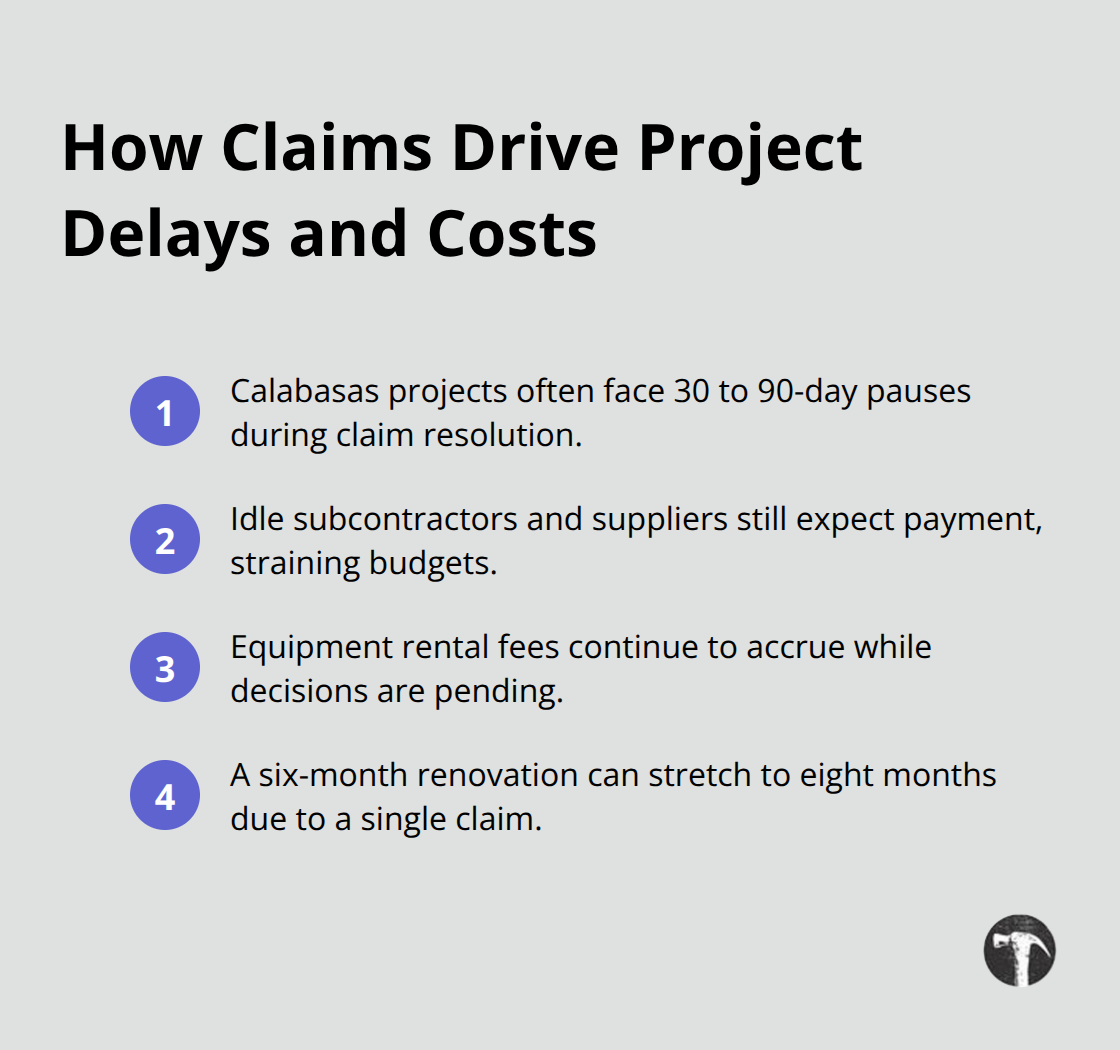
Construction claims halt progress immediately. When a contractor files a claim for extra work or an owner disputes workmanship, the entire project stalls while parties negotiate or prepare for dispute resolution. Calabasas projects often experience 30 to 90-day delays during the claim resolution phase, and those delays compound costs rapidly. Subcontractors and material suppliers sitting idle still expect payment, equipment rental charges continue accumulating, and labor costs climb as crews wait for direction. A single claim over scope changes or schedule extensions can push a six-month residential renovation into an eight-month ordeal, frustrating owners and straining relationships between all parties.
The financial impact extends beyond obvious costs. Property owners lose use of their homes, businesses miss revenue opportunities, and contractors face cash flow disruptions that threaten their ability to work on other projects. Mediation costs, legal fees, and lost productivity can easily exceed the original amount in dispute, making small disagreements into major financial burdens.
Disputes Over Responsibility and Scope
Disputes between contractors and property owners intensify when claims lack proper documentation or when contracts fail to clearly define who bears responsibility for changes. These disagreements often stem from oral agreements that contradict written contract terms, vague specifications that lead to differing interpretations, or unclear change order procedures that leave both sides uncertain about cost responsibility. When a contractor claims additional payment for unforeseen conditions and the owner refuses, neither party has a clear path forward without involving lawyers or mediators.
The longer disputes fester without resolution, the more expensive they become. Contractors and owners both suffer when ambiguous contract language creates confusion about who pays for what. Without clear documentation of scope changes, both parties waste time arguing about obligations instead of moving the project forward.
Quality Deterioration During Claims
Quality suffers when claims linger unresolved. Workers lose momentum, attention shifts from construction details to dispute management, and the project’s overall standards decline. Calabasas properties deserve careful workmanship and attention to finish details, but projects consumed by claims rarely receive either. Owners who experience claims often discover that contractors prioritize completing the project quickly to exit a contentious situation rather than delivering the craftsmanship initially promised.
When disputes consume project resources, the final product reflects that distraction. Subcontractors rush through their work, inspections become perfunctory, and attention to detail vanishes. The property owner ends up with a completed structure that fails to meet the original quality expectations, creating additional problems that compound the original claim.
Moving Toward Resolution
Early intervention when disputes surface prevents minor disagreements from escalating into expensive litigation or arbitration that can damage professional relationships and derail project completion. The path forward depends on your contract’s dispute resolution framework and the strength of your evidence. Understanding your options for moving forward-from settlement discussions to formal resolution processes-helps you protect your interests and keep your Calabasas project on track.
Steps to Resolve Construction Claims
Start With Direct Negotiation
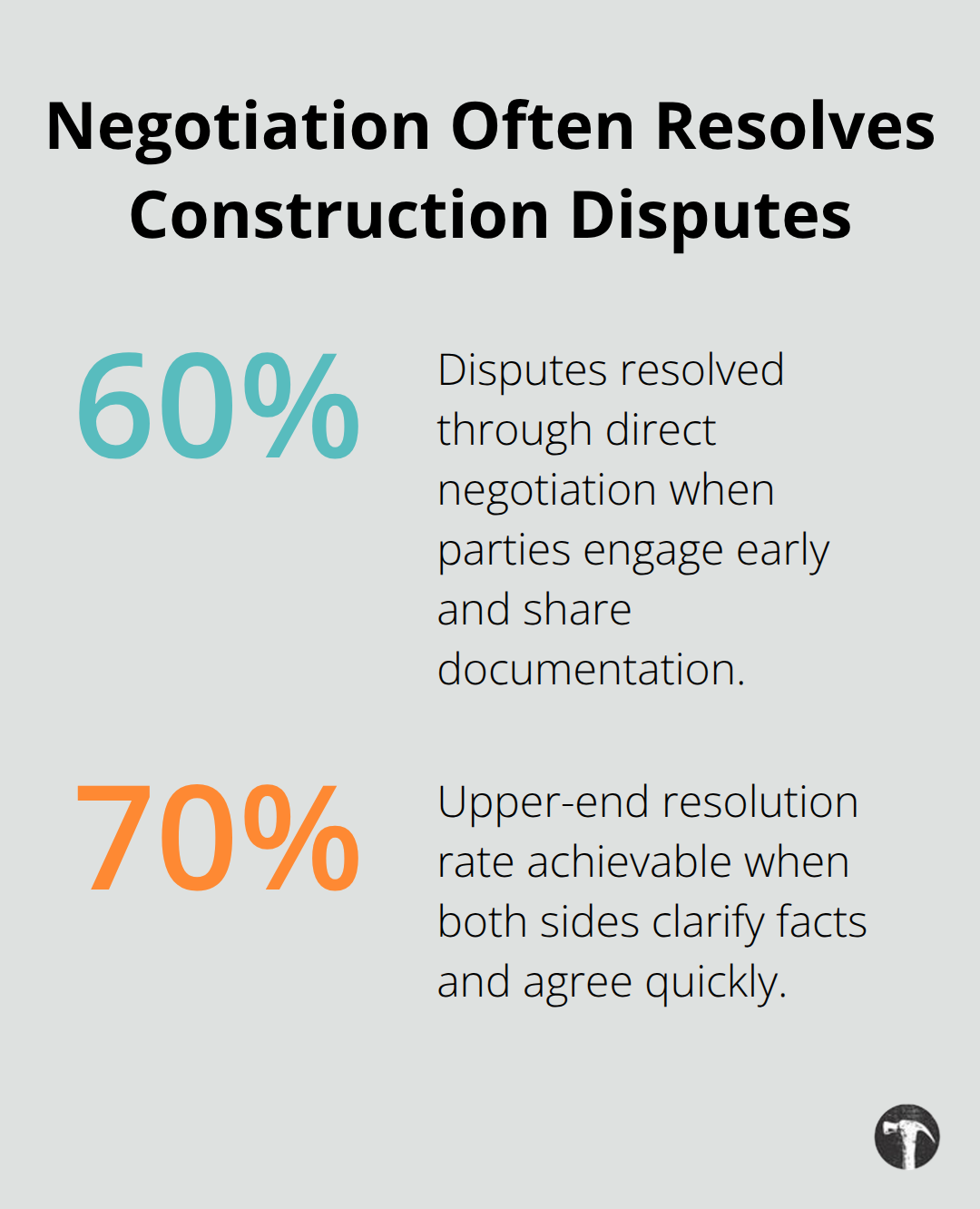
Negotiation resolves most Calabasas construction disputes before lawyers and mediators enter the picture. When both parties understand their positions clearly and feel motivated to move forward, settlement agreements happen quickly. Sit down with the other party and bring your documentation to the table. State your position factually without emotional language, listen to the other side’s concerns, and identify common ground. Many disputes stem from misunderstanding rather than genuine disagreement about facts. If you clarify what happened and why costs shifted or timelines changed, settlement often follows. Put any agreement in writing immediately, outlining what each party will do, what compensation changes hands, and how the work will proceed. A written settlement prevents future arguments about what was promised verbally. This direct approach costs nothing beyond your time and can resolve 60 to 70 percent of construction disagreements before they escalate.
Use Mediation When Negotiation Stalls
Mediation becomes necessary when negotiation fails but litigation feels premature. A neutral mediator helps both parties communicate more effectively and find middle ground without a judge or arbitrator deciding the outcome. Mediation typically costs between $1,500 and $4,000 depending on case complexity and mediator experience, making it far cheaper than litigation that can easily exceed $50,000 in attorney fees alone. The mediator does not impose a decision; instead, they facilitate conversation, point out unrealistic positions, and help each side understand the other’s concerns.
Calabasas projects benefit from mediation because it preserves working relationships better than adversarial processes. You might need to work with the same contractor or subcontractor again, and mediation allows both parties to walk away without permanent damage to professional relationships. Schedule mediation early, before legal fees mount and positions harden. Many construction contracts require mediation before arbitration or litigation, so check your contract language carefully.
Consider Arbitration for Faster Resolution
Arbitration offers another path forward when mediation fails. An arbitrator acts like a private judge, hears evidence from both sides, and issues a binding decision. Arbitration typically resolves faster than court litigation and costs less overall, though the arbitrator charges fees that both parties usually split. The process works well for construction disputes because arbitrators often have construction experience and understand industry standards, unlike judges who may know little about building practices.
Turn to Litigation as Your Final Option
Litigation in court becomes your last option when all other approaches fail or when the dispute involves issues that require judicial authority. Court litigation takes significantly longer (often 18 to 36 months from filing to trial) and costs substantially more. Attorney fees in construction litigation frequently reach $75,000 to $150,000 or higher depending on complexity. However, litigation makes sense when you believe the other party acted in bad faith, when the stakes justify the expense, or when you need a court judgment for enforcement purposes.
We at The Law Offices of Alan J. Carnegie, APC help clients throughout Los Angeles County evaluate which path suits their situation and guide them through whichever resolution process they choose.
Final Thoughts
Construction claims disrupt timelines, drain budgets, and strain relationships between property owners and contractors throughout Calabasas. Understanding what construction claims are and recognizing warning signs early gives you the power to act before disputes spiral into expensive litigation. Most Calabasas disputes resolve through negotiation or mediation without ever reaching a courtroom, saving both parties significant time and money.
Legal representation matters because construction law involves technical contract language, strict procedural deadlines, and complex damage calculations that require careful handling. Missing a filing deadline or failing to document your position properly can cost you thousands in lost claims. An attorney who understands construction disputes helps you evaluate settlement offers realistically and protect your interests throughout the resolution process.
We at The Law Offices of Alan J. Carnegies, APC represent property owners, contractors, and other parties in construction disputes throughout Los Angeles County. Whether you face mechanic’s lien issues, construction defect claims, or contract disputes, we help you navigate the resolution process that fits your situation. Contact us today to discuss your construction claim and learn how we can protect your interests.