
HOA conflicts in California affect thousands of homeowners every year. Whether you’re facing assessment disputes, architectural disagreements, or neighbor tensions, understanding your rights makes a real difference.
We at The Law Offices of Alan J. Carnegies, APC help homeowners throughout Los Angeles County navigate these complex situations. This guide walks you through your protections under California law and the practical steps to resolve disputes before they escalate.
Common Types of HOA Disputes in California
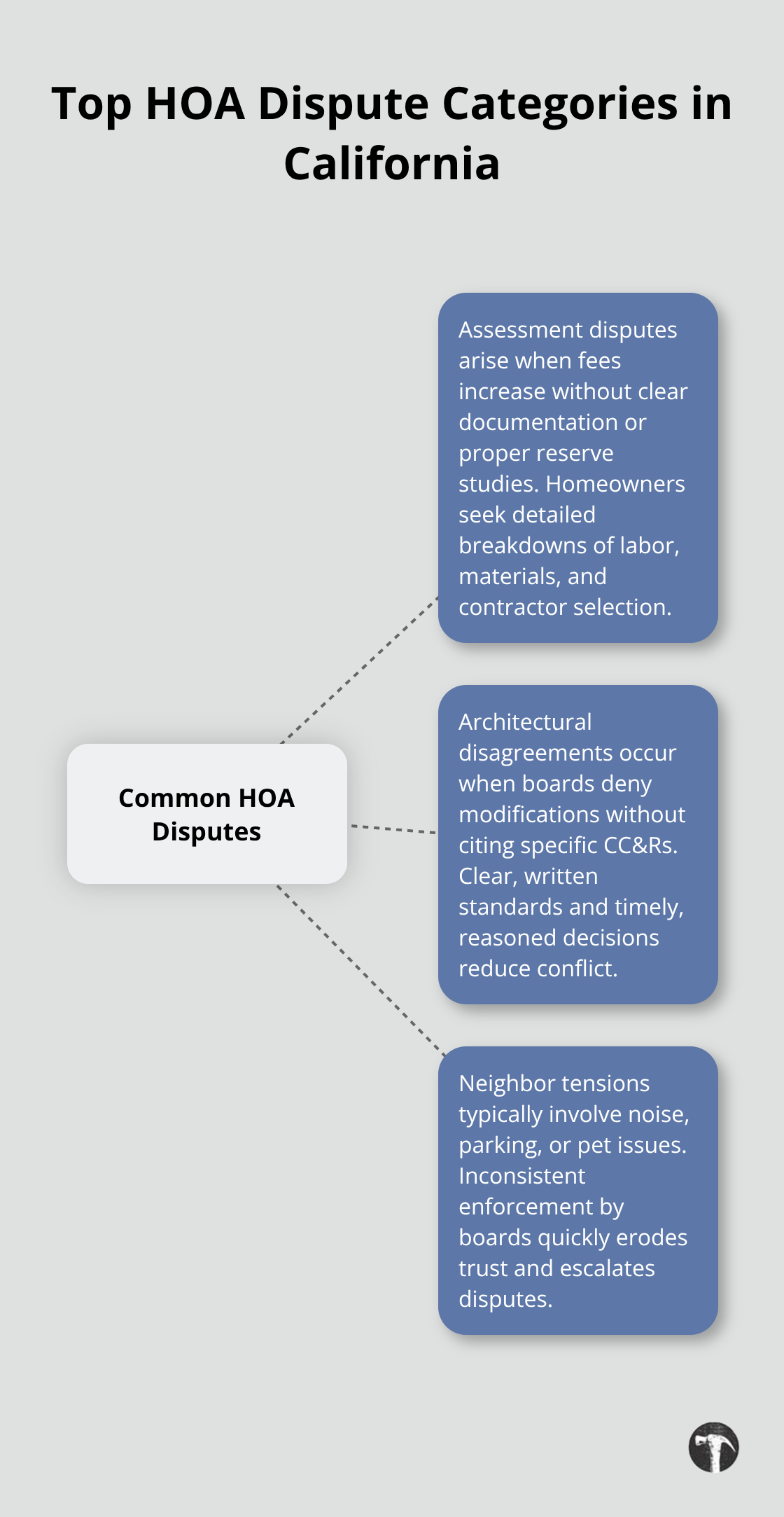
HOA conflicts in California affect thousands of homeowners every year. Over 14 million residents live under HOA governance in California, and many face unexpected or rising assessments without clear justification. Whether you’re facing assessment disputes, architectural disagreements, or neighbor tensions, understanding what divides communities helps you protect your rights.
Assessment Disputes Demand Financial Transparency
Rising assessments without supporting documentation create justified anger among homeowners. Many boards fail to conduct proper reserve studies before imposing special assessments, leaving homeowners wondering where their money actually goes. Request your HOA’s most recent reserve study, budget, and meeting minutes before any assessment vote occurs. If the board refuses these documents, that’s a red flag that warrants formal written requests under California law.
Challenge assessments that lack detailed breakdowns of labor, materials, and contractor bids. Boards must justify why they selected a particular contractor or why repair costs exceeded estimates. Document all communications requesting financial information and keep copies of every email, letter, or meeting note discussing assessments. The Davis-Stirling Act requires associations to provide detailed financial disclosures, yet inconsistent enforcement means some boards withhold budget breakdowns until homeowners formally request them.
Architectural Modifications Need Clear Standards
Homeowners submit requests to paint their home a non-standard color, install solar panels, or modify landscaping, only to face rejection without clear reasoning tied to the CC&Rs. Boards that deny architectural requests without citing specific CC&R violations invite disputes. Before submitting any modification request, pull your CC&Rs and rules, then match your proposal directly to the language. If your modification complies with the documents, the board’s denial becomes harder to defend.
Submit your architectural request in writing with photos, detailed plans, and a brief explanation of why your modification meets all requirements. Request written reasons for any denial within the timeframe specified in your CC&Rs. If the board’s response cites vague standards like community aesthetics without specific rules you’ve violated, push back in writing and ask for the exact provision you breached. Many boards lack formal architectural review processes or written standards, making decisions appear arbitrary.
Neighbor Conflicts Require Board Consistency
Neighbor-to-neighbor conflicts within HOA communities often stem from noise complaints, parking disputes, or pet issues. These disputes escalate quickly because homeowners feel the board either ignores their complaints or enforces rules inconsistently against other residents. When one neighbor receives warnings for a barking dog while another faces no action despite similar violations, trust in the board collapses.
Document every violation you report with dates, times, and descriptions. If the board fails to act on your complaint, request written explanation of why enforcement wasn’t pursued. Take photos or videos of violations when possible. If a neighbor’s dog barks excessively, document the dates and times, then formally notify the board in writing rather than relying on casual conversations. This creates a paper trail showing the board had notice and either acted or deliberately ignored the problem.
Understanding these three dispute categories positions you to recognize conflicts early and respond strategically. California law provides specific protections for homeowners facing these situations, and knowing your rights under the Davis-Stirling Act can shift the outcome in your favor.
What Rights Do California Homeowners Have Against HOAs
The Davis-Stirling Act Protects Your Access to Information
California law grants homeowners meaningful protections through the Davis-Stirling Common Interest Development Act, codified in the California Civil Code. The Act mandates that HOAs operate transparently and provide homeowners access to financial records, meeting minutes, and governing documents without unreasonable delay. If your board refuses to provide these materials within 10 days of your written request, California law allows you to pursue enforcement action. The Davis-Stirling Act also requires boards to conduct reserve studies at least every three years, meaning your HOA must maintain documented plans for major repairs and replacements rather than imposing surprise special assessments.
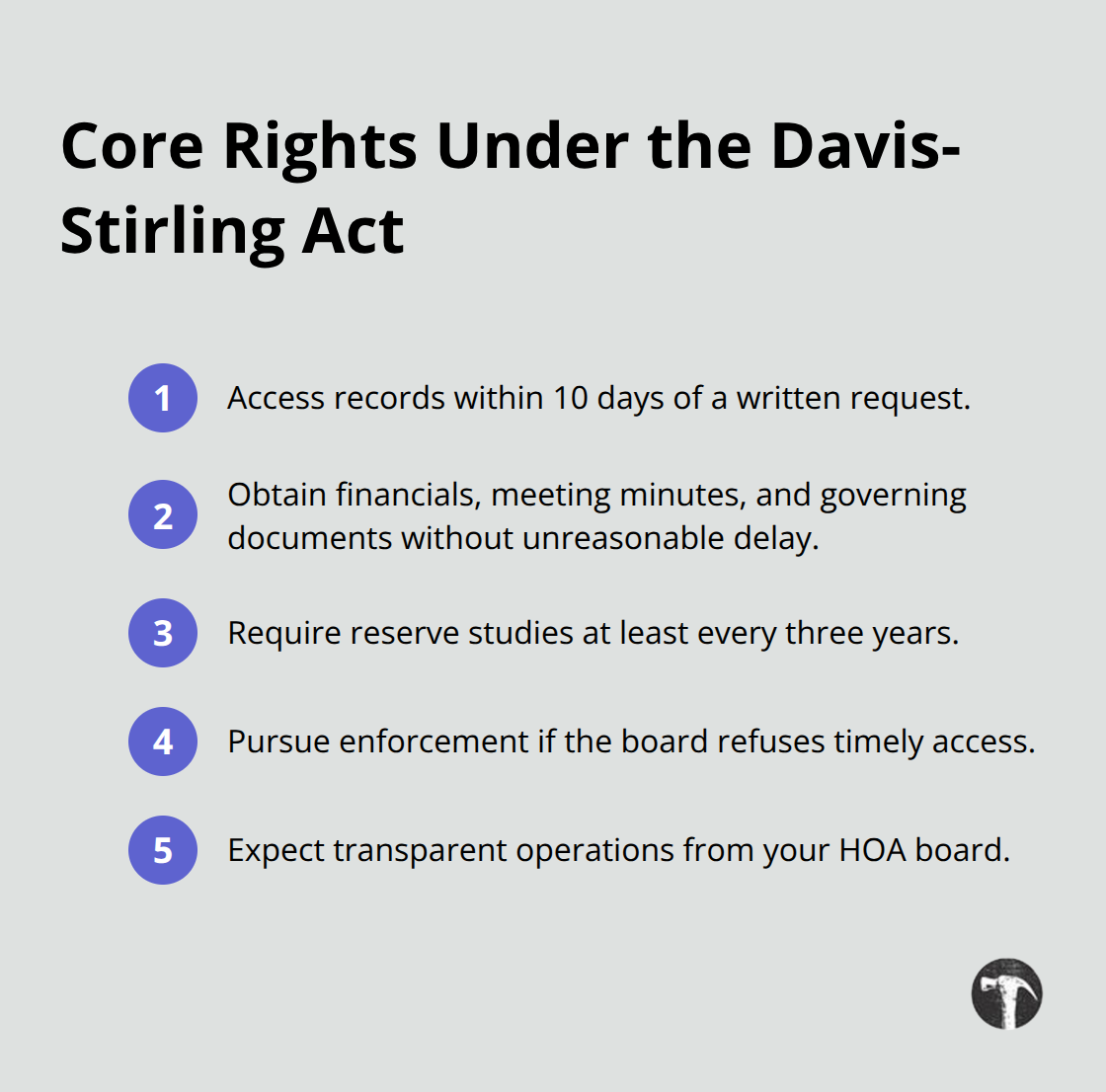
When a board fails to conduct proper reserve studies before charging homeowners tens of thousands of dollars for major projects, that violation weakens their legal position if you challenge the assessment. Request your HOA’s most recent reserve study and budget immediately. Boards that cannot produce these documents have violated state law, and that violation strengthens your position in any dispute.
Procedural Requirements Protect You During Disciplinary Actions
California Civil Code Section 5855 requires HOAs to provide you at least 10 days written notice before any disciplinary hearing and must allow you to present your case at an open meeting. The board must deliver a written decision explaining its reasoning within 14 days. Many boards skip these procedural requirements, which can invalidate their enforcement action entirely. If your board held a hearing without proper notice or failed to allow you to speak, that procedural violation gives you grounds to challenge the decision in court.
Document the exact date you received notice of any hearing. If the board provided fewer than 10 days’ notice, that violation alone may overturn the board’s decision. Attend the hearing prepared with evidence (photos, emails, maintenance records) that supports your position. Request a written copy of the board’s decision immediately after the hearing concludes.
Mandatory Dispute Resolution Pathways Save Time and Money
The Davis-Stirling Act created two mandatory dispute resolution pathways that must occur before litigation. Internal Dispute Resolution, sometimes called meet-and-confer, requires the board to meet with you face-to-face to discuss the conflict. You can bring an attorney to this meeting, and any written settlement you reach becomes legally binding. If IDR fails, California law allows either party to pursue Alternative Dispute Resolution through mediation or arbitration before filing a lawsuit.
These processes cost far less than litigation and often produce faster results. Many homeowners skip these steps and jump straight to court, wasting time and money. Boards frequently reverse decisions when faced with documented violations of California law and a homeowner prepared with evidence. Exhausting IDR and ADR first positions you to either resolve the dispute affordably or build a stronger case for litigation if settlement fails.
How to Build Your Case Before Legal Action
Start gathering evidence immediately when a dispute emerges. Document every communication with the HOA, including emails, letters, text messages, and notes from phone calls with board members or management. Write down the date, time, and substance of each conversation. Take photos or videos of violations, damage, or conditions that triggered the dispute. If the board denied your architectural request, save the denial letter and your original submission. If assessments seem unjustified, obtain copies of the reserve study, budget, and contractor bids. This paper trail becomes invaluable during mediation or litigation. Many homeowners wait months before organizing their evidence, losing critical details or forgetting exactly when violations occurred.
Request Documents in Writing and Track Responses
Request all relevant documents from your HOA in writing and keep copies of those requests. California Civil Code Section 5200 requires associations to provide homeowner records within 10 days. When the board delays providing documents, send a follow-up letter citing the statute and requesting compliance. If documents still don’t arrive, that violation strengthens your position if disputes escalate. Attend every HOA board meeting and take notes on what the board discusses, decides, and fails to address regarding your concern. Request that your comments appear in the meeting minutes. This creates an official record showing you raised the issue and when. Many homeowners skip meetings and later claim the board never heard their concerns. Board minutes prove otherwise. Organize your evidence chronologically in a folder or digital file so you can quickly reference specific dates and communications during negotiations or hearings.
Negotiate Directly With Neighbors First
Start with direct conversation if the dispute involves a neighbor rather than the board itself. Approach the neighbor calmly and explain the specific problem using concrete examples. Many parking disputes, noise complaints, and pet issues resolve quickly once neighbors understand how their actions affect others. If direct conversation fails or feels unsafe, submit a formal written complaint to the board with detailed documentation. The board must then address the issue according to the CC&Rs and California law. Do not assume the board will act fairly without pressure. Follow up in writing if the board ignores your complaint for more than two weeks. Request a written explanation of what steps the board took or why it declined to enforce the rule.
Use Internal Dispute Resolution to Challenge Board Decisions
When the dispute involves the board’s own decision, initiate the Internal Dispute Resolution process immediately. Send a letter requesting an IDR meeting and propose three dates when you’re available. The board must meet with you within a reasonable timeframe. Bring your evidence and a clear summary of your position. The board will explain its reasoning, and you’ll have a chance to respond. Many boards reverse decisions during IDR when faced with documented violations of California law or clear evidence they misinterpreted the CC&Rs. If the board stands firm, ask directly whether they’re willing to mediate the dispute with a neutral third party. Mediation typically costs between $300 and $1,500 per session depending on the mediator’s hourly rate, far less than litigation. Mediators often find creative solutions that satisfy both sides because neither party needs to admit fault. A mediator might suggest the board reduce your assessment by a certain amount while you agree to drop your challenge, or agree to a payment plan that works for both parties. These compromises resolve disputes that would otherwise drag through courts for years.
Pursue Litigation When Resolution Efforts Fail
At this point, you’ve documented everything, attempted negotiation, and pursued mediation without success. The board has violated California law, breached the CC&Rs, or caused you measurable financial harm. Litigation in California costs between $5,000 and $50,000 depending on case complexity, court jurisdiction, and how long discovery takes.
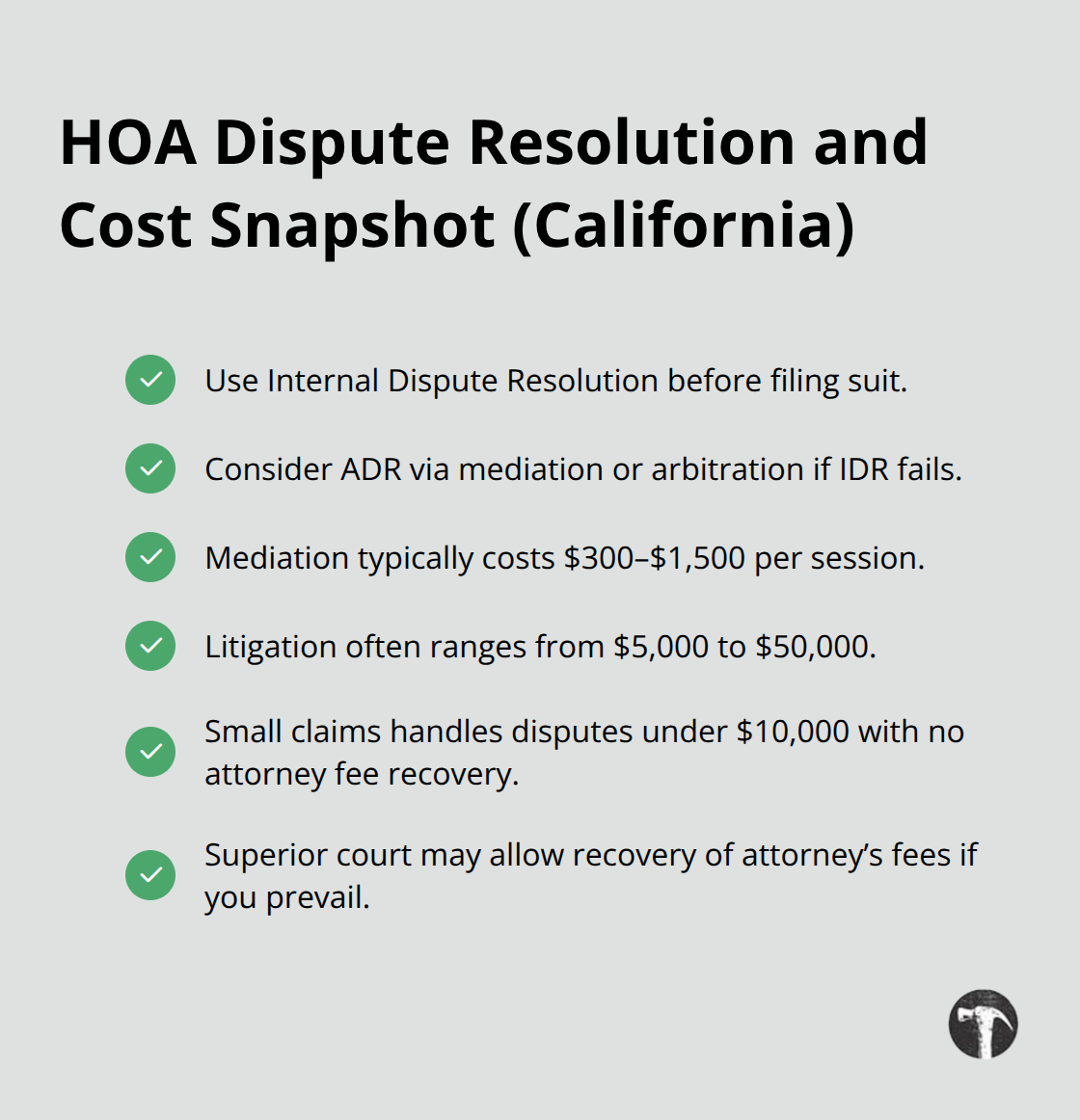
Small claims court handles disputes under $10,000 with no attorney required, though you cannot recover attorney fees if you win. Superior court handles larger disputes and allows attorney fee recovery if you prevail, meaning the losing party pays your legal costs. Consult an attorney before filing suit to understand your damages, likelihood of success, and total cost exposure. The Law Offices of Alan J. Carnegies, APC represents property owners in HOA conflicts throughout Los Angeles County and can evaluate your claim, advise on litigation strategy, and represent you throughout trial if necessary.
Final Thoughts
HOA conflicts in California stem from assessment disputes, architectural disagreements, and neighbor tensions that escalate when homeowners don’t understand their rights. The Davis-Stirling Act provides real protections: your board must provide financial records within 10 days, conduct reserve studies every three years, and follow strict procedural requirements before disciplinary action. These aren’t theoretical safeguards-they’re enforceable rules that shift power back to homeowners when boards ignore them.
Document everything from the moment a dispute emerges, and save emails, letters, photos, and notes from conversations. Start with direct negotiation or the Internal Dispute Resolution process before pursuing mediation or litigation, since these early steps cost far less and often produce faster results than court proceedings. Boards frequently reverse decisions when faced with documented violations of California law and a homeowner prepared with evidence.
We at The Law Offices of Alan J. Carnegies, APC represent property owners in HOA conflicts throughout Los Angeles County and help homeowners understand their rights under California law. We evaluate your claim, advise on resolution strategy, and represent you through negotiation, mediation, or litigation if necessary. Contact us today to discuss your situation and protect your interests.