


Securities litigation in California protects investors from fraud, misconduct, and violations that drain portfolios. Financial advisors, brokers, and companies sometimes breach their duties, leaving victims with significant losses.
We at The Law Offices of Alan J. Carnegies, APC represent investors across Los Angeles County who face these threats. This guide covers what securities violations look like, the risks you face, and how legal action recovers your money.
What Securities Violations Really Look Like in Calabasas, California
Three Categories of Securities Violations
Securities violations in California fall into three distinct categories that investors and business owners need to understand. The first involves misrepresentation or omission of material facts-when brokers, advisors, or companies hide critical information that would affect investment decisions. The second covers fraudulent trading schemes, including insider trading where individuals exploit non-public information for profit, and Ponzi schemes that promise unrealistic returns while using new investor money to pay earlier participants. The third category involves breach of fiduciary duty, where financial advisors prioritize their own commissions over client interests or fail to disclose conflicts of interest.
State and Federal Legal Framework
California Corporations Code Section 25400 specifically prohibits fraudulent and manipulative practices in securities transactions, making these violations both state and potentially federal crimes. The Department of Financial Protection and Innovation tracks enforcement actions and publishes monthly bulletins highlighting emerging fraud patterns. The Securities Act of 1933 and the Securities Exchange Act of 1934 establish federal baselines, while California’s Corporate Securities Law of 1968 adds state-level requirements that every securities offering must be qualified with the California Commissioner or exempted under specific rules. Exemptions from qualification do not shield issuers from fraud liability-they only waive registration costs and formalities. The Financial Industry Regulatory Authority oversees broker-dealers and conducts examinations to maintain ethical standards, while the SEC enforces disclosure requirements for publicly traded companies.
Real Consequences: A Los Angeles County Case
A Los Angeles County case from 2021 to 2023 illustrates how serious these violations become. A defendant operating an investment scam collected approximately $250,000 from victims through personal relationships, diverting funds to personal expenses rather than legitimate investments. The defendant faced 18 felony counts-9 for securities fraud and 9 for grand theft-and received a lifetime bar from the SEC from acting as a broker. California prosecutors collaborated with the Department of Financial Protection and Innovation and federal regulators to pursue both criminal and civil remedies, demonstrating the enforcement power behind securities laws.
Protecting Yourself Before Investing
Before investing, verify registration status and exemptions directly with regulators to reduce fraud risk. Check the SEC’s EDGAR database for corporate filings and review DFPI’s Investor Center for registration status of brokers and advisors. If you discover misrepresented credentials, hidden fees, or pressure to invest quickly without documentation, these are red flags indicating potential violations. When you spot these warning signs, contact The Law Offices of Alan J. Carnegies, APC to discuss your situation and understand your legal options across Los Angeles County.
Insider Trading, Ponzi Schemes, and Advisor Misconduct in Calabasas, California
How Insider Trading Harms California Investors
Insider trading remains one of the most damaging violations in California markets because it operates silently until regulators or victims uncover it. When corporate insiders, brokers, or financial advisors trade on non-public information-such as unreleased earnings, pending acquisitions, or regulatory decisions-they gain unfair advantages while ordinary investors lose money. The SEC reports that insider trading cases have increased in frequency over the past decade, with enforcement actions targeting both individual traders and firms that fail to prevent such conduct.
Victims often don’t know they’ve been harmed until months or years after transactions occur. Unusual trading activity before major announcements, rapid portfolio changes without your authorization, or advisors buying securities for themselves before recommending them to clients all suggest potential insider trading.
Ponzi Schemes: How Scammers Exploit Trust
Ponzi schemes operate differently but with equal destructiveness. They promise unrealistic returns-often 15% to 30% annually-and initially deliver payments to early investors using money from new recruits rather than legitimate investment gains. The Los Angeles County case described earlier collected approximately $250,000 over roughly two years before collapsing, and the operator exploited personal relationships to build false trust.
DFPI’s monthly bulletins document recurring patterns: scammers claim connections to exclusive investment opportunities, pressure victims to move quickly without documentation, and isolate investors from independent verification. These tactics create urgency and prevent victims from asking critical questions about how returns actually materialize.
Fiduciary Duty Breaches by Financial Advisors
Breach of fiduciary duty by financial advisors cuts deeper because victims trust these professionals with retirement savings and long-term goals. California law requires advisors to disclose conflicts of interest, recommend investments suitable for clients’ risk tolerance and financial situations, and prioritize client interests over their own commissions.
Many violations occur when advisors recommend high-fee products that generate larger commissions despite lower suitability, fail to disclose that they receive compensation from product manufacturers, or recommend concentrated positions in a single security without diversification. The Financial Industry Regulatory Authority maintains records of advisor disciplinary history through its BrokerCheck system, which you should review before hiring anyone.
Red Flags That Demand Legal Action
If an advisor resists questions about fees, becomes defensive about past performance, or pressures you to sign documents without time to review them, these warning signs indicate potential violations. Contact The Law Offices of Alan J. Carnegies, APC to evaluate whether your rights have been violated and what recovery options exist in Los Angeles County. Understanding these three violation types prepares you to recognize threats, but identifying misconduct is only the first step-taking action to recover losses requires understanding how California courts and regulators handle securities disputes.
How We Protect Your Investments in Securities Disputes
Investigation and Documentation Review
When you discover potential securities violations, your next step determines whether you recover losses or watch them disappear. A detailed review of your transactions, advisor communications, and account statements identifies specific violations under California Corporations Code Section 25400 or federal securities laws. We examine whether your advisor disclosed conflicts of interest, whether recommendations matched your risk tolerance, and whether fees were hidden or excessive. This investigation phase typically uncovers documentation that proves misconduct-emails showing unsuitable recommendations, account statements revealing unauthorized trades, or performance records contradicting promised returns.
Choosing Your Legal Forum
We file claims in California courts or pursue arbitration through the Financial Industry Regulatory Authority, depending on your account agreement and the violation type. FINRA arbitration often moves faster than court litigation and avoids jury trials, but we evaluate which forum gives you the strongest position before proceeding. Your account agreement typically specifies whether disputes go to arbitration or court, and this choice affects both timeline and potential outcomes.
Calculating and Recovering Your Losses
Recovery requires understanding the damages available in California securities cases. Courts award compensatory damages covering your actual losses plus interest, and sometimes punitive damages when misconduct was intentional or reckless. A Los Angeles County prosecution from 2021 to 2023 recovered approximately $250,000 from a Ponzi scheme operator, demonstrating that restitution becomes possible once violations are proven. We calculate your losses by comparing what you actually received against what you should have received under suitable recommendations or honest advice.
Pursuing Claims Against Firms and Advisors
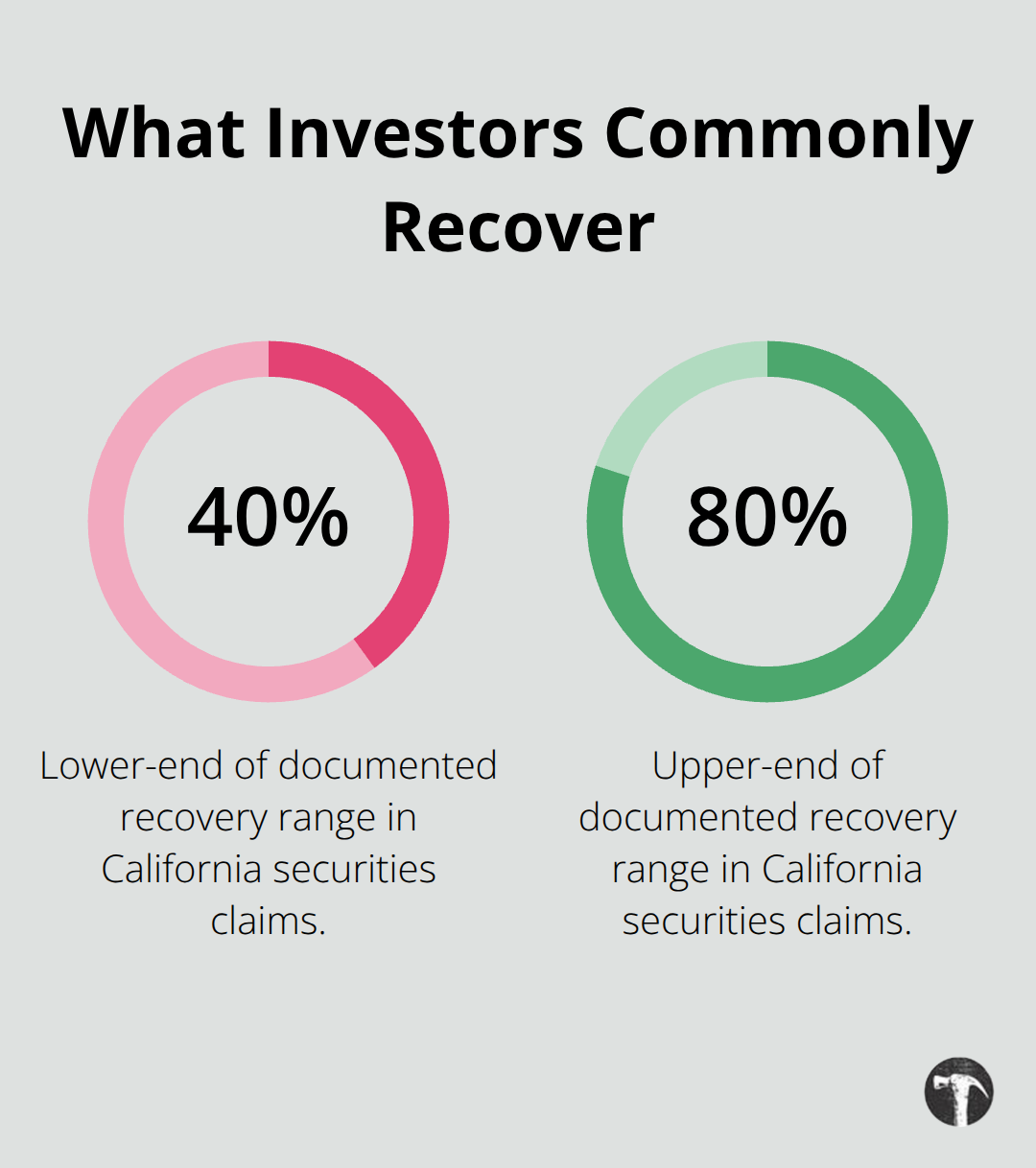
We also pursue claims against the advisor’s firm for failure to supervise, which often produces larger settlements because firms carry insurance and have deeper resources than individual advisors. Investors who pursue claims recover between 40 to 80 percent of documented losses depending on case strength and defendant solvency. Settlement negotiations typically occur within 12 to 18 months after filing, though complex cases involving multiple defendants or regulatory investigations can extend timelines.
Managing Communications and Strategy
Throughout this process, we handle all communications with opposing counsel, regulators, and insurance companies so you avoid statements that could undermine your claim. Strategic communication protects your position and prevents inadvertent admissions that defendants could use against you.
Final Thoughts
Securities litigation in California protects your financial future when advisors, brokers, or companies breach their obligations. Document everything immediately-account statements, emails, performance reports, and communications with your advisor or firm. Write down dates when you discovered the misconduct and what specific actions harmed your investments, as this documentation becomes critical evidence in your case.
Contact a securities litigation attorney within your state’s statute of limitations, which typically ranges from three to five years depending on violation type. Waiting reduces your recovery options because evidence disappears, witnesses become unavailable, and defendants may transfer assets. Early consultation also protects you from making statements that could undermine your claim.
We at The Law Offices of Alan J. Carnegies, APC represent investors across Los Angeles County who face securities violations. We investigate your situation, identify responsible parties, and pursue recovery through litigation or arbitration. Contact us today for a consultation about your securities case-we evaluate your claim at no cost and explain your legal options in plain language.