


Franchise disputes in California are growing more complex as both franchisors and franchisees navigate strict state regulations. Disagreements over territory rights, disclosure violations, and contract terminations can derail your business and drain resources.
We at The Law Offices of Alan J. Carnegies, APC help franchise owners and operators throughout Los Angeles County resolve these conflicts effectively. This guide walks you through the legal landscape and practical strategies to protect your franchise rights.
What Franchise Disputes Actually Look Like in California
Termination and Non-Renewal: The Most Destructive Disputes
Termination disputes dominate California’s franchise landscape, and they’re rarely simple contract disagreements. When a franchisor terminates or refuses to renew without clear cause, franchisees lose their entire investment. California’s Franchise Relations Act requires good cause and material breach before termination, meaning vague brand standards language often fails to hold up in court. Franchisors frequently cite technical violations-minor operational slip-ups or ambiguous compliance issues-as grounds for termination. A franchisee misses one training deadline or falls slightly short on a performance metric, and suddenly faces non-renewal threats. The fix requires meticulous documentation from day one. Track every communication with the franchisor, every training completion, every financial report you submit. This creates a defense when disputes arise.
Misrepresentation and Disclosure Violations
Misrepresentation claims stem from incomplete or misleading disclosures in the Franchise Disclosure Document. Item 19 of the FDD contains financial performance representations, and franchisors often overstate earnings potential or downplay operational costs. Item 3 reveals the franchisor’s litigation history over the past five years-extensive disputes signal serious risk. Before signing anything, request detailed accounting of royalties and fees, and negotiate clear definitions of what counts as gross sales. Returns, refunds, promotional discounts, and technology fees commonly trigger disputes because franchisees and franchisors interpret these deductions differently.
Territory and Encroachment Conflicts
Territory and encroachment conflicts arise when exclusivity isn’t explicitly granted in writing. A franchisor opens a competing location nearby, launches an online sales channel that undercuts your protected area, or allows another franchisee to operate within your boundaries. The California Franchise Investment Law requires precise geographic definitions of territory and clear statements on whether rights are exclusive or non-exclusive. Without this clarity, courts struggle to enforce territorial protections. Track actual monthly sales and compare them to reported figures to catch discrepancies early-waiting years to challenge fee calculations weakens your position considerably.
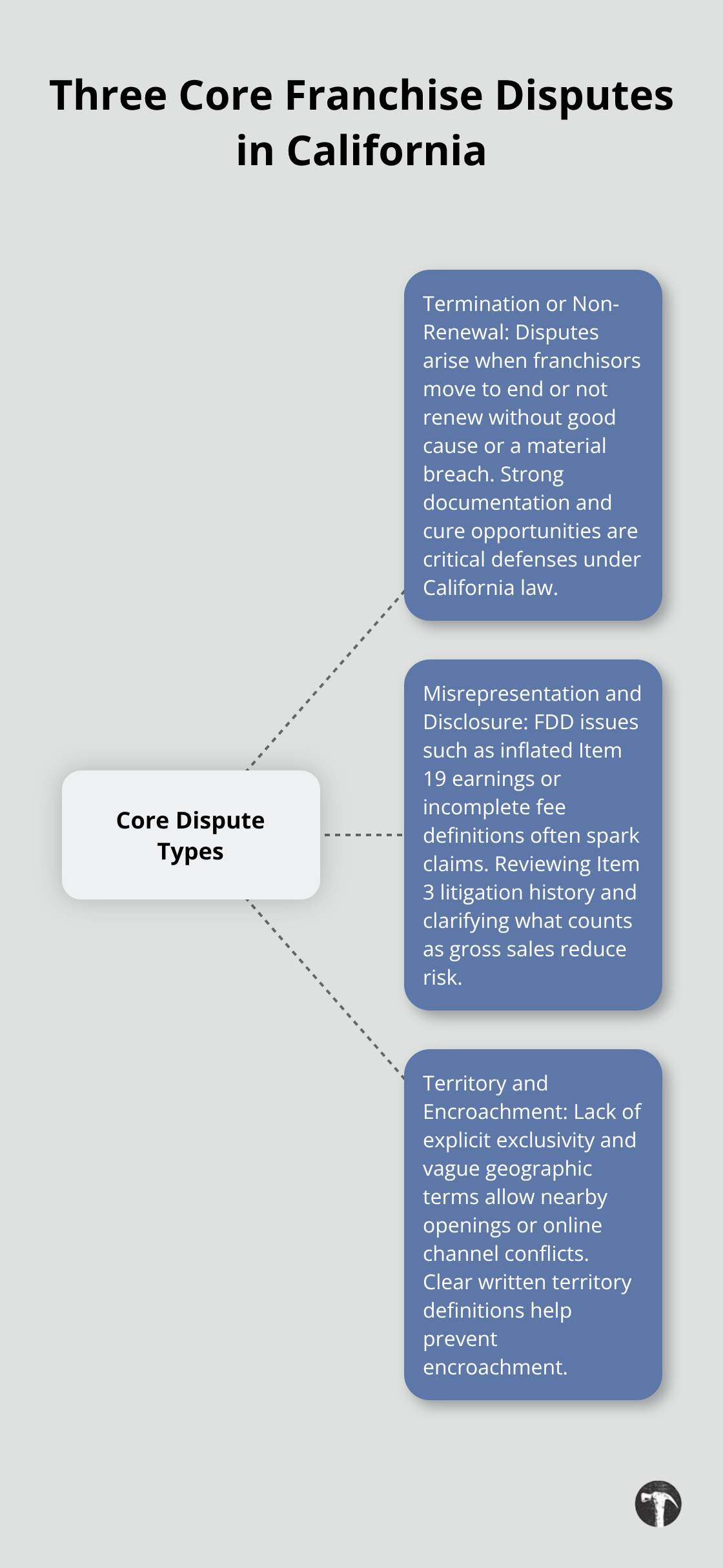
Understanding these three dispute categories helps you recognize problems before they escalate into costly litigation.
What California Law Actually Requires From Franchisors
The Franchise Disclosure Document and State Registration
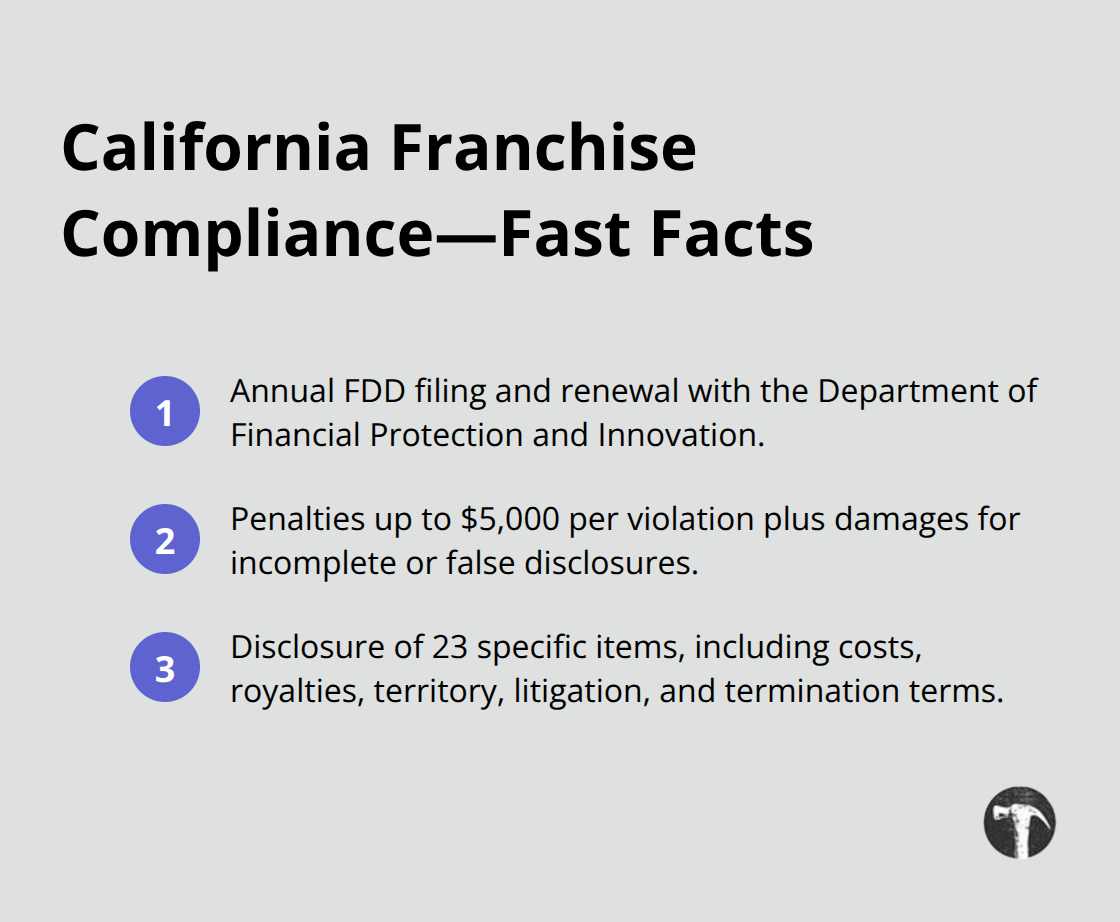
California’s franchise regulations rank among the strictest in the nation, and they impose hard obligations on franchisors before they can legally sell a franchise. The California Department of Financial Protection and Innovation requires franchisors to file and renew a Franchise Disclosure Document annually, with penalties reaching $5,000 per violation plus damages if a franchisee relied on incomplete or false information. This isn’t theoretical-franchisors operating in California must comply with the California Franchise Investment Law, which mandates disclosure of 23 specific items including initial investment costs, royalty structures, territorial rights, litigation history, and termination conditions.
Critical FDD Items That Protect Franchisees
Item 3 of the FDD covers the franchisor’s litigation history over the past five years, and you should treat extensive disputes as a red flag for operational instability. Item 19 requires financial performance representations, yet many franchisors either omit earnings claims entirely or present them in ways that obscure actual profitability. Federal FTC franchise regulations layer on top of state law, requiring the FDD to be delivered at least 14 calendar days before you sign anything or hand over money. The FTC enforces this timeline strictly, and violations can trigger regulatory action against the franchisor.
Termination and Non-Renewal Protections Under California Law
When termination or non-renewal occurs in California, the Franchise Relations Act provides protections that don’t exist in most other states. Franchisors cannot terminate or refuse renewal without material breach and reasonable notice to cure, which means vague language about brand standards or compliance typically fails in court. California courts have consistently ruled that ambiguous termination clauses are interpreted against the franchisor, the party that drafted them. If a franchisor claims you violated operational standards but never documented the violation or gave you a chance to fix it, California law likely protects you. California law also prohibits franchisors from requiring you to waive your rights under California franchise law as a condition of the franchise relationship.
Remedies and Resolution Pathways Available to Franchisees
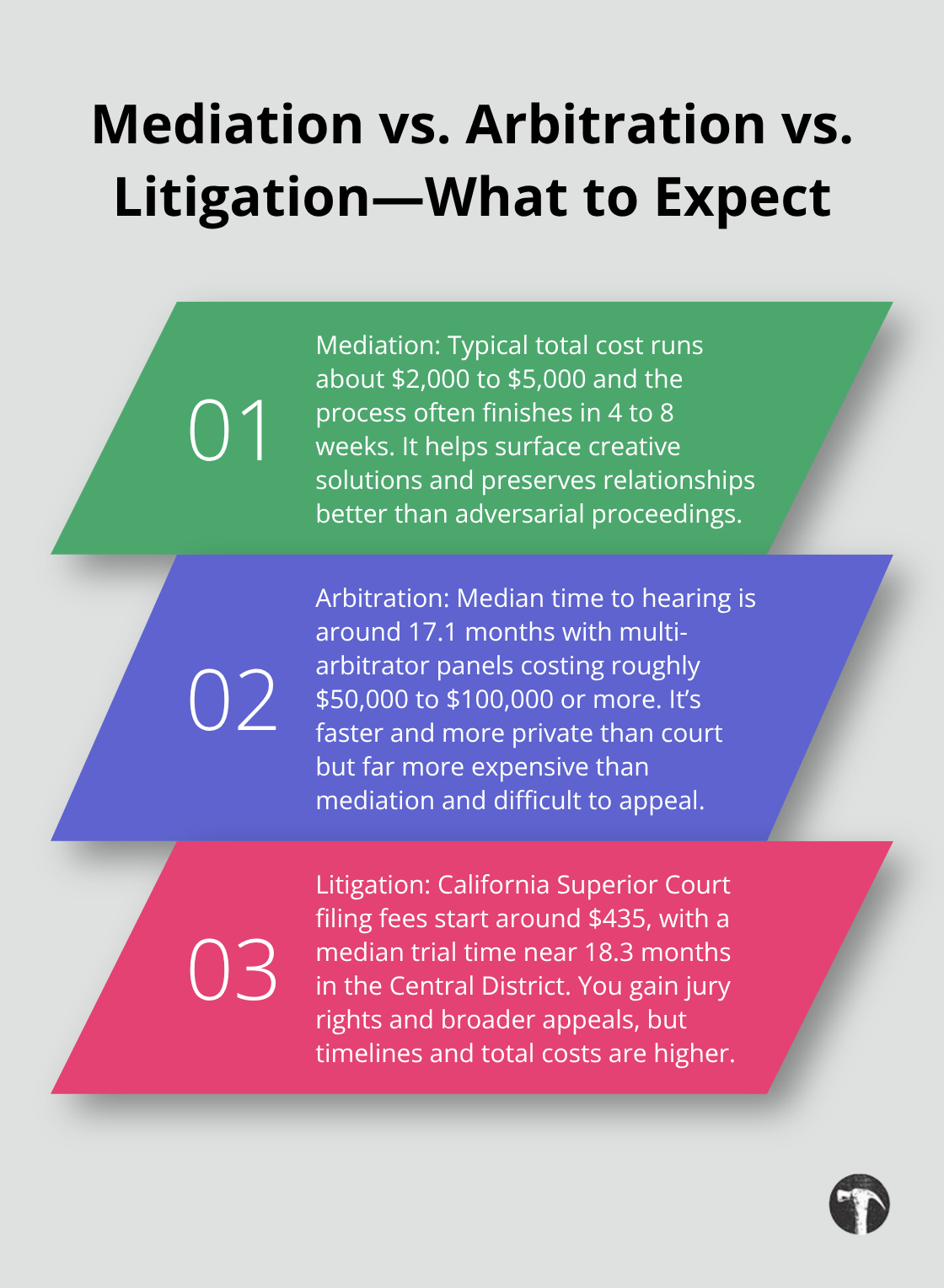
Remedies available under California law include damages for breach of contract, potential rescission of the entire franchise agreement, and attorney-fee recovery if you prevail in court or arbitration. The California Unfair Competition Law allows franchisees to seek restitution and damages for deceptive or unlawful practices. However, most franchise agreements contain mandatory arbitration clauses governed by the Federal Arbitration Act, which preempts California’s jury-trial protections. Arbitration with AAA or JAMS typically takes 17.1 months to hearing and costs $50,000 to $100,000 or more for multi-arbitrator panels, making early resolution through negotiation or mediation far more cost-effective. California Superior Court litigation has lower filing costs around $435 but discovery costs run high, with median trial time in the Central District of California around 18.3 months. The path you choose-mediation, arbitration, or litigation-depends entirely on the dispute amount, your timeline, and whether preserving the franchisor relationship matters to your business strategy. Understanding these legal requirements and remedies positions you to make informed decisions when disputes arise.
How to Stop Franchise Disputes Before They Drain Your Business
Send a Demand Letter First
A written letter to your franchisor stops most disputes before they escalate. This single step separates franchisees who control their disputes from those who get controlled by them. Your letter should cite specific contract language, attach supporting documentation, and propose a concrete resolution-whether that’s a fee adjustment, territorial clarification, or performance timeline extension. Send it via email with read receipt or certified mail so you have proof of delivery. This creates a paper trail that strengthens your negotiating position and demonstrates good faith if the dispute later moves to mediation or arbitration. Many franchisors respond constructively to a well-drafted demand letter because they recognize the cost of formal proceedings. If the franchisor ignores your letter or responds dismissively, you’ve still gained valuable information: they’re unwilling to negotiate reasonably, which tells you what to expect in the next phase.
Try Mediation Before Formal Proceedings
Mediation should be your second move if negotiation stalls. JAMS and AAA both maintain rosters of mediators with franchise experience, and mediation typically costs $2,000 to $5,000 total and takes 4 to 8 weeks-a fraction of arbitration or litigation expenses. A neutral mediator helps both sides identify common ground and creative solutions that pure legal arguments miss. Territory disputes sometimes resolve through adjusted boundaries, reduced royalty rates during a transition period, or exclusive rights to specific customer segments rather than geographic areas. Royalty disputes frequently settle through revised accounting procedures or one-time fee adjustments that both parties can live with. The mediator’s role is to move past positional bargaining and surface underlying interests: the franchisor wants stable operations and compliance; you want fair treatment and profit potential. Mediation preserves the business relationship better than adversarial processes, which matters if you’re genuinely committed to making the franchise work long-term. If mediation fails, you’ve still reduced the dispute scope by clarifying which issues are negotiable and which are deal-breakers.
Understand Arbitration Costs and Timelines
Arbitration becomes necessary when your franchise agreement includes a mandatory arbitration clause, which most do under the Federal Arbitration Act. Expect median time to hearing around 17.1 months according to FINRA statistics, with costs potentially ranging from $50,000 to $100,000 or more for multi-arbitrator panels. This timeline and expense make arbitration dramatically more costly than mediation but faster and more private than court litigation.
Arbitration decisions are nearly impossible to appeal, so the arbitrator’s competence and background matter enormously. Request arbitrators with franchise-specific experience and challenge any arbitrator with prior relationships to the franchisor or its counsel. Document every communication during arbitration-written submissions create a record that protects you if you later need to challenge the arbitrator’s conduct or award.
Consider Litigation for Statutory Violations
California Superior Court litigation remains an option for statutory violations, bad-faith conduct, or situations where establishing public precedent benefits the franchising community. Court filing costs start around $435, but discovery expenses climb quickly, with median trial time in the Central District of California around 18.3 months. Litigation gives you jury trial rights and broader appeal options, but those advantages come with extended timelines and higher total costs. The franchise dispute landscape in California tends to favor franchisors unless you have solid documentation, a well-drafted agreement, and strong legal guidance throughout the process.
Choose Your Resolution Path Strategically
The path you choose-mediation, arbitration, or litigation-depends entirely on the dispute amount, your timeline, and whether preserving the franchisor relationship matters to your business strategy. A dispute over $15,000 in disputed royalties may not justify $75,000 in arbitration costs, making mediation or negotiated settlement far more rational. A territorial encroachment that threatens your entire market position may warrant litigation despite the timeline and expense. We at The Law Offices of Alan J. Carnegies, APC help franchise owners throughout Los Angeles County navigate each of these resolution paths and choose the strategy that protects your specific situation.
Final Thoughts
Franchise disputes in California demand immediate action and strategic thinking. The three core dispute types-termination, misrepresentation, and territorial encroachment-escalate rapidly without intervention. Documentation from day one protects you when conflicts arise, so track communications, maintain compliance records, and preserve evidence of your performance against franchise standards. California’s legal framework provides stronger protections than most states, but only if you understand and assert your rights.
The resolution path you choose matters enormously. A demand letter costs nothing and resolves many disputes before they consume resources, while mediation at $2,000 to $5,000 and 4 to 8 weeks offers reasonable cost and timeline for most franchise disputes in California. Arbitration and litigation become necessary only when the dispute amount justifies the expense and timeline. Franchise disputes California franchisees face often stem from preventable misunderstandings-ambiguous territory definitions, unclear fee calculations, or vague performance standards-so clarity in your original agreement and proactive communication throughout the relationship reduce conflict substantially.
We at The Law Offices of Alan J. Carnegies, APC represent franchise owners and operators throughout Los Angeles County in complex business disputes. Our approach combines thorough contract review, strategic negotiation, and aggressive representation when disputes require formal proceedings. Whether you face termination threats, fee disputes, or territorial conflicts, early legal guidance protects your investment and clarifies your options.