


Partnership disputes in California can destroy years of hard work and investment. When partners clash over money, strategy, or management decisions, the business suffers and relationships fracture.
We at The Law Offices of Alan J. Carnegies, APC help partners navigate these conflicts with practical solutions that protect their interests and preserve what’s possible of their business.
What Triggers Partnership Conflicts in Calabasas, California
Financial Disagreements Lead Most Partnerships to Fail
Money disagreements rank as the most common reason partnerships fall apart. According to research from the Small Business Administration, approximately 50% of business partnerships dissolve within five years, with financial disputes leading the way. When partners contribute different amounts of capital or sweat equity, tension builds quickly.
One partner might expect equal profit distribution despite working fewer hours, while another feels their larger initial investment warrants higher returns. These expectations rarely get discussed upfront, and when they clash, resentment hardens fast. The partnership agreement should specify exactly how profits split and how each partner’s contribution gets valued, but many entrepreneurs skip this step entirely because they trust their partners initially.
Strategic Visions Create a Second Major Fault Line
Strategic disagreements paralyze decision-making for months. One partner wants aggressive growth and market expansion while the other prioritizes stability and reinvestment. One partner pushes to enter a new market segment while the other sees it as reckless. These conflicting visions about business direction pit partners against each other with no clear resolution path.
When partners cannot align on strategy, the business stalls. Decisions that require unanimous approval get blocked repeatedly. Opportunities pass by while partners argue about whether to pursue them. The longer these disagreements persist, the more damage they inflict on operations and morale.
Fiduciary Duty Breaches Destroy Trust Permanently
Fiduciary duty breaches represent a third category of disputes where one partner diverts business opportunities for personal gain, fails to disclose conflicts of interest, or mismanages company funds without transparency. Financial mismanagement often emerges only after damage accumulates significantly. Partners who discover unauthorized withdrawals or undisclosed side deals frequently face difficult choices about whether to salvage the relationship or exit entirely.
The earlier you address these problems with clear documentation and professional guidance, the better your options become. When one partner acts in self-interest rather than the partnership’s interest, the legal and emotional fallout can be severe. These breaches typically require immediate investigation and often lead to formal dispute resolution or litigation across Los Angeles County, California.
How to Stop Partnership Disputes Before Court Gets Involved in Calabasas, California
Most partnership disputes never reach a courtroom because partners resolve them through direct negotiation or mediation before positions harden into legal warfare. The key is starting the resolution process immediately when tension surfaces, not waiting months while resentment builds. Partners who address conflicts early spend thousands of dollars less on legal fees and preserve far more of their business value than those who let disputes fester.
Mediation Resolves Most Disputes Without Litigation
Mediation works best when both partners still want to find common ground. A neutral mediator helps partners communicate their actual concerns rather than defensive positions. The process typically takes two to four sessions and costs between $2,000 and $10,000 total, according to the American Arbitration Association. This is dramatically cheaper than litigation, which averages $50,000 to $150,000 for business disputes in California.
During mediation, partners sit down with a trained professional who identifies areas of agreement and helps craft solutions that address underlying interests rather than surface demands. Unlike litigation, mediation keeps discussions confidential, protects business secrets, and allows partners to maintain some working relationship afterward. The mediator does not decide who wins or loses-partners reach their own settlement agreement. If mediation stalls, partners can still pursue other options without losing time or money invested in the process.
Arbitration Provides a Faster Alternative to Court
Arbitration offers a middle ground between mediation and full litigation when partners cannot resolve disputes on their own. An arbitrator acts like a private judge, hears evidence from both sides, and makes a binding decision. Arbitration typically costs $15,000 to $40,000 and takes four to eight months, making it faster and less expensive than court litigation.
The real advantage appears in your partnership agreement-if it includes an arbitration clause requiring disputes to go to arbitration before court, you avoid the public record, discovery delays, and procedural complexities of California courts. This protection matters significantly for businesses that want to keep sensitive financial information private.
Partnership Agreements Prevent Costly Disputes
A well-drafted partnership agreement establishes a roadmap for handling conflicts before they spiral into litigation that damages the business and drains resources. Without clear dispute resolution language, one partner can unilaterally file a lawsuit, forcing everyone into expensive court proceedings. Your agreement should specify whether mediation comes first, whether arbitration is required, and what happens if partners cannot agree.
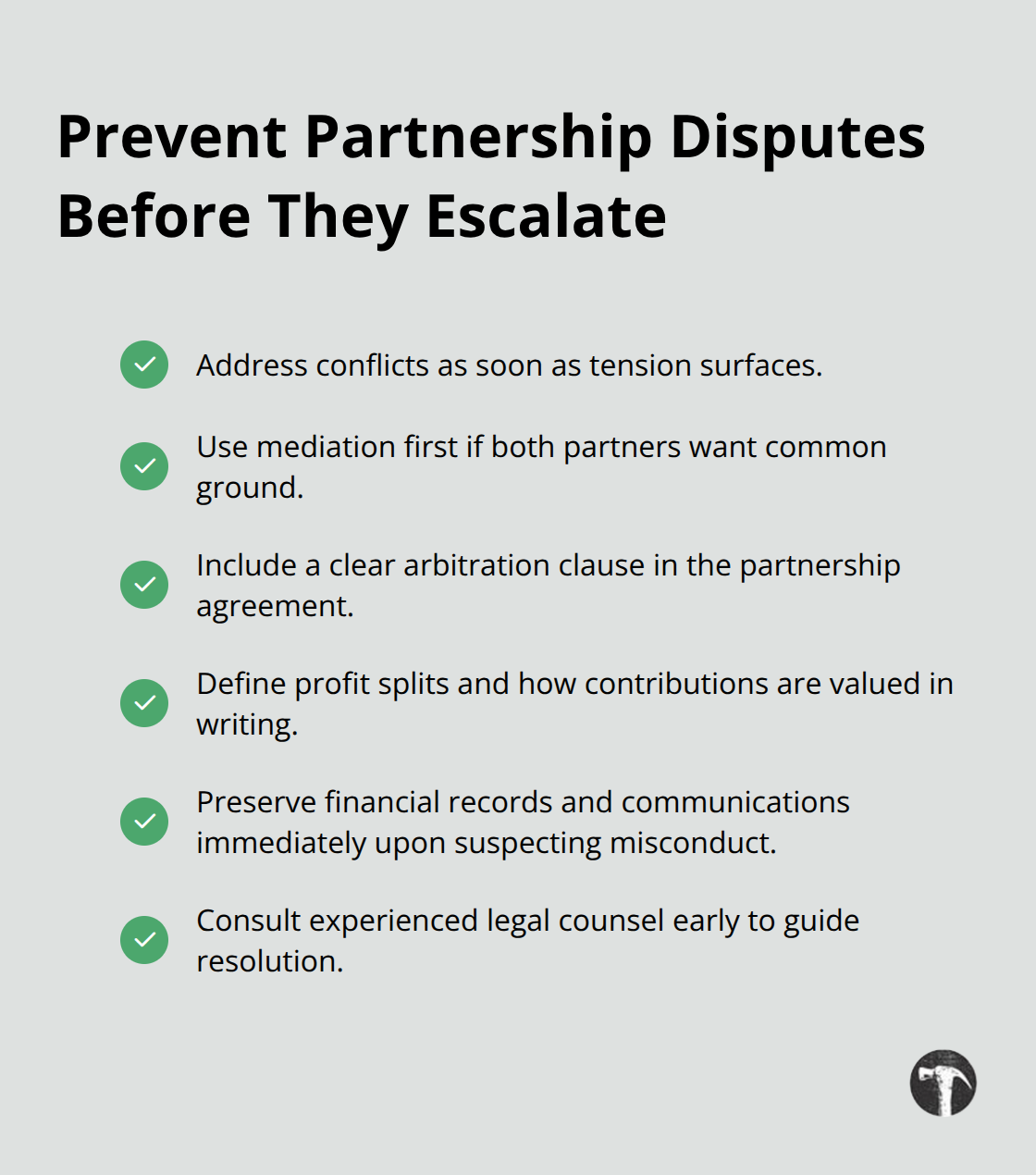
We at The Law Offices of Alan J. Carnegies, APC assist businesses with partnership disputes and can help you draft or review partnership agreements that include strong dispute resolution provisions. When conflicts do arise despite preventive measures, having the right legal guidance makes the difference between a manageable resolution and a business-destroying battle.
When Disputes Escalate to Legal Action in Calabasas, California
Litigation Forces Partners Into Formal Court Proceedings
When mediation and arbitration fail to resolve partnership conflicts, litigation becomes unavoidable. Filing a lawsuit in California courts forces partners into formal legal proceedings where a judge or jury decides the outcome, and both sides bear substantial costs. California courts handle partnership disputes under the Uniform Partnership Act, which governs how partnerships operate and what remedies exist when partners breach their duties. The litigation process typically takes 18 to 36 months from filing to trial, and costs escalate rapidly as attorneys conduct discovery, take depositions, and prepare for court appearances. Business litigation in California averages $50,000 to $150,000 or more depending on case complexity, according to the American Bar Association. Unlike mediation, litigation creates a public record of your business disputes, financial information, and internal conflicts that competitors and customers can access. Partners who reach this stage have already decided the relationship is beyond repair and are fighting over asset division and damages rather than trying to preserve the business.
Dissolution Requires Court-Ordered Asset Division
Dissolution of partnership becomes the next critical issue once litigation begins. California law allows partners to seek a court-ordered dissolution when disputes make it impossible to continue operating the partnership, or when one partner has breached fiduciary duties so severely that continuing would be inequitable. During dissolution, the court must determine asset values, calculate each partner’s ownership stake, and divide assets according to partnership agreements or state law if no agreement exists. Asset valuation disputes frequently become the most contentious part of dissolution because partners rarely agree on what the business is worth. One partner might argue the business has significant goodwill and brand value while another claims liabilities exceed assets. Courts appoint neutral business valuation experts to assess fair market value, which costs $5,000 to $25,000 depending on business complexity. After assets are valued and divided, partners receive their share and the partnership terminates.
Damages Claims Require Solid Documentation
Recovery of damages becomes possible when one partner can prove the other breached fiduciary duty, misappropriated funds, or diverted business opportunities. Damages awards cover direct losses like stolen money, lost profits from diverted business, and sometimes punitive damages if the breach involved fraud or intentional misconduct. Partners must document all losses with receipts, bank statements, and business records to support damage claims, and they need expert testimony from accountants or business valuators to quantify lost profits. Courts rarely award damages beyond actual provable losses, so partners should focus on preserving documentation immediately when they discover misconduct rather than waiting months to gather evidence. The strength of your damage claim depends entirely on how thoroughly you preserve evidence from the moment you suspect wrongdoing (financial records, communications, and transaction histories all matter significantly). Partners who act quickly to secure documentation and consult with legal counsel stand a far better chance of recovering meaningful damages than those who delay.
Final Thoughts
Partnership disputes in California demand immediate action the moment tension surfaces between partners. Waiting for problems to resolve themselves guarantees escalating costs and deteriorating business value. The resolution path you choose-mediation, arbitration, or litigation-determines whether your business survives intact or dissolves in acrimony and legal fees.
Start with mediation if both partners still want to find common ground, as this approach costs a fraction of litigation and preserves confidentiality while keeping your business operational. If mediation stalls, arbitration provides a faster alternative that avoids public court records and the delays inherent in California’s court system. Only pursue litigation when all other options have failed, understanding that court battles typically consume 18 to 36 months and drain $50,000 to $150,000 or more from your business resources.
Your partnership agreement serves as your first line of defense against costly disputes. A well-drafted agreement with clear dispute resolution clauses prevents one partner from unilaterally forcing the business into expensive court proceedings, and preserving financial records, communications, and transaction histories immediately upon discovering misconduct determines whether you can recover damages. Contact us today to discuss your partnership dispute situation and learn how we at The Law Offices of Alan J. Carnegies, APC can protect your interests throughout Los Angeles County.