
Partition actions in Calabasas, California give co-owners a court path when shared real estate no longer works for everyone. Whether the property is a family home, an investment duplex, or land held by siblings after a parent dies, California’s partition statutes can force a division or a sale when owners cannot agree on what happens next.
We at The Law Offices of Alan J. Carnegies, APC help property owners across Los Angeles County and nearby communities navigate these conflicts. This guide explains what a partition action actually is, how California courts decide between dividing the land and ordering a sale, and the mistakes that commonly derail an otherwise strong case so you can move forward with confidence.
What a Partition Action Actually Is Under California Law
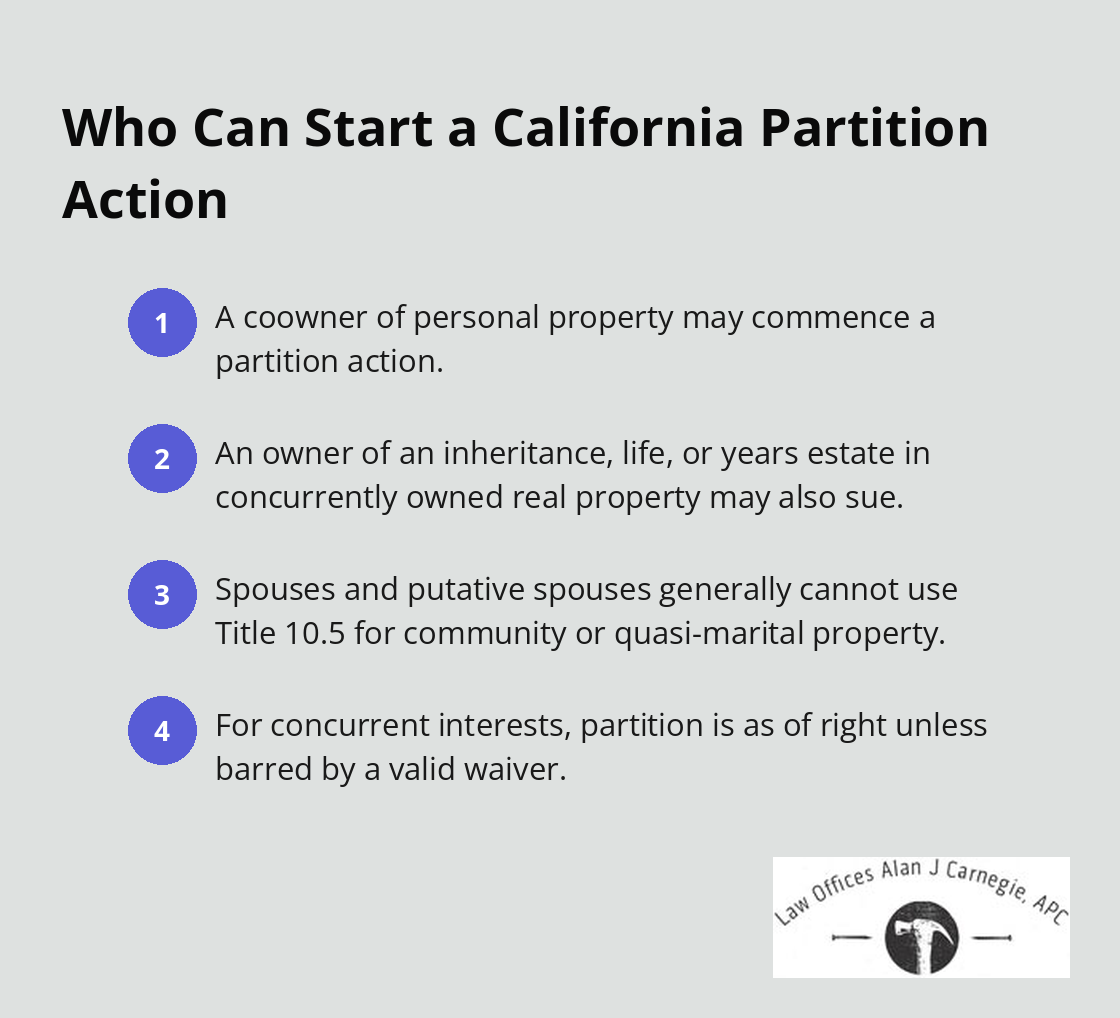
A partition action is a lawsuit that asks the court to end concurrent ownership of property. Title 10.5 of the Code of Civil Procedure, beginning at section 872.010, sets out the rules. Under section 872.210(a), a partition action may be commenced by a coowner of personal property, or by an owner of an estate of inheritance, an estate for life, or an estate for years in real property where that property or estate is owned by several persons concurrently or in successive estates. In practical terms, tenants in common and joint tenants often use this process when one owner wants out and the others will not buy them out or agree to sell.
Who May File and Who May Not
Section 872.210(a) opens the courthouse door to co-owners and to certain successive estate holders. Section 872.210(b) then draws a hard line for married and putative spouses: an action between spouses or putative spouses for partition of their community or quasi-community property, or their quasi-marital interest in property, may not be commenced or maintained under Title 10.5. Those disputes belong in family court, not in a general partition case. For unmarried co-owners, siblings, investors, and other concurrent owners in Calabasas and the surrounding Los Angeles County cities, the partition statutes remain available.
What the Complaint Must Include
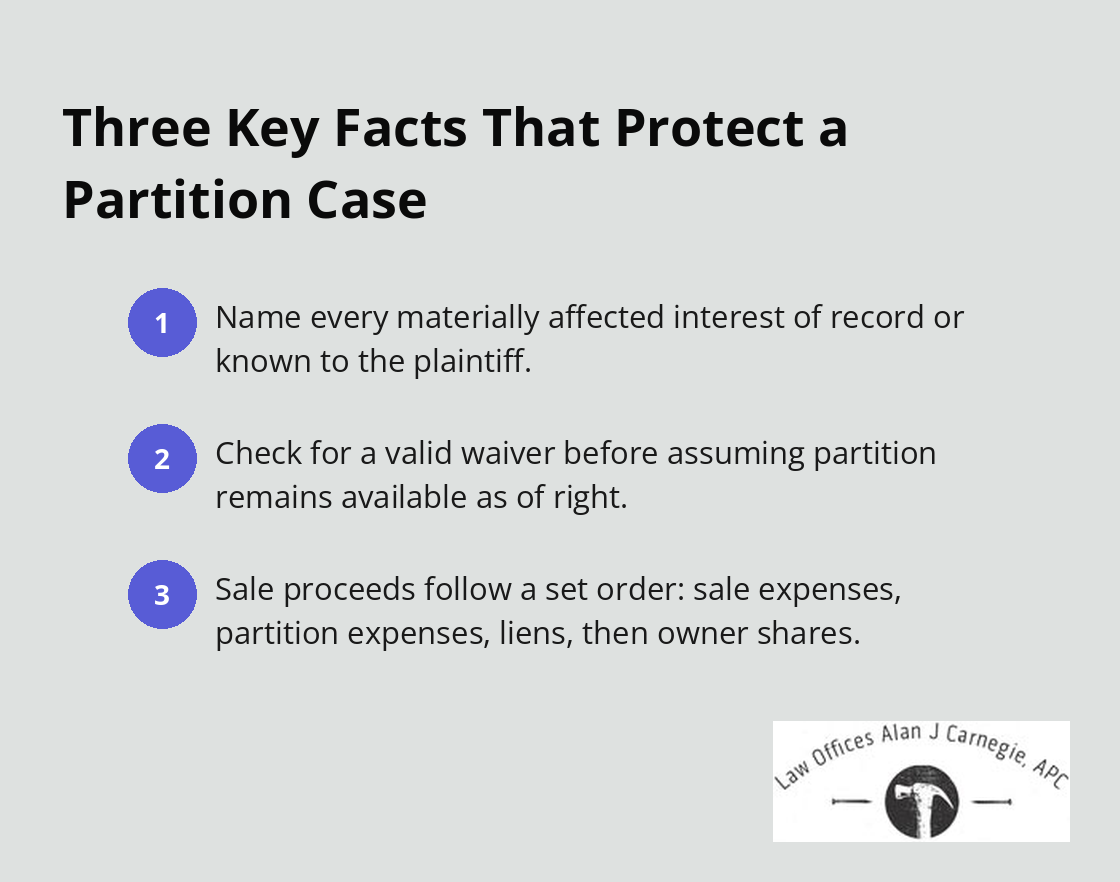
Section 872.230 tells the plaintiff exactly what belongs in the complaint. For real property, the description must include both the legal description and the street address or common designation, if any. The complaint must also set out all interests the plaintiff has or claims, all interests of record or actually known to the plaintiff that other people have or claim and that the plaintiff reasonably believes will be materially affected, the estate as to which partition is sought with a prayer for partition, and, where the plaintiff seeks sale, an allegation of the facts justifying that relief in ordinary and concise language. Leaving out known claimants or filing a vague description invites delay and demurrers that push the case sideways.
Partition as of Right for Concurrent Interests
At trial, section 872.710(a) requires the court to decide whether the plaintiff has the right to partition. For concurrent interests, section 872.710(b) says partition shall be as of right unless barred by a valid waiver, except as provided in section 872.730. That “as of right” language is the heart of many Calabasas partition cases: one co-owner generally does not need the others’ permission to ask the court to end the co-ownership, unless they already waived that right in a binding agreement. Successive estates are different. Section 872.710(c) allows partition of successive estates only when it is in the best interest of all the parties, and it lists equitable factors the court must weigh.
How California Courts Actually Divide or Sell the Property
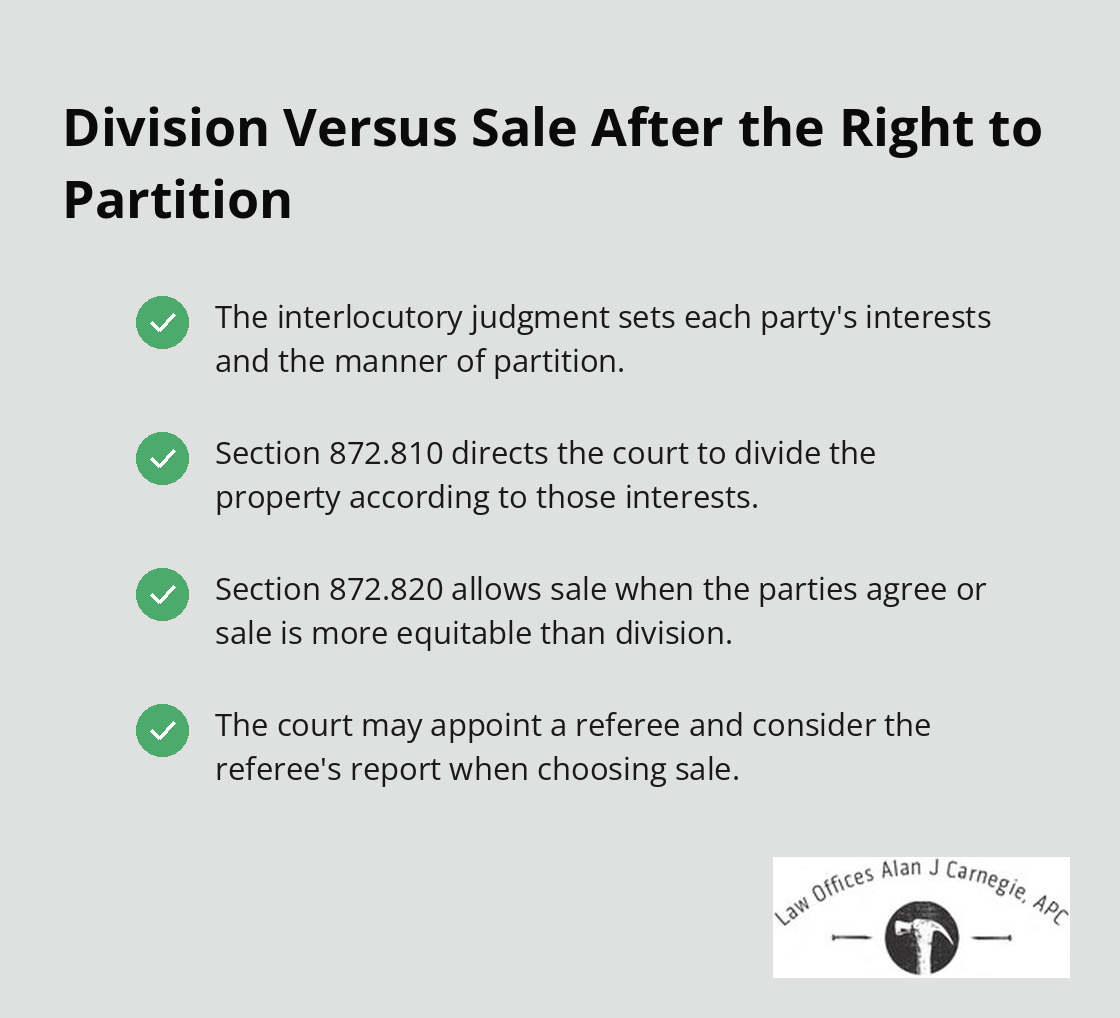
Winning the right to partition is only the first half of the case. The court still has to decide how to carry it out. Section 872.720(a) says that if the plaintiff is entitled to partition, the court shall make an interlocutory judgment that determines the interests of the parties and orders the partition of the property and, unless it is to be later determined, the manner of partition. That interlocutory judgment is the roadmap for everything that follows.
Division in Kind Comes First on the Statute
Section 872.810 directs the court to order that the property be divided among the parties in accordance with their interests as determined in the interlocutory judgment. Physical division, sometimes called partition in kind, keeps each owner with a share of the land itself. It works best when the parcel can be split fairly, access and utilities can be preserved, and zoning or hillside topography in places like Calabasas does not make equal lots impractical. Many residential lots cannot be cut cleanly without creating unbuildable remnants, which is why sale becomes the more common path in practice even though division appears first in the statute.
When the Court Orders a Sale Instead
Section 872.820 overrides section 872.810 in two situations. First, the parties may agree to a sale and division of the proceeds, by their pleadings or otherwise. Second, the court may determine that, under the circumstances, sale and division of the proceeds would be more equitable than division of the property. For that determination, the court may appoint a referee and take the referee’s report into account. Hillsides, shared driveways, small lots, and mixed residential-commercial improvements often push Calabasas cases into this second path.
Referees, Sale Procedures, and How Proceeds Are Applied
Section 873.010(a) requires the court to appoint a referee to divide or sell the property as ordered. The court may also decide whether a bond is necessary, instruct the referee, fix reasonable compensation, settle accounts, remove a referee, and appoint a new one. When the order is a sale, section 873.510 says the referee shall sell the property in the manner and following the procedures in Chapter 6 of Title 10.5. After the sale, section 873.820 applies the proceeds in a fixed order: expenses of sale, other partition expenses allowed by the court, in whole or in part, or amounts set aside to secure partition expenses allowed later, liens on the property in their order of priority except liens that are to remain under the terms of sale, and then distribution of the residue among the parties in proportion to their shares as determined by the court.
What Commonly Derails Partition Actions in Calabasas, California
Partition is often described as a right, but the case still fails or stalls when the ownership record is incomplete, a waiver is ignored, or the parties treat settlement talks as a substitute for meeting statutory requirements. The problems below show up repeatedly in Los Angeles County co-ownership disputes.
Missing Claimants and Incomplete Title Facts
Section 872.230 requires the complaint to identify interests of record and interests actually known to the plaintiff that will be materially affected. Skipping a recorded trust deed holder, a previously unnoticed heir, or a person with a claimed life estate can force amended pleadings and postpone the interlocutory judgment. Before filing, a careful title review and ownership timeline protect the schedule of the case more than any later argument about fairness.
Ignoring a Valid Waiver or the Spousal Bar
Section 872.710(b) preserves partition as of right for concurrent interests unless barred by a valid waiver. Co-owners sometimes signed buy-sell terms, partnership agreements, or deed restrictions that already limit that right. Separately, section 872.210(b) blocks Title 10.5 actions between spouses or putative spouses over community, quasi-community, or quasi-marital interests. Filing the wrong kind of case wastes months and can create issue-preclusion problems in the forum that should have heard the dispute.
Assuming Sale Always Comes First, or Always Comes Last
Owners sometimes assume the court will automatically sell every residential property, or that the court must always attempt a physical split no matter how impractical the lot. The statute is more precise. Section 872.810 starts with division according to the parties’ interests, and section 872.820 authorizes sale when the parties agree or when sale is more equitable under the circumstances, with a referee’s report available to inform that decision. Presenting clear evidence on access, topography, zoning, improvement layout, and the parties’ relative interests helps the court choose the manner of partition that the interlocutory judgment will actually carry out.
Final Thoughts
Partition actions in Calabasas, California rest on a clear statutory framework. Code of Civil Procedure section 872.210 identifies who may sue, section 872.710 treats concurrent-interest partition as a right unless waived, section 872.720 requires an interlocutory judgment that sets interests and the manner of partition, and sections 872.810 through 873.820 govern division, sale, referees, and the order for applying sale proceeds. The strength of a case still depends on accurate ownership facts, a complete set of interested parties, and a practical plan for either dividing the land or selling it.
If you share property in Calabasas or elsewhere in Los Angeles County and co-ownership has become unworkable, contact The Law Offices of Alan J. Carnegies, APC to discuss your options. We will review the title, explain how Title 10.5 may apply to your situation, and help you take a practical next step.