

A preliminary injunction in Calabasas, California can be the difference between protecting your business or property and watching irreversible harm unfold while a lawsuit moves slowly toward trial. When a former partner is diverting customers, a neighbor is building on land you believe is yours, or a contractor is about to remove materials from a project, waiting months for a final judgment may not be a real option. California law gives courts the power to order a party to stop certain conduct while the case is pending, but that power comes with strict procedural rules and demanding proof. Understanding how these orders work helps you decide quickly whether to seek one, or how to respond if one is sought against you.
At the Law Offices of Alan J. Carnegie, APC, we represent business owners, property owners, and builders throughout Los Angeles County in disputes where timing matters, so you can move forward with confidence. This guide explains what a preliminary injunction actually is, how the request moves through the court, and the mistakes that can derail an otherwise strong application.
What a Preliminary Injunction Actually Does
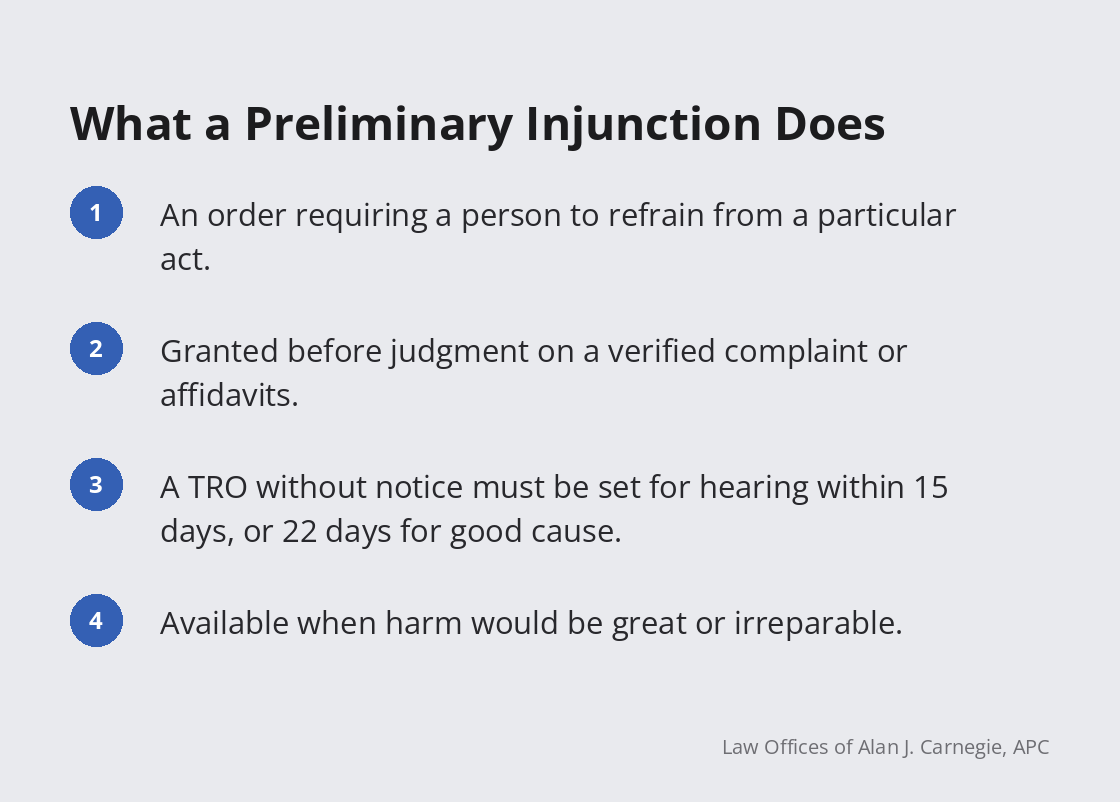
California’s Code of Civil Procedure defines an injunction in simple terms. Under Section 525, an injunction is a writ or order requiring a person to refrain from a particular act. A preliminary injunction is the temporary version of that order. Section 527 provides that a preliminary injunction may be granted at any time before judgment, based on a verified complaint or affidavits that show satisfactorily that sufficient grounds exist. In other words, it is a court order that holds things in place, or stops specific conduct, while the parties litigate the underlying dispute.
It is important to understand that a preliminary injunction is not a final ruling on who wins the case. It is a provisional remedy that the court uses to keep a lawsuit from becoming meaningless before it can be decided. The case still proceeds through pleadings, discovery, and, if necessary, trial, and the court can later enter a permanent injunction, deny one, or resolve the matter in some other way.
The Difference Between a TRO and a Preliminary Injunction
People often use the terms interchangeably, but they are different tools. A temporary restraining order, or TRO, is a short-term order designed to preserve the situation until the court can hold a full hearing on a preliminary injunction. Section 527 sets a tight schedule when a TRO is issued without notice to the other side. The matter must be set for a hearing on an order to show cause why a preliminary injunction should not be granted on the earliest day the court’s business allows, and no later than 15 days, or 22 days if good cause appears, from the date the TRO is issued. The preliminary injunction, if granted at that hearing, can then remain in place while the case continues.
Situations Where California Law Allows an Injunction
Section 526 lists the situations in which an injunction may be granted. They include cases where the commission or continuance of some act during the litigation would produce waste or great or irreparable injury to a party, where a party is doing or threatening an act that would violate another party’s rights and tend to make the judgment ineffectual, where monetary compensation would not afford adequate relief, and where it would be extremely difficult to determine what compensation would be adequate. Section 526 also allows an injunction where restraint is necessary to prevent a multiplicity of judicial proceedings, or where the obligation arises from a trust.
Common Business and Property Disputes Involving Injunctions
In practice, injunction requests come up frequently in the kinds of matters we handle across Calabasas and the rest of Los Angeles County. Business owners may seek to stop the misuse of confidential information, interference with customer relationships, or a partner’s unauthorized use of company assets. Property owners may ask a court to halt construction that encroaches on their land, the removal of trees or structures that are the subject of the dispute, or interference with access to their property. Builders and owners on construction projects sometimes seek orders preserving the status quo on a jobsite while contract disputes are resolved. In each situation, the key question is whether the harm is the kind that money alone cannot fix after the fact.
How the Preliminary Injunction Process Works in Los Angeles County
Because injunctions are powerful, California courts require careful procedure. The California Rules of Court and the Code of Civil Procedure lay out how the request is made, how the other side receives notice, and what happens after the court rules. Following these steps precisely is often just as important as the strength of the underlying claim.
Filing the Complaint and Supporting Declarations
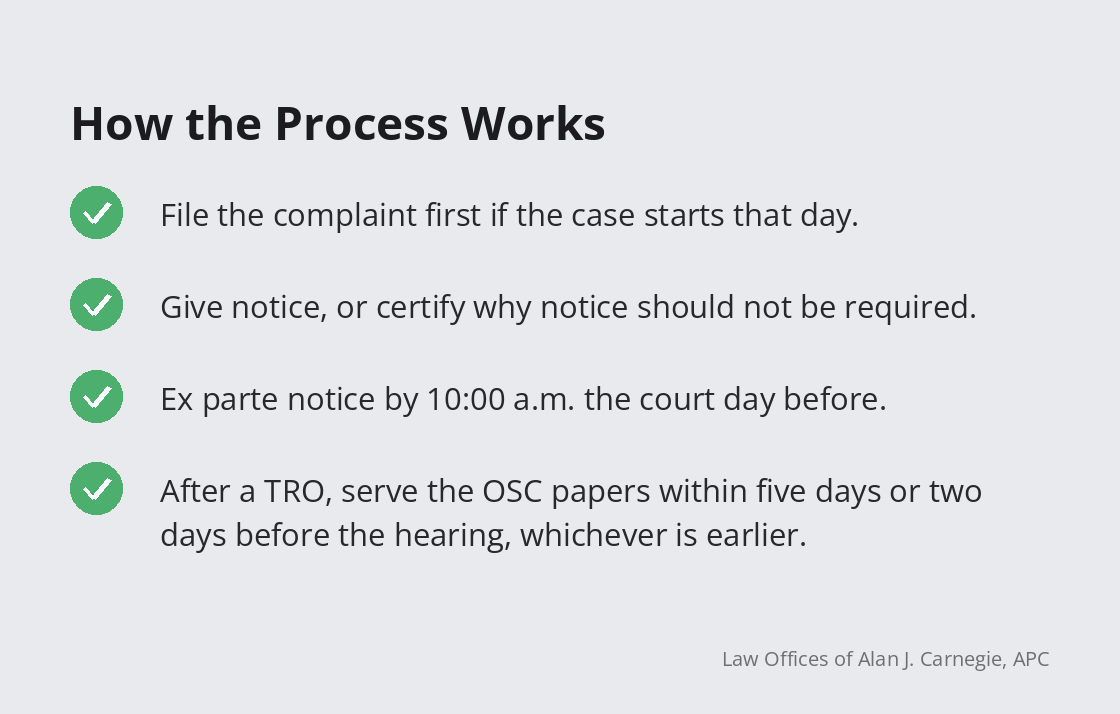
The request must rest on evidence. Section 527 allows a preliminary injunction based on a verified complaint or on affidavits, and the court must be satisfied from those papers that sufficient grounds exist. California Rules of Court, rule 3.1150 adds practical requirements. If the lawsuit is started on the same day the TRO or order to show cause is sought, the complaint must be filed first, and the moving party must provide a file-stamped copy to the judge hearing the application. The application must also state whether any previous application for similar relief has been made and, if so, what happened. Strong declarations from people with personal knowledge, supported by documents, photographs, and correspondence, are usually the backbone of a persuasive request.
Giving Notice to the Other Side
Notice is central to the process. Section 527 provides that no preliminary injunction may be granted without notice to the opposing party. A TRO may be granted without notice only if the facts show that great or irreparable injury will result before the matter can be heard on notice, and the applicant or attorney certifies under oath either that the other side was informed of when and where the application would be made, that a good faith attempt to inform them failed, or specific reasons why notice should not be required. When a TRO is sought on an ex parte basis, rule 3.1203 of the California Rules of Court requires notice to all parties no later than 10:00 a.m. the court day before the ex parte appearance, absent a showing of exceptional circumstances that justify shorter notice.
The Order to Show Cause Hearing
Rule 3.1150 explains that a party requesting a preliminary injunction may proceed either by a noticed motion or by obtaining and serving an order to show cause, and an order to show cause must be used when a TRO is sought. When a TRO has been issued without notice, Section 527 requires the party who obtained it to serve the complaint, the order to show cause, the supporting affidavits, and points and authorities within five days of issuance or two days before the hearing, whichever is earlier. The opposing party is entitled to one continuance of not less than 15 days, or a shorter period if that party requests it, to prepare a response, and the TRO stays in effect until the continued hearing. If the party who obtained the TRO is not ready to proceed at the first hearing, or failed to complete the required service, the court must dissolve the TRO.
What Derails a Preliminary Injunction Request
Even a party with a sympathetic story can lose an injunction request because of avoidable missteps. Courts look closely at the evidence, the timing, and the scope of what is being requested. Knowing where applications commonly go wrong helps you build a stronger request, or identify weaknesses when you are the party being restrained.
Waiting Too Long to Act
The entire premise of a preliminary injunction is urgency. If you claim that conduct is causing great or irreparable injury but waited a long time after learning of it before going to court, the other side will argue that the harm cannot be as serious as you say. Acting promptly, documenting the harm as it occurs, and contacting counsel early gives you the best chance of presenting a credible, time-sensitive request. Delay can also allow the situation to change in ways that make an order less useful, such as a project being completed or assets being moved.
Asking for Relief the Law Does Not Allow
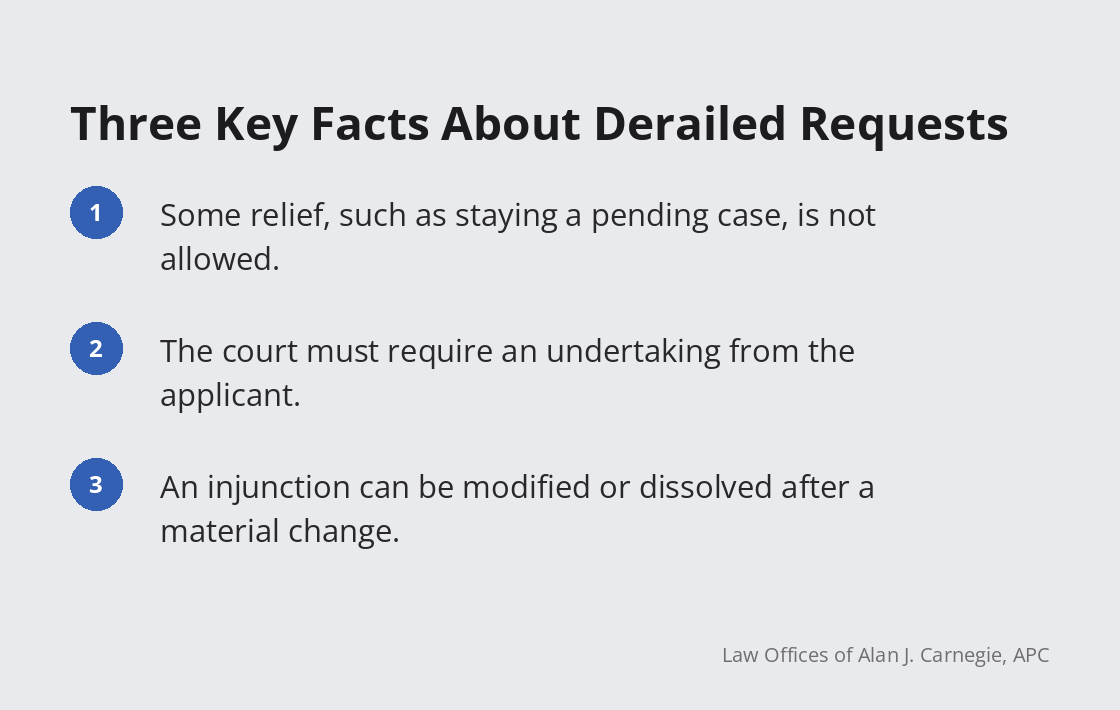
Section 526 also lists situations in which an injunction cannot be granted. These include staying a judicial proceeding that was pending when the action began, unless necessary to prevent a multiplicity of proceedings, staying proceedings in a court of the United States, and preventing the breach of a contract whose performance would not be specifically enforced, subject to a narrow exception for certain written personal services contracts. An injunction also cannot be used to prevent the execution of a public statute by officers of the law for the public benefit. Requests that ignore these limits, or that are drafted so broadly that they sweep in lawful conduct, are vulnerable to denial. Rule 3.1150 also requires the order to show cause to describe the injunction sought and the TRO to describe the activities to be restrained, so precise drafting matters.
Overlooking the Undertaking and Later Changes
Winning the hearing is not the final step. Section 529 provides that, on granting an injunction, the court must require an undertaking from the applicant, which protects the restrained party if the court finally decides the applicant was not entitled to the injunction. The person enjoined may object to the undertaking within five days after service of the injunction, and if the court finds it insufficient and a sufficient undertaking is not filed in time, the injunction must be dissolved. Rule 3.1150 also requires the proposed order and the undertaking to be presented to the judge within one court day after the application is granted, or within the time ordered. Injunctions are not permanent fixtures either. Under Section 533, the court may modify or dissolve an injunction on a showing of a material change in the facts, a change in the law, or that the ends of justice would be served. Under Section 904.1, an order granting or dissolving an injunction, or refusing to grant or dissolve one, may be appealed in cases other than limited civil cases.
Final Thoughts
A preliminary injunction can protect your business, your property, or your project from harm that cannot be undone later. California law allows these orders in defined situations, requires notice and solid evidence, and sets short deadlines once a temporary restraining order is in place. The procedure is detailed, and small errors in timing, service, or drafting can leave you without the relief you need.
Whether you need to stop harmful conduct quickly or you have been served with papers asking a court to restrain you, acting early and carefully makes a meaningful difference. A clear plan built on strong declarations and precise requests gives the court what it needs to rule in your favor.
If you are facing an urgent business or real estate dispute in Calabasas or anywhere in Los Angeles County, contact the Law Offices of Alan J. Carnegie, APC to speak with our litigation team. We will review your situation, explain whether an injunction makes sense, and help you take the next step with confidence.