
Construction projects in Southern California face unique challenges. Payment disputes, defects, and lien claims happen regularly across Los Angeles County, and they can derail timelines and budgets fast.
At The Law Offices of Alan J. Carnegies, APC, we help builders and owners navigate these conflicts before they spiral. This guide covers what you need to know about Southern California construction disputes, how to prevent them, and when to get legal help.
What Disputes Actually Happen on Southern California Construction Sites
Defective Work Costs Time and Money
Construction defects represent the most common conflict we see on Southern California projects. Builders cut corners on materials, skip quality inspections, or hire subcontractors without proper vetting. Owners then discover cracked foundations, water intrusion, electrical code violations, or structural problems months or years after completion. The California Department of Consumer Affairs reports that construction defect claims represent a significant portion of residential construction litigation in the state. These disputes are expensive because fixing defects often requires demolition and reconstruction, not just surface repairs.
Payment Disputes and Mechanics Liens Create Cascading Problems
Payment disputes rank equally high in frequency on Los Angeles County projects. Contractors don’t receive payment on time, owners withhold funds claiming incomplete work, and disputes over change orders spiral into litigation. Mechanics liens complicate payment issues further-subcontractors and material suppliers file liens against properties when they don’t receive payment from the general contractor, even if the owner paid the contractor. A mechanics lien clouds property title and prevents refinancing or sale until resolved.
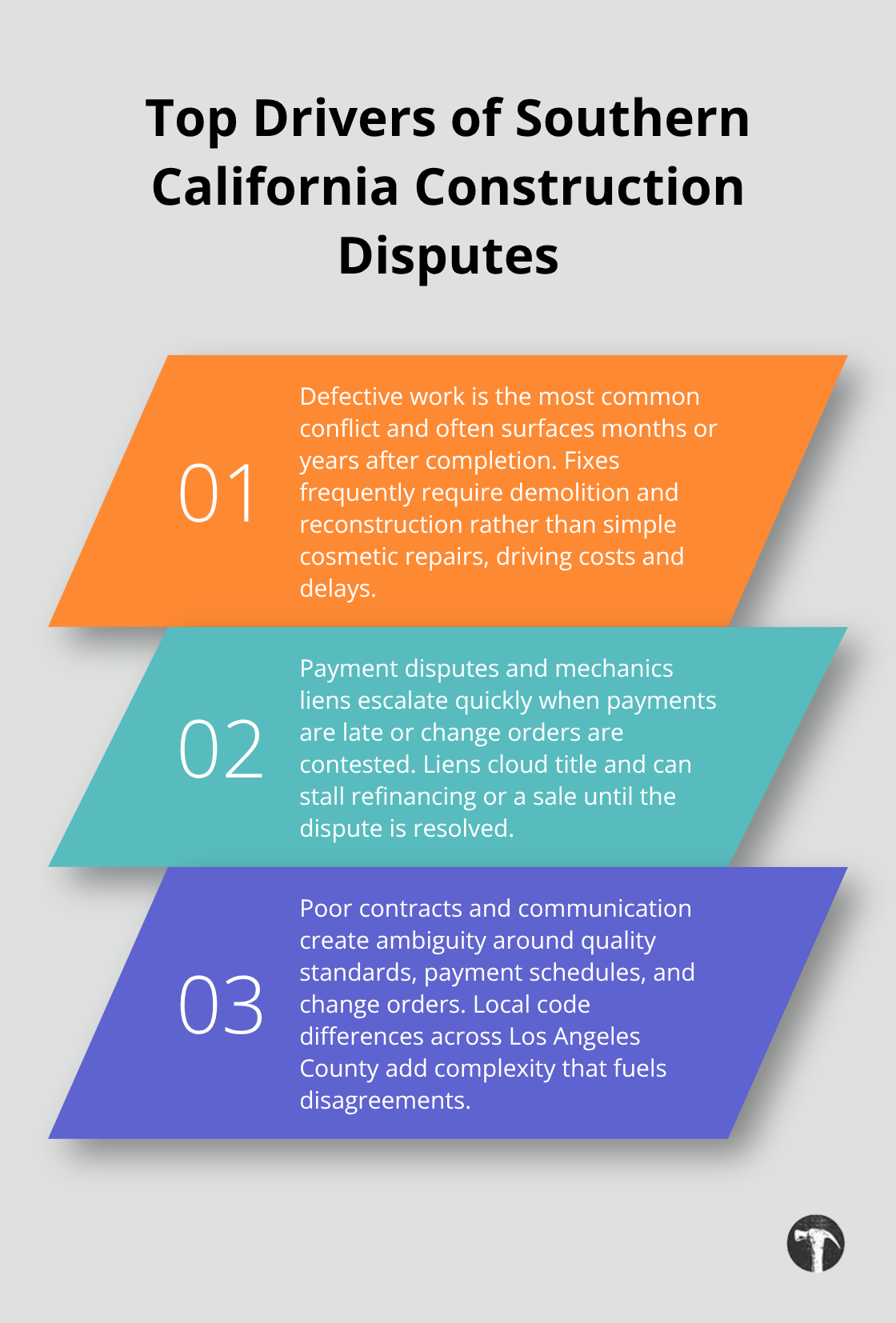
This three-part problem (defects, payment delays, and liens) destroys project relationships and timelines.
Poor Contracts and Communication Breakdowns Drive Most Conflicts
Most construction disputes stem from poor initial agreements or communication failures. Vague contracts that don’t specify quality standards, payment schedules, or change order procedures invite conflict. Los Angeles County projects face additional complexity because local building codes, permit requirements, and inspection protocols vary significantly from city to city. A contractor licensed in one jurisdiction may not understand Calabasas requirements or Santa Monica standards. The strongest defense against these conflicts is starting correctly-with clear contracts, documented communication, and regular inspections from day one.
When Legal Guidance Prevents Escalation
Small disagreements transform into six-figure litigation battles when parties ignore early warning signs. Getting legal guidance at the first sign of trouble stops disputes from spiraling out of control. The cost of addressing a payment dispute or defect claim early is minimal compared to the expense of full litigation. Construction projects move fast, and legal problems move faster-waiting to act only increases your exposure and costs.
What Rules Govern Construction Projects in Southern California
California’s Strict Timeline for Construction Defect Claims
California law treats construction disputes differently than other contract conflicts. The state imposes strict timelines for filing claims, mandatory notice requirements before litigation, and specific rules about who can file mechanics liens. The California Code of Civil Procedure Section 337.15 sets a four-year statute of limitations for construction defect claims measured from substantial completion of the work, not from when the defect appears. A homeowner who discovers water intrusion five years after project completion cannot sue for defects-the claim is time-barred regardless of merit. Contractors and owners who miss this deadline lose their right to recover damages entirely, making early action non-negotiable when problems surface.
Mechanics Liens Operate on Tight Deadlines
Mechanics liens operate under California’s specific statutory framework, and understanding the timeline protects both contractors seeking payment and owners protecting property. A subcontractor or material supplier must file a preliminary notice within 20 days of first furnishing labor or materials to preserve lien rights. The actual mechanics lien must be filed within 90 days of the last date work was performed or materials were supplied.
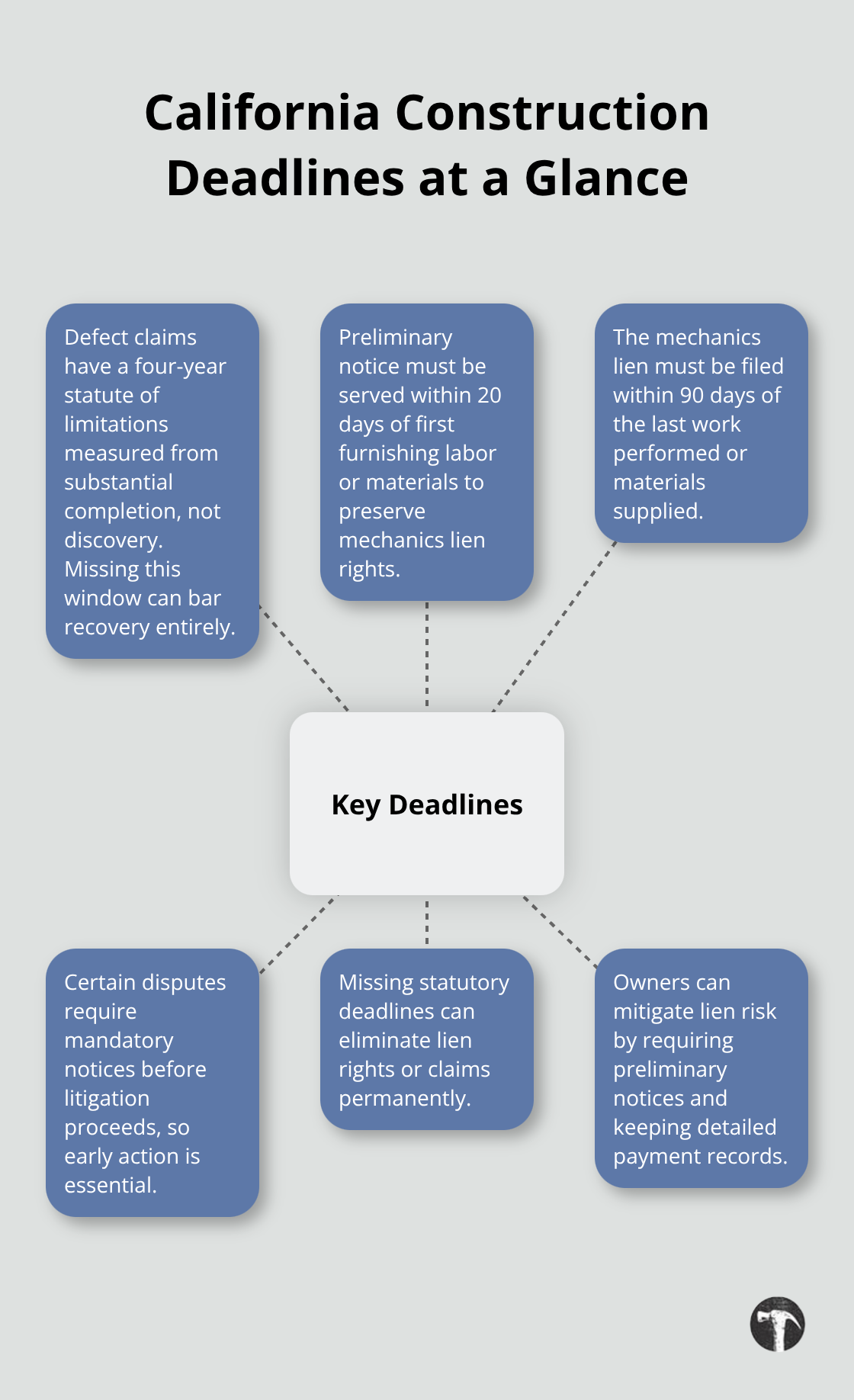
Missing either deadline eliminates lien rights permanently. Property owners can prevent liens by requiring preliminary notice compliance and maintaining detailed payment records showing what was paid to whom and when.
Los Angeles County Adds Local Complexity
Los Angeles County adds another layer of complexity because individual cities within the county enforce their own building codes and permit requirements. Calabasas enforces different electrical standards than Santa Monica, and inspection protocols vary significantly across jurisdictions. Los Angeles County projects require compliance with local building permits, inspections at specific construction phases, and adherence to city-specific codes-violations create liability exposure for both builders and owners.
Early Legal Guidance Protects Your Position
Getting legal guidance before signing contracts or as soon as payment issues emerge protects your position under these strict timelines and prevents claims from becoming uncollectible or unenforceable. We at The Law Offices of Alan J. Carnegies, APC represent property owners, contractors, and other parties in construction disputes, including mechanic’s liens, construction defects, and construction contract disputes. Understanding these rules matters less than acting on them quickly-the window to preserve your rights closes fast in Southern California construction disputes.
Stop Disputes Before They Start
Write Contracts That Leave No Room for Disagreement
Start with a contract that specifies what gets built, how much it costs, and what happens when problems arise. Most Southern California construction disputes trace back to vague agreements that leave room for disagreement. Your contract should define quality standards with reference to specific building codes, establish a payment schedule tied to project milestones, outline the change order process with cost and timeline impacts, and identify who handles inspections and approvals. Los Angeles County projects demand extra clarity because local codes vary significantly across jurisdictions. A Calabasas project must reference Calabasas municipal code requirements, not generic California standards.
Include a dispute resolution clause that specifies mediation or arbitration before litigation, which saves both parties money and time. This approach prevents costly court battles and keeps projects moving forward. Construction defect claims in California have strict timelines, and written documentation proves what was agreed to and when work was completed.
Document Everything in Writing From Day One
Text messages and phone calls create confusion and disputes later. Write down scope changes, approval requests, and payment schedules before work proceeds. Email confirmations, signed change orders, and written approvals create an audit trail that protects both builders and owners if disputes emerge later. This documentation becomes critical evidence if claims arise, and it prevents the “he said, she said” conflicts that destroy project relationships.
Schedule Inspections at Critical Construction Phases
Regular inspections during construction catch defects early when fixes are inexpensive rather than after completion when reconstruction becomes necessary. Schedule inspections at specific phases: foundation, framing, electrical rough-in, plumbing rough-in, and before final sign-off. Assign one person responsible for inspections and require written reports documenting what passed and what failed.
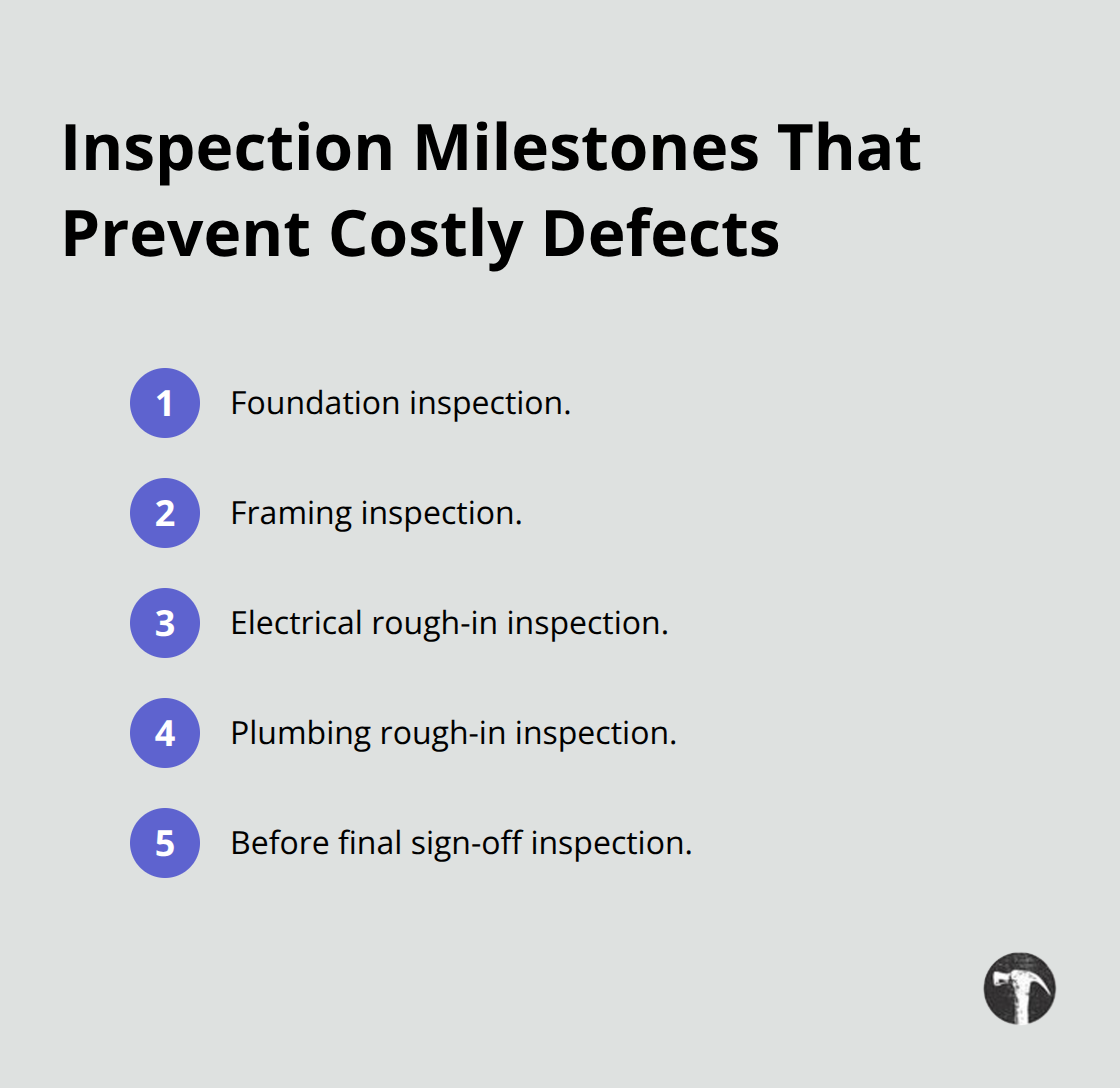
This creates an audit trail that protects both builders and owners if disputes emerge later.
Address Problems the Moment They Surface
Payment or quality issues demand immediate attention, not delayed response. The moment a contractor misses a payment deadline or an inspection reveals defects, contact the responsible party in writing and request correction within a specific timeframe. Early intervention stops small problems from becoming major disputes that halt construction and trigger litigation. Waiting allows problems to compound and costs to multiply, making resolution far more expensive and complicated.
Final Thoughts
Southern California construction disputes follow predictable patterns, and most of them are preventable. Projects that run smoothly share three things in common: clear written contracts that specify exactly what gets built and how much it costs, documented communication that creates an audit trail for every decision, and regular inspections that catch problems before they become expensive. Builders and owners who invest time in these fundamentals avoid the payment disputes, defect claims, and mechanics liens that derail timelines and drain budgets.
The legal framework governing construction in California operates on tight deadlines that punish delay. A four-year statute of limitations sounds generous until a defect surfaces five years after completion and becomes uncollectible. Mechanics liens must be filed within 90 days or the right to payment disappears entirely. Los Angeles County adds complexity because local codes vary significantly across jurisdictions, and what works in one city may violate requirements in another.
The moment a payment issue emerges, a quality problem surfaces, or a contract disagreement arises, contact a construction law professional. Early intervention costs far less than waiting until disputes become entrenched and positions harden. We at The Law Offices of Alan J. Carnegies, APC represent property owners, contractors, and other parties in Southern California construction disputes throughout Los Angeles County, including mechanic’s liens, construction defects, and construction contract disputes.