


Minority shareholders often face unfair treatment within their own companies. Freezeouts, withheld dividends, and exclusion from decisions can leave you powerless while others profit.
Shareholder oppression claims exist to protect your rights. We at The Law Offices of Alan J. Carnegies, APC serve all of Los Angeles County from our Calabasas base, and we’ve helped countless minority shareholders fight back against these violations.
What Counts as Shareholder Oppression
Shareholder oppression occurs when majority owners weaponize their control to benefit themselves while deliberately harming minority shareholders. This isn’t about disagreement or poor business decisions-it’s about systematic conduct designed to strip minority shareholders of their rights and financial returns. California courts have consistently held that oppression takes place when controlling shareholders act contrary to the company’s best interests and violate the reasonable expectations minority shareholders held when they invested. The pattern of conduct matters far more than isolated incidents, so courts examine ongoing behavior to determine whether oppression has occurred.
How Majority Owners Exclude Minorities from Decisions
Controlling shareholders often freeze minorities out of management entirely. They stop inviting minority owners to board meetings, exclude them from strategic decisions, and make major business moves without notice or discussion. In closely held companies with few shareholders, this exclusion proves devastating because no public market exists to sell your shares and no other way allows you to influence company direction. When a minority shareholder who expected a management role suddenly finds themselves completely shut out, courts recognize this as oppressive conduct. California law grants minority shareholders voting rights on directors and major actions, so deliberately preventing them from exercising these rights violates their statutory protections.
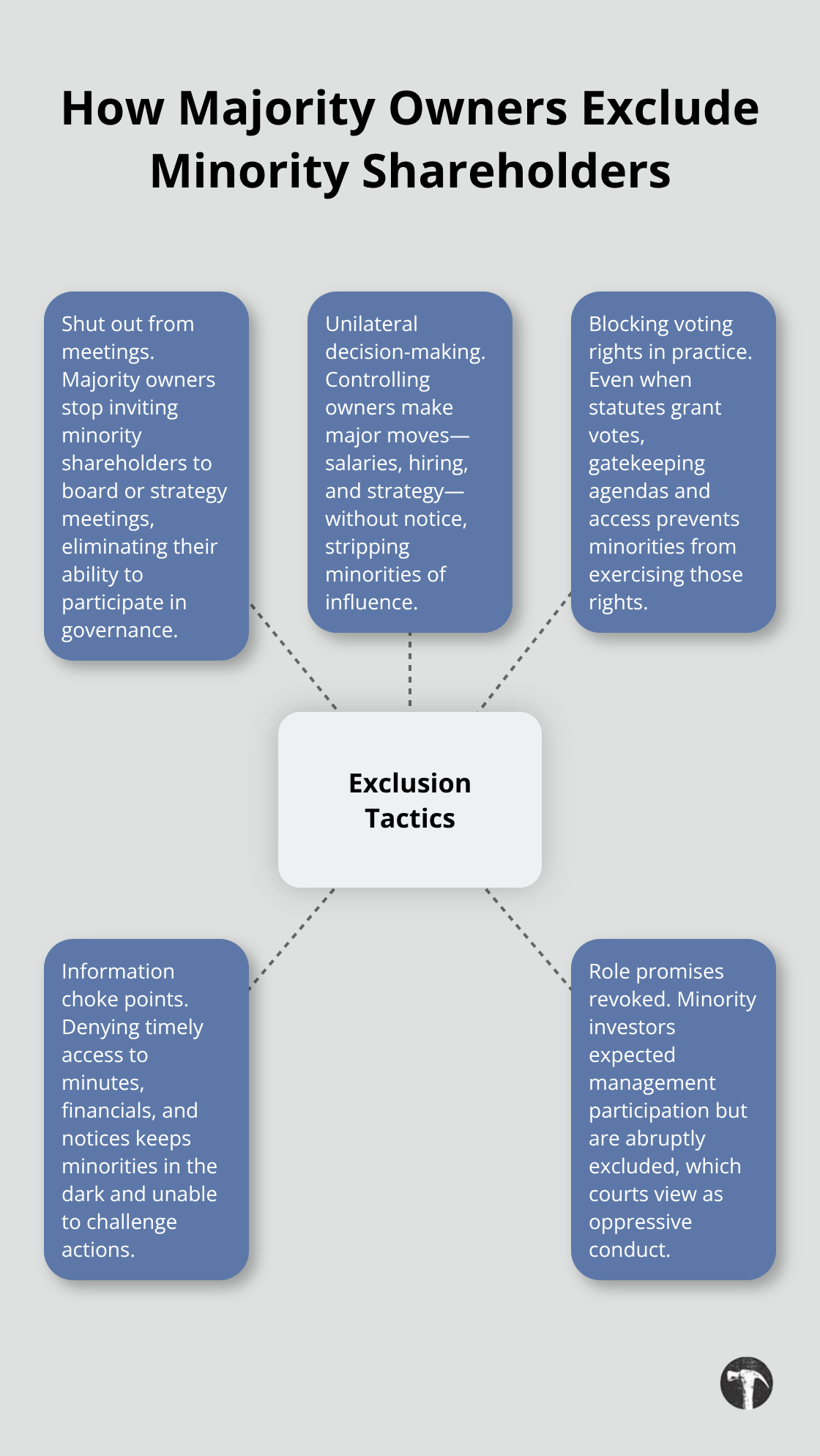
The controlling shareholders use their majority position to make unilateral decisions about salaries, dividends, hiring, and company strategy while the minority watches helplessly from the sidelines.
Withholding Dividends and Distributions
Dividend withholding ranks among the most common oppressive tactics because it directly harms minority shareholders’ financial returns. A company might generate substantial profits and hold significant cash reserves, yet the majority declares no dividends while paying themselves inflated salaries as compensation. This strategy lets majority owners extract value through paychecks while minority shareholders receive nothing on their investment. California courts have found this pattern oppressive when the company has clear capacity to pay dividends and the withholding serves no legitimate business purpose. Minority shareholders reasonably expect to receive returns on their investment in closely held companies, especially when they negotiated their ownership stake with the understanding that dividends would flow during profitable years. The majority’s refusal to declare dividends despite financial capacity directly contradicts those expectations and harms the minority’s financial position.
Misappropriation and Asset Diversion
Controlling shareholders sometimes siphon company assets for personal benefit through self-dealing transactions, excessive related-party contracts, or outright theft. They might have the company overpay for services from companies they own, transfer valuable contracts to themselves at below-market rates, or loan company funds to themselves without repayment terms (all of which drain corporate resources that rightfully belong to all shareholders). Courts view this conduct as oppressive because it enriches the majority at the minority’s direct expense and violates the fiduciary duties majority shareholders owe to minorities. California law requires majority shareholders to act with loyalty and good faith, meaning they cannot use their control to benefit themselves at the company’s expense. When minorities can prove the company overpaid for goods or services, made improper loans, or transferred assets at unfair terms, they have strong grounds for oppression claims.
Understanding the Legal Framework
California Corporations Code sections 1600 and 1601 grant minority shareholders the right to inspect accounting books, records, and minutes of proceedings. Those holding at least 5% of shares have an absolute right to inspect and copy records, while those with 1% may access records with proper documentation. These inspection rights exist precisely because courts recognize that minorities need access to information to detect oppressive conduct. When controlling shareholders deny minorities access to financial statements, board minutes, or decision documents, they compound the oppression by preventing detection and accountability. The legal framework treats information access as foundational to minority protection, which means your ability to monitor the company’s financial health and decisions directly supports your ability to identify and challenge oppressive behavior.
Understanding what oppression looks like helps you recognize when your rights have been violated, but identifying the problem is only the first step. The remedies available to oppressed shareholders-and how courts apply them-determine whether you can actually recover your losses and restore your position.
Legal Remedies Available to Oppressed Shareholders
Forced Buyouts at Fair Value
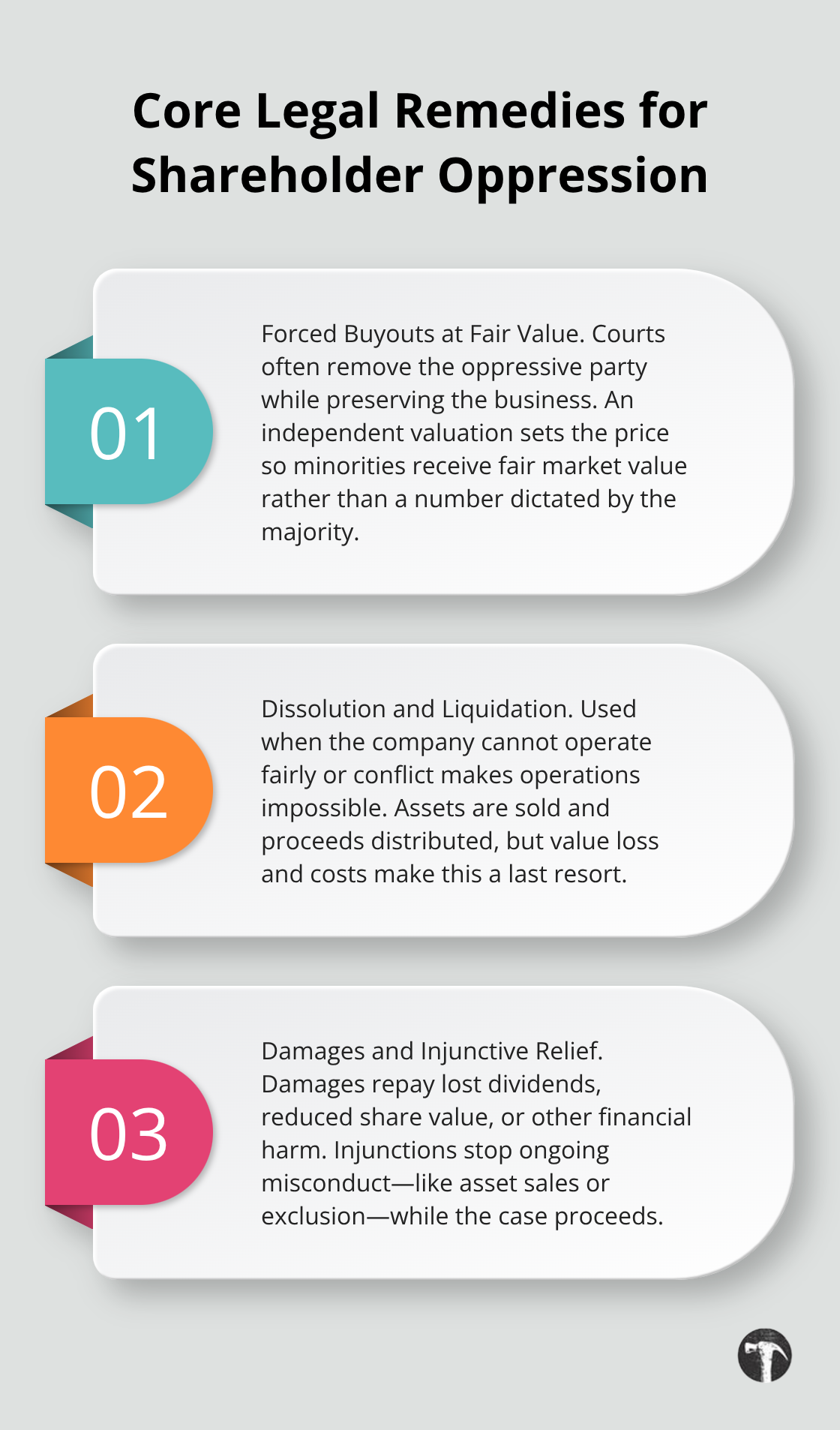
California courts favor forced buyouts as the primary remedy for shareholder oppression because this approach preserves the business while removing the oppressive party. When a court orders a buyout, it compels one party to purchase the other’s shares at a price determined by an independent valuation expert rather than through negotiation between hostile parties. This protection guarantees you fair market value compensation instead of trapping you in a company controlled by someone harming your interests.
Courts appoint independent valuation experts to determine fair value, ensuring the price reflects actual company worth rather than an artificially depressed number the majority might propose. The valuation process examines financial performance, comparable business sales, earnings potential, and asset value, producing an objective price that courts enforce as binding. A buyout remedy typically takes 1–3 years to complete when litigation is necessary, though discovery complexity and party cooperation affect the timeline.
If the majority controls the company, a court-ordered buyout forces them to purchase your shares at fair value, ending the oppression by removing you from the toxic relationship. If you control the company as the oppressive party, a court-ordered buyout forces you to sell your shares at fair value, compensating the minority for the harm you caused.
Dissolution and Liquidation
Dissolution represents the nuclear option courts use when oppression is so severe that the business cannot continue fairly or when shareholder conflict makes ongoing operations impossible. Courts dissolve the company and liquidate its assets, distributing proceeds to shareholders based on their ownership percentages after paying creditors and expenses. Dissolution makes sense when the company’s value depends entirely on the oppressive majority’s continued control, or when the parties’ conflict renders the business unworkable.
However, dissolution often destroys business value because forced sales rarely fetch market prices and liquidation costs consume additional assets. Courts therefore treat dissolution as a remedy of last resort, ordering it only when buyouts or other solutions cannot work.
Damages and Injunctive Relief
Damages awards compensate you for financial losses caused by oppressive conduct, including lost dividends, diminished share value, or personal losses if you were wrongfully terminated as an employee. Courts calculate damages by examining how much money the oppression cost you, then ordering the responsible parties to pay that amount.
Injunctive relief stops ongoing oppressive conduct in real time, preventing the majority from taking further harmful actions while the case proceeds. A court might enjoin the majority from declaring additional dividends to themselves, selling company assets, or excluding minorities from meetings until the oppression case resolves. This remedy protects your interests during litigation rather than waiting years for a final judgment.
Governance Reforms and Custodianship
Courts can impose governance changes or enhanced transparency requirements (bylaws revisions, reporting standards, audits) to prevent recurrence of oppression. These reforms address the structural problems that enabled the oppressive conduct in the first place. In severe cases, courts appoint receivers or custodians to oversee the corporation and protect minority interests, removing day-to-day control from the oppressive majority while the case proceeds.
Understanding which remedy applies to your situation depends on your goals, the company’s circumstances, and the severity of the oppression. The next step involves taking action to protect your rights before the oppression causes irreversible damage to your investment.
How to Protect Your Position Before Oppression Takes Hold
Waiting for oppression to become undeniable before taking action costs you time, money, and leverage. The minority shareholders who recover most successfully are those who document problems early, understand their contractual rights, and monitor company finances continuously.
Build a Documentary Record Immediately
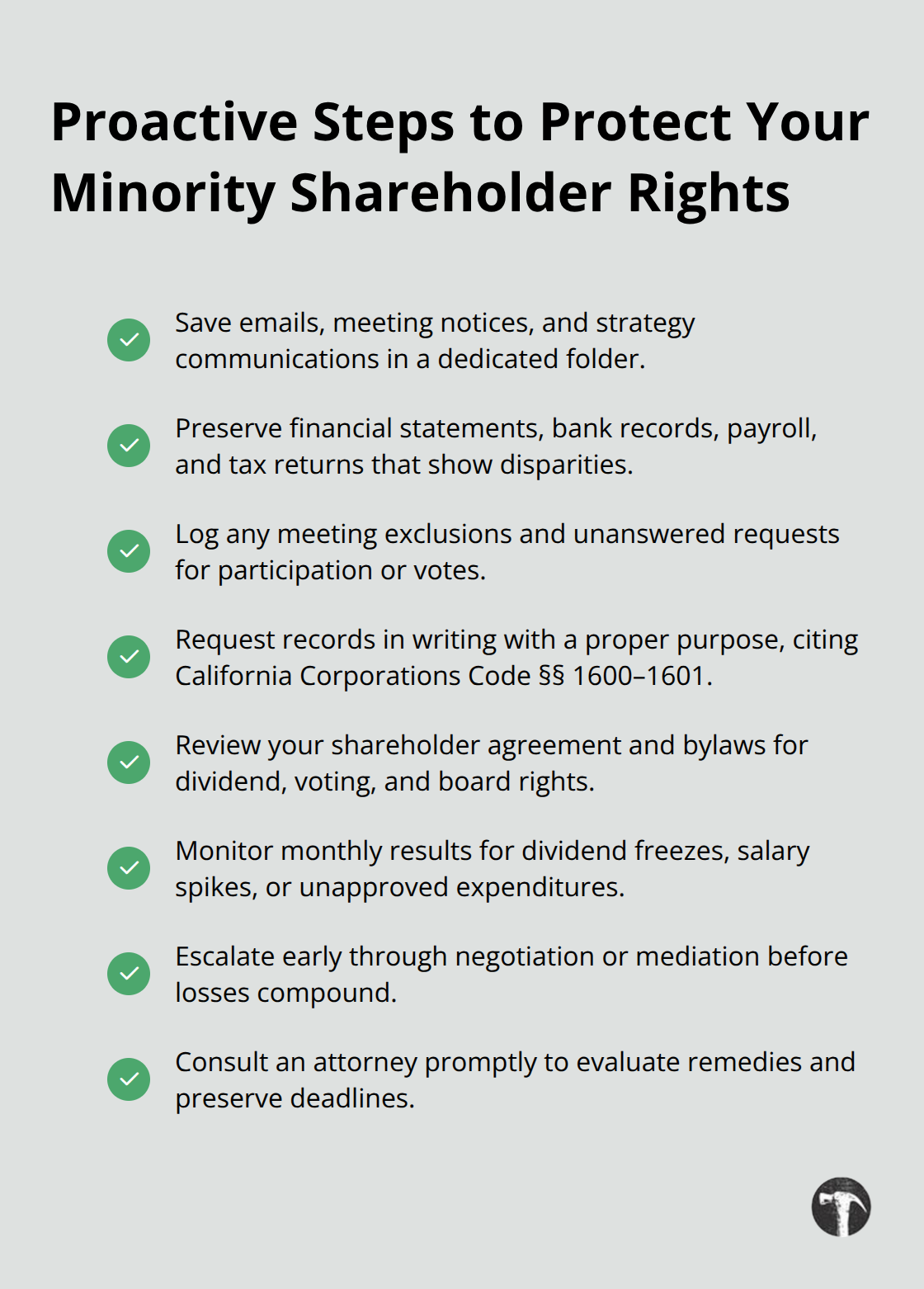
Start protecting yourself immediately by establishing a paper trail of every decision affecting your ownership stake. Save all emails, board meeting notices, dividend announcements, and communications about company strategy. When you need to prove oppression later, these contemporaneous records carry far more weight than your recollection months or years after events occurred.
Courts examining oppression cases rely heavily on documentary evidence because it shows what actually happened rather than what parties remember happening. If the majority excluded you from a critical meeting, that email saying you were not invited becomes powerful evidence. If they withheld dividends despite cash reserves, bank statements and financial statements prove the company had capacity to pay. If they paid themselves inflated salaries while cutting your distributions, payroll records and tax returns demonstrate the disparity. Start a dedicated folder today and add to it consistently, because the moment you suspect problems is the moment your documentation becomes legally valuable.
Review Your Shareholder Agreement and Bylaws
Your shareholder agreement and corporate bylaws contain specific language defining your rights, and most minority shareholders never read these documents carefully enough to understand what protections they actually negotiated. Pull out your shareholder agreement immediately and identify sections addressing dividend policies, voting rights, management participation, information access, and dispute resolution.
Many shareholder agreements include alternative dispute resolution clauses requiring mediation or arbitration before litigation, which can resolve oppression disputes faster and more confidentially than court proceedings. If your agreement specifies that minority shareholders receive board representation or must approve major decisions, you have contractual rights beyond what California law provides. Conversely, if your agreement contains a drag-along provision allowing the majority to force you to sell shares in a merger, understanding this language protects you from surprises. Review whether your agreement grants you inspection rights to financial records and what timeline you must follow to request them.
California Corporations Code sections 1600 and 1601 provide baseline inspection rights, but your agreement might expand or restrict these rights. Once you understand what your documents say, you can enforce those provisions before oppression becomes severe. Request financial statements and board minutes in writing with a proper purpose statement, creating a dated record of your request and the company’s response. If they deny your request, that denial itself becomes evidence of oppression and strengthens your legal position.
Monitor Financial Performance and Red Flags
Monitor your company’s financial statements and performance metrics monthly rather than annually, because early detection of suspicious patterns gives you time to respond. Compare actual financial results against your reasonable expectations when you invested, and flag significant deviations for investigation.
If dividends suddenly stop despite consistent profitability, if management salaries spike without business justification, or if major expenditures occur without board approval, these red flags warrant immediate attention. Request detailed explanations in writing and preserve the company’s responses. When you spot these warning signs early, you can address them through negotiation, mediation, or legal action before the oppression causes irreversible damage to your investment. The Law Offices of Alan J. Carnegies, APC serves all of Los Angeles County from our Calabasas location and can review your specific situation to identify warning signs before they become irreversible oppression.
Final Thoughts
Minority shareholders in California possess meaningful legal protections, but only if you recognize oppression when it occurs and take action before your investment becomes worthless. The conduct outlined throughout this article-exclusion from decisions, withheld dividends, and asset misappropriation-represents systematic harm that courts take seriously. California law grants you inspection rights, fiduciary protections, and multiple remedies ranging from forced buyouts to damages awards, yet these protections only help you if you use them.
The most important step is documenting problems immediately by saving emails, financial statements, and communications showing what happened and when. Review your shareholder agreement carefully because it may contain dispute resolution clauses or governance rights you’ve overlooked, and monitor your company’s finances monthly rather than annually so early detection gives you leverage to negotiate solutions before litigation becomes necessary. When you spot red flags-dividend freezes despite profitability, unexplained salary increases, or denied access to records-request explanations in writing and preserve those responses.
Shareholder oppression claims succeed when you have evidence, clear contractual language, and professional guidance navigating California’s corporate law. Contact The Law Offices of Alan J. Carnegies, APC to discuss your specific circumstances if you suspect oppression is occurring, as we represent shareholders throughout Los Angeles County from our Calabasas office and can evaluate whether your situation meets oppression standards under California law. Early consultation preserves your options and prevents deadlines from passing while you delay.