

When a contract is broken, the financial impact can be severe. Calculating contractual breach damages requires understanding the different types of remedies available and how courts determine what you’re owed.
At The Law Offices of Alan J. Carnegies, APC, we help clients throughout Los Angeles County navigate these complex calculations. The methods used to measure damages-from lost profits to reliance expenses-directly affect the outcome of your dispute.
What Damages Can You Actually Recover in Calabasas, California?
California law recognizes three primary categories of contractual breach damages, and understanding which applies to your situation dramatically changes what you can recover. Compensatory damages form the foundation of most breach claims. These damages aim to put you in the position you would have occupied if the contract had been performed as agreed. Under California Civil Code Section 3300, courts measure compensatory damages by the detriment proximately caused by the breach. If a vendor failed to deliver equipment you contracted to buy for $50,000 and replacement equipment costs $65,000, your compensatory damages equal $15,000.
Expectation and Consequential Damages
This compensatory category splits into expectation damages, which cover direct financial losses from the breach, and consequential damages, which address indirect harms that flow from the breach. Expectation damages represent the most straightforward calculation-the difference between what you paid and what replacement performance costs. Consequential damages require proof that the breaching party knew about special circumstances when the contract formed. For example, if a supplier knew a delayed shipment would halt your manufacturing operation and cause lost sales, you might recover those lost sales as consequential damages.
Courts apply strict foreseeability requirements here. The Lewis Jorge Construction Management, Inc. v. Pomona Unified School District case established that lost profits from future contracts cannot be recovered unless you prove they were reasonably probable, not speculative. Documentation matters intensely for consequential damages-you need contracts, emails, or communications showing the other party understood the potential consequences of breach.
Liquidated Damages Clauses
Liquidated damages clauses specify a predetermined amount payable upon breach, and California law presumes these clauses are valid unless the breaching party proves otherwise under Civil Code Section 1671. The critical requirement is that the amount must reasonably forecast actual damages at the time the contract was formed. Courts will strike down liquidated damages if they function as penalties rather than genuine damage estimates.
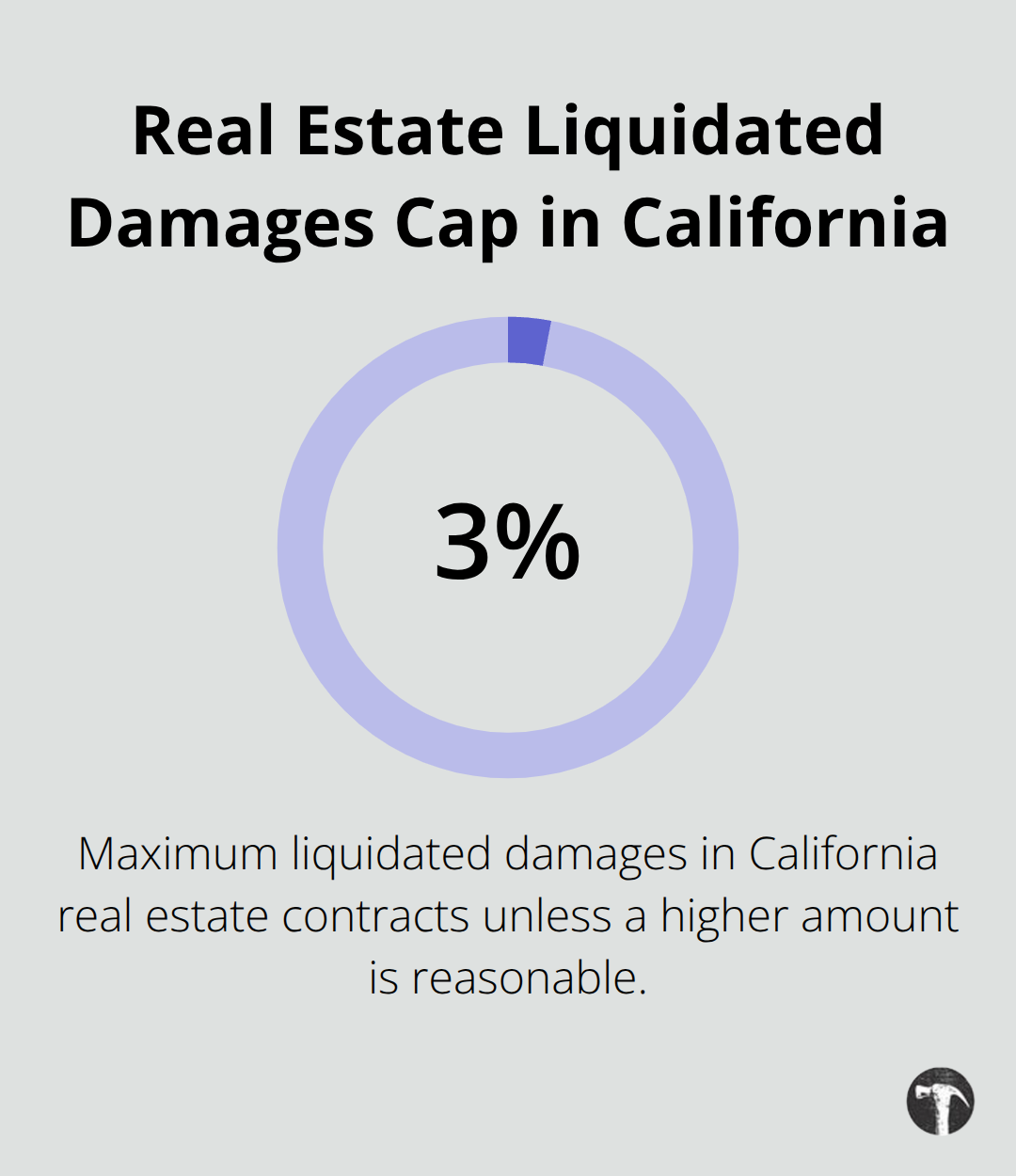
In real estate transactions, liquidated damages cannot exceed 3% of the purchase price unless the excess amount is reasonable under the circumstances. Many real estate contracts use earnest money forfeiture as liquidated damages when a buyer backs out without cause. This approach works because the seller can document why quantifying exact damages was impractical when the contract was signed.
Liquidated damages are not punitive-they cannot punish the breaching party for bad conduct. If a clause attempts to penalize rather than compensate, courts will disregard it and calculate actual damages instead. The advantage of liquidated damages is certainty and speed; you avoid lengthy disputes over damage calculations.
Restitution and Unjust Enrichment
Restitution damages prevent the breaching party from keeping profits or benefits they obtained through the breach. If a contractor performs 80% of a construction project then abandons the work, restitution requires them to return the profit they earned on completed work. This remedy focuses on what the breaching party gained, not what you lost.
Restitution often appears in cases where breach involves misappropriation of funds or trade secrets. A former employee who breaches a non-compete agreement and uses your client list to solicit customers might owe restitution equal to the profits they earned from those stolen relationships. Restitution requires careful calculation of the actual benefits received. Courts will examine what the breaching party kept and order disgorgement of those specific gains. This remedy works well when actual damages are difficult to quantify but unjust enrichment is clear.
The type of damages you pursue directly affects your recovery strategy and timeline. Different breach scenarios call for different damage theories, and selecting the right approach requires careful analysis of your contract terms and the specific harm you suffered.
How to Prove and Measure Your Actual Damages in Calabasas, California
Expectation Damages: The Direct Loss Calculation
Expectation damages form the backbone of most breach claims, measuring the direct financial loss you suffered when the other party failed to perform. The calculation is straightforward: take the cost of replacement performance and subtract what you originally paid. If you contracted to buy commercial property for $500,000 and the seller breached, forcing you to purchase identical property for $525,000, your expectation damages equal $25,000. This method works across industries-whether you’re dealing with service contracts, supply agreements, or real estate transactions.
Documentation determines whether courts accept your expectation damages claim. Courts require invoices, quotes, purchase orders, and communications proving the replacement cost. Many clients lose expectation damage claims not because the math is wrong but because they failed to document the replacement purchase when it occurred. If you wait months to calculate what replacement would have cost, courts view those numbers as speculative.
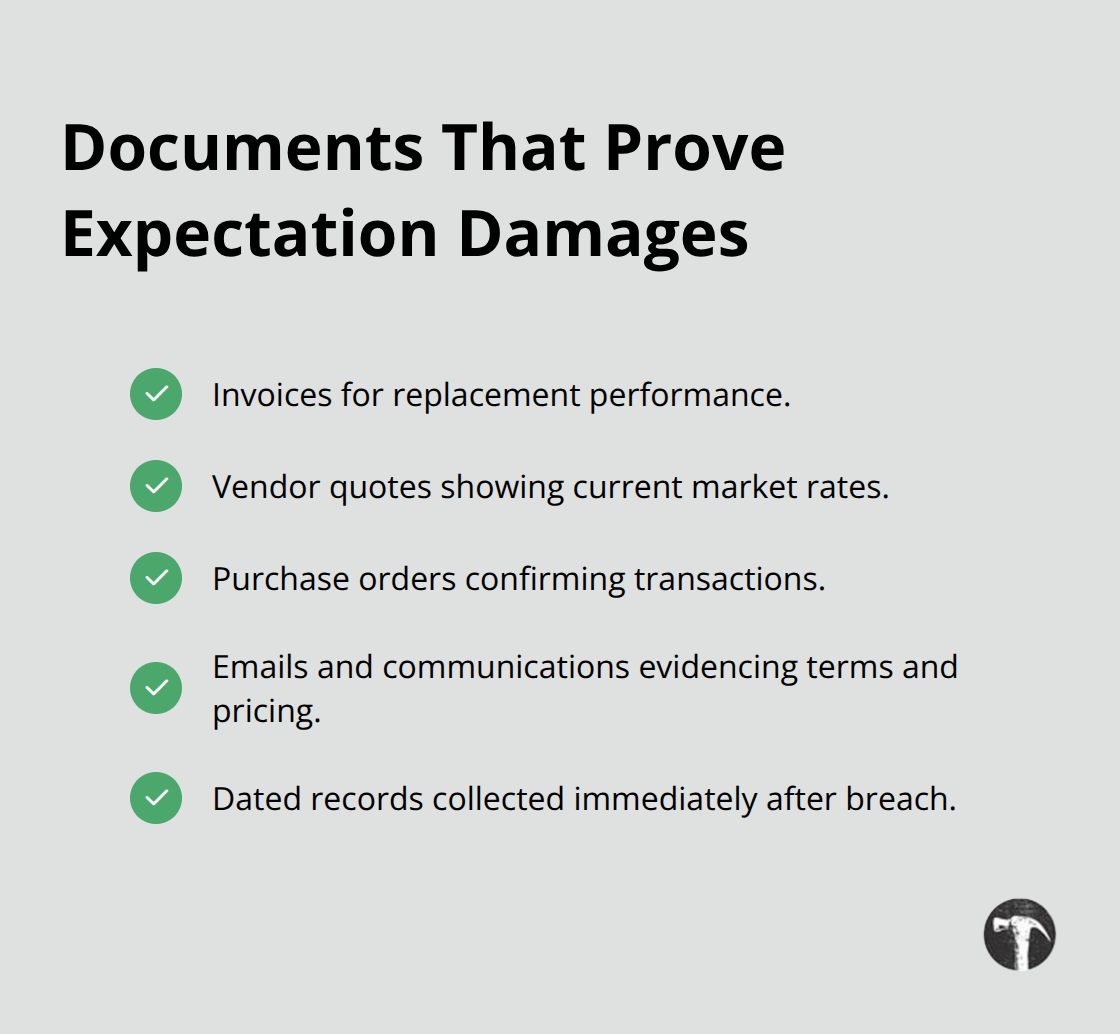
Collect documentation immediately after breach becomes apparent, including multiple vendor quotes showing market rates for replacement performance.
Reliance Damages: Recovering Your Preparation Costs
Reliance damages compensate you for expenses you incurred in anticipation of the contract being performed. If you hired subcontractors, purchased materials, or paid for preparation work based on the breaching party’s promise, those costs become reliance damages. A manufacturer who orders specialized equipment and pays engineering fees to integrate it into their production line can recover those expenses if the equipment supplier breaches before delivery.
The critical requirement is showing the breaching party knew these expenses were necessary when the contract was formed. California courts recognize reliance damages under the principle that you shouldn’t bear the cost of preparing for performance that never happens. Unlike expectation damages, reliance damages focus on what you spent, not what you failed to gain. This distinction matters significantly when the breaching party’s actions prevented you from completing your own performance obligations.
Restitution Damages: Preventing Unjust Enrichment
Restitution damages operate on an entirely different principle-they prevent the breaching party from profiting from their breach. When someone partially performs a contract then abandons it, restitution requires them to return the profit they earned on completed work. A construction contractor who completes 60% of a $100,000 project then walks away cannot keep the full contract price for the work performed; restitution forces them to disgorge excess profits.
This remedy matters most when calculating exact losses is nearly impossible but unjust enrichment is obvious. Trade secret theft, misappropriation of customer lists, and unauthorized use of confidential information all trigger restitution claims. The breaching party’s gain becomes the measure of damages, regardless of your actual loss. Courts examine what the breaching party kept and order disgorgement of those specific gains. This approach works well in cases where breach involves misappropriation of funds or confidential business information.
Choosing the Right Damages Theory for Your Situation
The type of damages you pursue directly affects your recovery strategy and timeline. Different breach scenarios call for different damage theories, and selecting the right approach requires careful analysis of your contract terms and the specific harm you suffered. Some contracts contain multiple types of losses-you might claim expectation damages for the replacement cost, reliance damages for preparation expenses, and restitution damages if the breaching party profited from partial performance. Understanding which damages apply to your facts positions you to maximize recovery and avoid pursuing theories that courts will reject as speculative or unsupported by evidence. When facing contract disputes in California, the next section examines the critical limitations courts impose on all damage awards, including the duty to mitigate losses and foreseeability requirements that can significantly reduce what you ultimately recover.
What Stops You From Recovering Full Damages in Calabasas, California
The Duty to Mitigate Losses
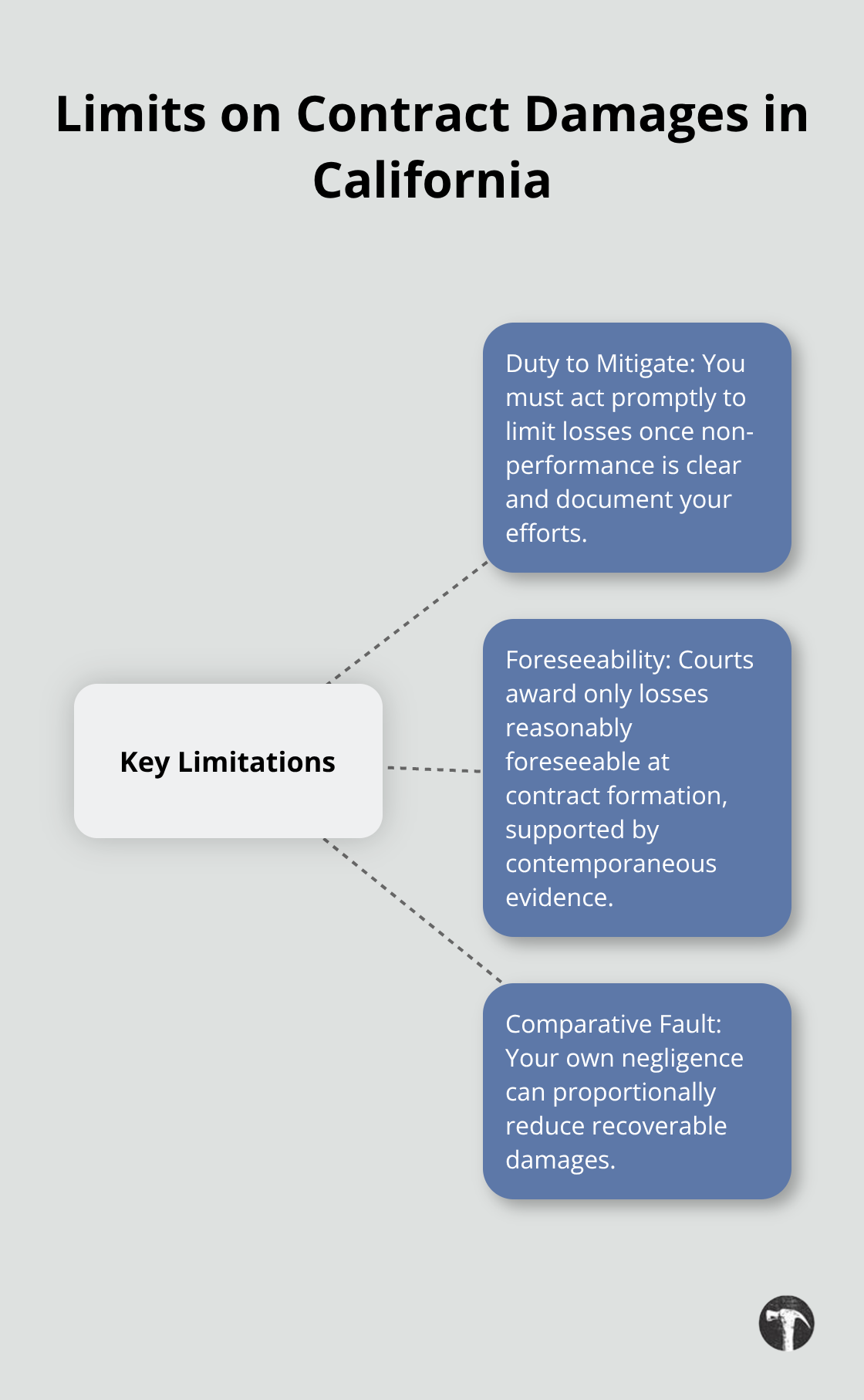
Courts impose hard limits on breach damages that catch many clients off guard. The most significant limitation is your duty to mitigate losses once you know the other party won’t perform. This isn’t a suggestion-it’s a legal obligation that directly reduces what you can recover.
In the Luten Bridge Co. v. Rockingham County case, a contractor continued building a bridge after the county breached the contract. The court ruled the contractor had to stop work immediately upon learning of the breach, and continuing construction only to pile up damages was not permitted.
This principle applies across all contract types. If a vendor breaches a supply agreement, you cannot keep ordering materials from them at inflated prices and then sue for the difference. You must take reasonable steps to find alternative suppliers and minimize the financial impact. What counts as reasonable depends on your industry and the circumstances, but courts expect documented mitigation efforts.
Collect quotes from alternative suppliers, document when you stopped incurring unnecessary expenses, and maintain records showing you actively sought replacement performance. Without this documentation, judges reduce damage awards based on what you could have reasonably avoided. The trigger for mitigation is notice of non-performance, not merely the breach itself. Once you learn the other party won’t perform, your obligation to limit losses begins immediately.
Foreseeability Requirements
Foreseeability creates another hard ceiling on damages. California courts won’t award damages for losses that were not reasonably foreseeable when the contract was signed. If a manufacturer breaches a delivery contract, you can recover lost profits from customers you had confirmed orders with-that’s foreseeable. You cannot recover lost profits from hypothetical future customers you might have obtained if performance had occurred.
The Lewis Jorge case reinforces this principle: lost profits from future contracts are speculative and unrecoverable unless you prove they were reasonably probable at contract formation. This means you need contemporaneous evidence showing the breaching party understood the specific consequences of their breach. An email where you explained that delays would halt your production line carries weight with courts. A vague statement that delays would hurt your business does not.
Courts also consider whether damages are too remote from the breach itself. A construction delay that increases labor costs is foreseeable; a construction delay that causes your entire business to fail is likely too speculative unless you provided specific notice. The detriment proximately caused by the breach-not distant or theoretical harm-determines what courts will award.
Comparative Fault and Damage Reduction
Comparative fault can reduce damages even in clear breach cases. If your own negligence contributed to the loss, California courts may reduce your award proportionally. If you failed to inspect delivered goods within a reasonable timeframe and missed discovering defects, your damages might be reduced. If you ignored obvious warning signs that the other party intended to breach and took no protective action, courts may find you partially at fault for the resulting losses.
This doctrine prevents parties from profiting from their own inaction or carelessness. Courts examine whether you took steps a reasonable person in your position would have taken to protect yourself. Failure to demand assurances when performance became questionable, failure to document the breaching party’s statements about their ability to perform, or failure to seek alternative performance when warning signs appeared-all these can trigger comparative fault reductions.
Final Thoughts
Calculating contractual breach damages requires understanding multiple damage theories, proving your losses with solid documentation, and recognizing the limitations courts impose on awards. The methods available to you-expectation damages, reliance damages, restitution, and liquidated damages-each serve different situations, and selecting the right approach determines whether you recover fully or face significant shortfalls. Your strongest claims rest on contemporaneous documentation: invoices, emails, purchase orders, and communications showing what you spent, what replacement performance cost, and what the breaching party knew about potential consequences.
The duty to mitigate losses and foreseeability requirements create hard ceilings on damages that many parties underestimate. You cannot sit idle while losses mount and expect courts to award the full amount. You must take reasonable steps to minimize harm, document those efforts, and prove the breaching party understood the specific consequences of their breach. Comparative fault can reduce your award if your own negligence contributed to losses, so protecting yourself through careful contract drafting and performance monitoring matters significantly.
When contractual breach damages disputes arise in Los Angeles County, the complexity of damage calculations and the strict evidentiary requirements make professional guidance invaluable. We at The Law Offices of Alan J. Carnegies, APC represent parties across all types of contract disputes, from construction conflicts to business disagreements to real estate transactions. Contact us to discuss how we can help you navigate damage calculations, gather the documentation courts require, and pursue the recovery you deserve.