

Private nuisance in Calabasas, California is a legal claim that homeowners and property owners raise when a neighbor’s conduct, or the condition of nearby property, interferes with the use and enjoyment of their own land. Persistent noise, foul odors, smoke, floodlights shining into bedrooms, drainage problems, and overgrown or neglected property are common examples. Many property owners are unsure whether a disagreement with a neighbor is simply an annoyance or something the law treats as a nuisance.
At the Law Offices of Alan J. Carnegie, APC, we represent property owners and businesses across Los Angeles County, including Calabasas, so you can move forward with confidence. This guide explains how California defines a private nuisance, the remedies the Civil Code provides, and the practical steps that help owners resolve problems early.
How Private Nuisance Claims in Calabasas, California Actually Work
California’s nuisance law is found in Part 3 of Division 4 of the Civil Code, beginning at section 3479. The statutes are short, but the concepts behind them are broad. Understanding the vocabulary is the first step in deciding whether a dispute is a legal matter or a neighbor-relations issue that can be solved by conversation.
What the Civil Code Calls a Nuisance
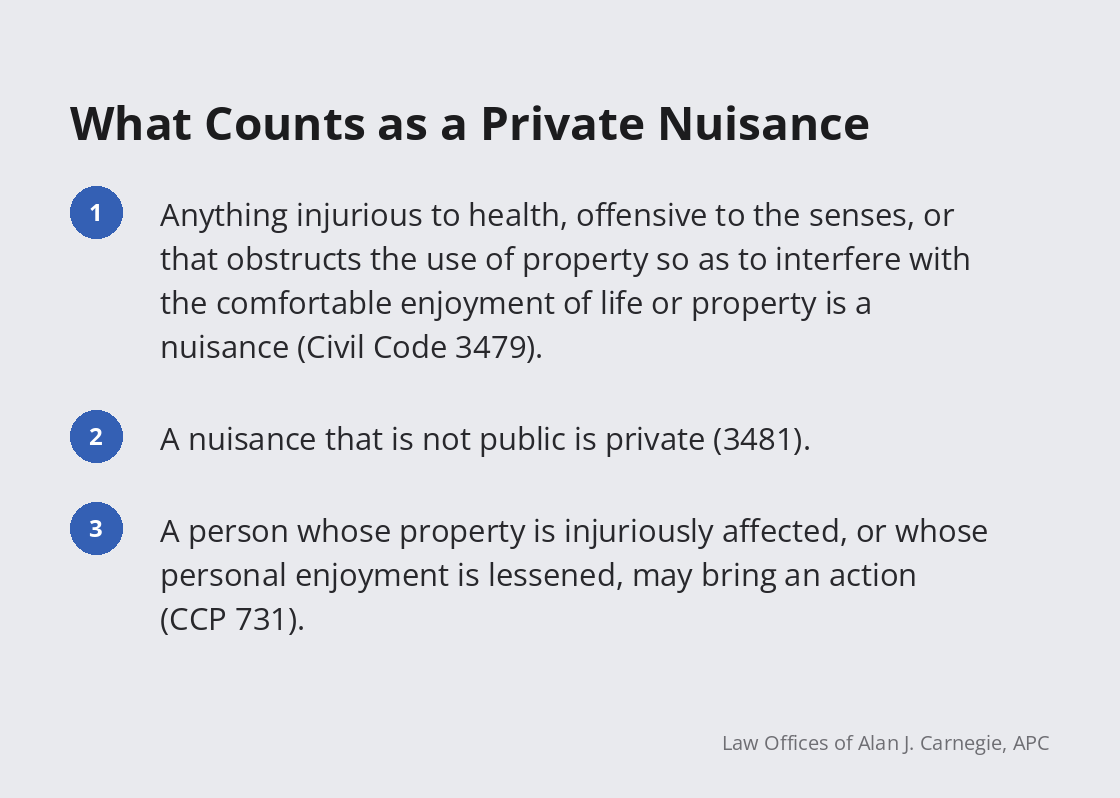
Civil Code section 3479 states that anything which is injurious to health, or is indecent or offensive to the senses, or is an obstruction to the use of property, so as to interfere with the comfortable enjoyment of life or property, is a nuisance. The definition also covers certain obstructions of navigable waters and public places. The central idea is interference. A condition on a neighbor’s property that does not affect you is not a nuisance as to you, but one that interferes with the comfortable enjoyment of your home can be.
Public Versus Private Nuisances
Section 3481 provides that every nuisance not included in the definition of a public nuisance is private. Section 3480 describes a public nuisance as one which affects at the same time an entire community or neighborhood, or any considerable number of persons. A private nuisance, by contrast, typically affects a smaller number of people, often a single property owner or a few neighbors. In a Calabasas neighborhood, a barking-dog problem that affects only the house next door, or a drainage issue that floods one yard, is typically a private matter, and the owner of the affected property is the person who brings the claim.
Who Can Bring a Claim
Code of Civil Procedure section 731 provides that an action may be brought by any person whose property is injuriously affected, or whose personal enjoyment is lessened by a nuisance as defined in section 3479. That language reaches property owners, and it also reaches people whose personal enjoyment is lessened. A tenant, for example, may have a claim even though the tenant does not own the home. Whether a particular person can bring a claim depends on the facts and the relationship to the property.
When a Statute Authorizes the Activity
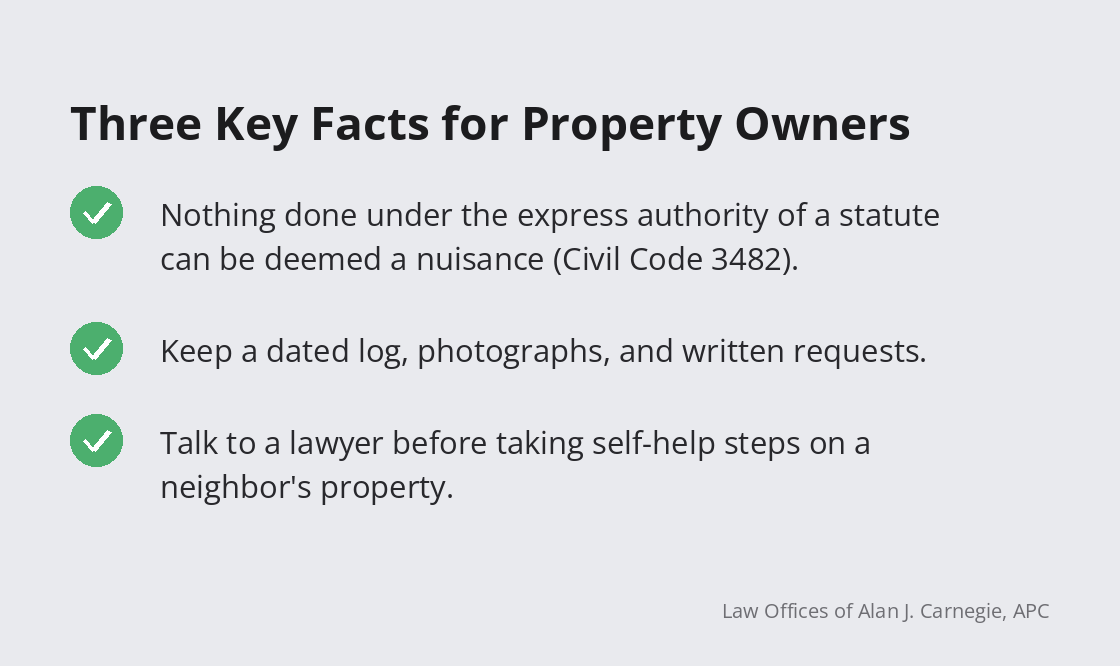
Section 3482 states that nothing which is done or maintained under the express authority of a statute can be deemed a nuisance. This is a limit on nuisance claims. If a neighbor’s activity is expressly authorized by a statute, it cannot be treated as a nuisance, even if it is annoying. A claim should therefore start with a close look at what the neighbor is doing and whether any law authorizes it.
Remedies for a Private Nuisance Under California Law
When a nuisance is real and continuing, California law gives property owners more than one way to respond. Which path makes sense depends on how serious the problem is, how the neighbor has responded, and what outcome you need.
A Civil Action or Abatement
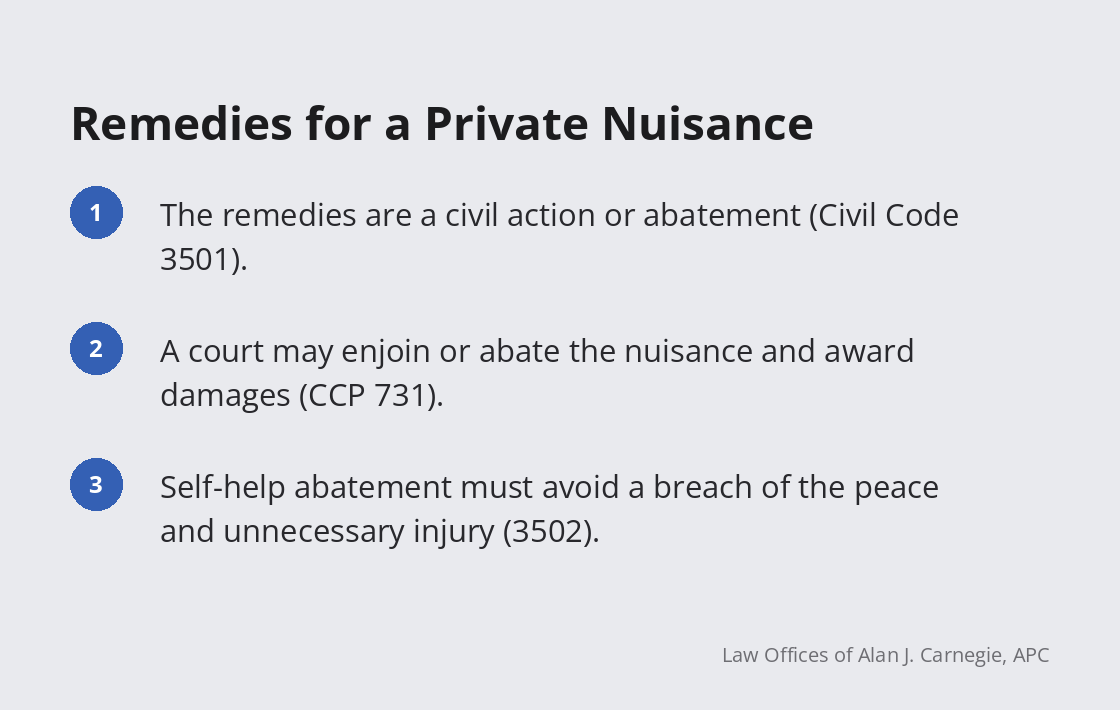
Section 3501 provides that the remedies against a private nuisance are a civil action or abatement. A civil action is a lawsuit filed in court. Abatement means stopping or removing the nuisance itself. The two remedies serve different purposes, and in a real dispute they are often considered together.
Injunctions and Damages
Under Code of Civil Procedure section 731, by the judgment in a nuisance action the nuisance may be enjoined or abated as well as damages recovered. An injunction is a court order that requires a neighbor to stop a harmful activity or to correct a harmful condition. In many Calabasas disputes, the property owner cares less about money and more about ending the problem, so the ability to ask a court to order the nuisance stopped can be the most important remedy.
Self-Help Abatement and Its Limits
Section 3502 provides that a person injured by a private nuisance may abate it by removing, or, if necessary, destroying the thing which constitutes the nuisance, without committing a breach of the peace or doing unnecessary injury. That sentence is narrower than it sounds. Entering a neighbor’s property, cutting down a fence, or removing something without consent can lead to a trespass or damage claim against you. Before taking any step on your own, speak with a lawyer about whether the action is permitted and how to document the problem first.
Practical Steps for Calabasas Property Owners
Most nuisance disputes begin with a simple problem that grows because no one addresses it. Careful early steps can resolve the issue without a lawsuit, and they build a record if the dispute does reach court.
Document the Interference
Keep a dated log of what happens, including the time, duration, and effect on you and your family. Take photographs and video, and save messages and emails. Note any dealings with the city, the homeowners association, or code enforcement. Specific, consistent records are far more persuasive than general complaints, and they help show that the interference is continuing rather than a one-time event.
Start With a Direct and Respectful Request
A courteous letter or conversation often solves the problem. Describe the issue plainly, explain how it affects you, and ask for a specific change. A written request shows that the neighbor knew about the problem and gives you a record of the date. Many neighbors act promptly once they learn that a condition on their property is causing harm.
Check Community Rules and Local Authorities
Calabasas properties are often part of homeowners associations with rules on noise, lighting, landscaping, and exterior conditions. An association may be able to enforce its rules, and local code enforcement may address certain conditions. These channels do not replace a nuisance claim, but they can resolve some problems faster and create additional documentation.
Consider Mediation Before Litigation
Neighbors will often continue to live next door to each other long after a dispute ends. Mediation gives both sides a chance to explain their concerns and to agree on a practical solution, such as a change in activity hours, a barrier, or a repair. Even when mediation does not succeed, the effort shows a willingness to resolve the matter reasonably.
Know When to Call a Lawyer
If the interference is serious, continuing, or harming your health or the use of your home, or if the neighbor has ignored your requests, it is time to discuss legal options. A lawyer can evaluate whether the facts meet the statutory definition, whether a statute authorizes the activity, and which remedy fits your goals.
Final Thoughts
A private nuisance is a condition or activity that interferes with the comfortable enjoyment of your life or property and that is not a public nuisance. California law allows a property owner, or a person whose personal enjoyment is lessened, to bring an action, and it provides remedies that include a civil action and abatement, with the court able to enjoin or abate the nuisance and award damages. The law also limits claims, including when a statute expressly authorizes the activity, and it limits self-help.
If a neighbor’s conduct or property is interfering with your home in Calabasas or elsewhere in Los Angeles County, contact the Law Offices of Alan J. Carnegie, APC to speak with our team. We will review the facts, explain your options, and help you move forward with confidence.