
Subcontractor disputes can derail even well-planned projects, costing time and money that you can’t afford to lose. Payment disagreements, scope conflicts, and quality issues are common problems that pop up on job sites across Los Angeles County, California.
We at The Law Offices of Alan J. Carnegies, APC help contractors navigate these conflicts and protect their bottom line. This guide walks you through practical resolution strategies and legal options to keep your project moving forward.
What Causes Subcontractor Disputes to Escalate
Payment Delays Trigger the Most Disputes
Payment disputes top the list of construction conflicts, and the numbers back this up. Unpaid invoices and delayed payments are the single most common trigger for subcontractor disputes across Los Angeles County. When a general contractor withholds payment or misses deadlines, subcontractors lose cash flow they need to pay their own workers and suppliers.
California Civil Code Section 8850, effective January 1, 2026, now mandates a four-step dispute resolution process for private construction contracts. Under this law, if an owner receives a claim for payment, they have 30 days to respond in writing identifying what portions are disputed versus undisputed. Undisputed amounts must be paid within 60 days of that response.
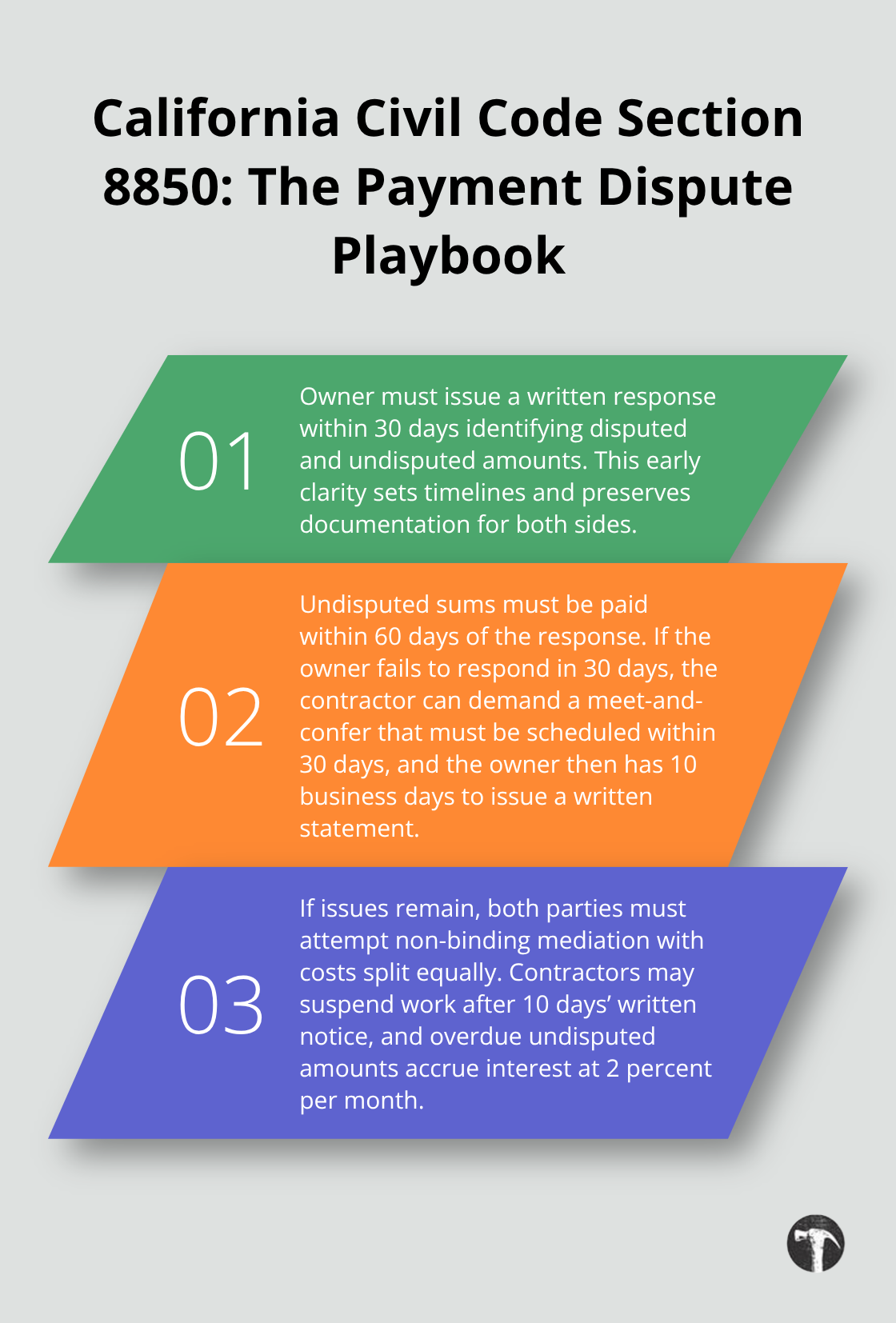
If the owner fails to respond within the initial 30-day window, the contractor can demand an informal meet-and-confer conference, and the owner must schedule it within 30 days. After that conference, the owner has 10 business days to issue a written statement. If payment issues remain unresolved after the informal conference, both parties must attempt non-binding mediation with costs split equally. Contractors who face non-payment can suspend work after providing 10 days written notice, and any undisputed amounts not paid on time accrue interest at 2 percent per month. This statute applies only to contracts signed after January 1, 2026, and excludes residential projects under five stories, but it dramatically shifts leverage toward contractors and subcontractors pursuing legitimate payment claims.
Scope Disagreements Create Costly Conflicts
Scope disagreements and contract interpretation problems run a close second as dispute drivers. These conflicts often stem from vague language, incomplete specifications, or verbal agreements that never made it into the written contract. A subcontractor performs work they believe falls within their scope, but the general contractor disputes this and refuses to pay for the extras.
The SCL Delay and Disruption Protocol emphasizes that clear, detailed project documentation from day one prevents these misunderstandings. Written specifications, detailed drawings, and itemized scope statements eliminate ambiguity about what work each party must complete. Contractors who document scope changes in writing and obtain written approval before proceeding protect themselves from later disputes.
Quality Issues Require Solid Evidence
Quality and performance disputes arise when work fails to meet contract standards or industry norms. These claims require concrete evidence: daily records of labor, equipment, and progress, plus photographic documentation of defects. Weak contract administration-delayed payment responses, late change order approvals, slow design clarifications-inflames all three dispute types.
Owners and contractors who respond quickly, communicate in writing with facts rather than emotion, and attach supporting documents protect themselves and keep disputes from festering into costly litigation. This foundation of clear communication and documentation sets the stage for understanding how to resolve disputes before they spiral out of control.
How to Stop Disputes Before They Spiral
Start with a Strong Paper Trail
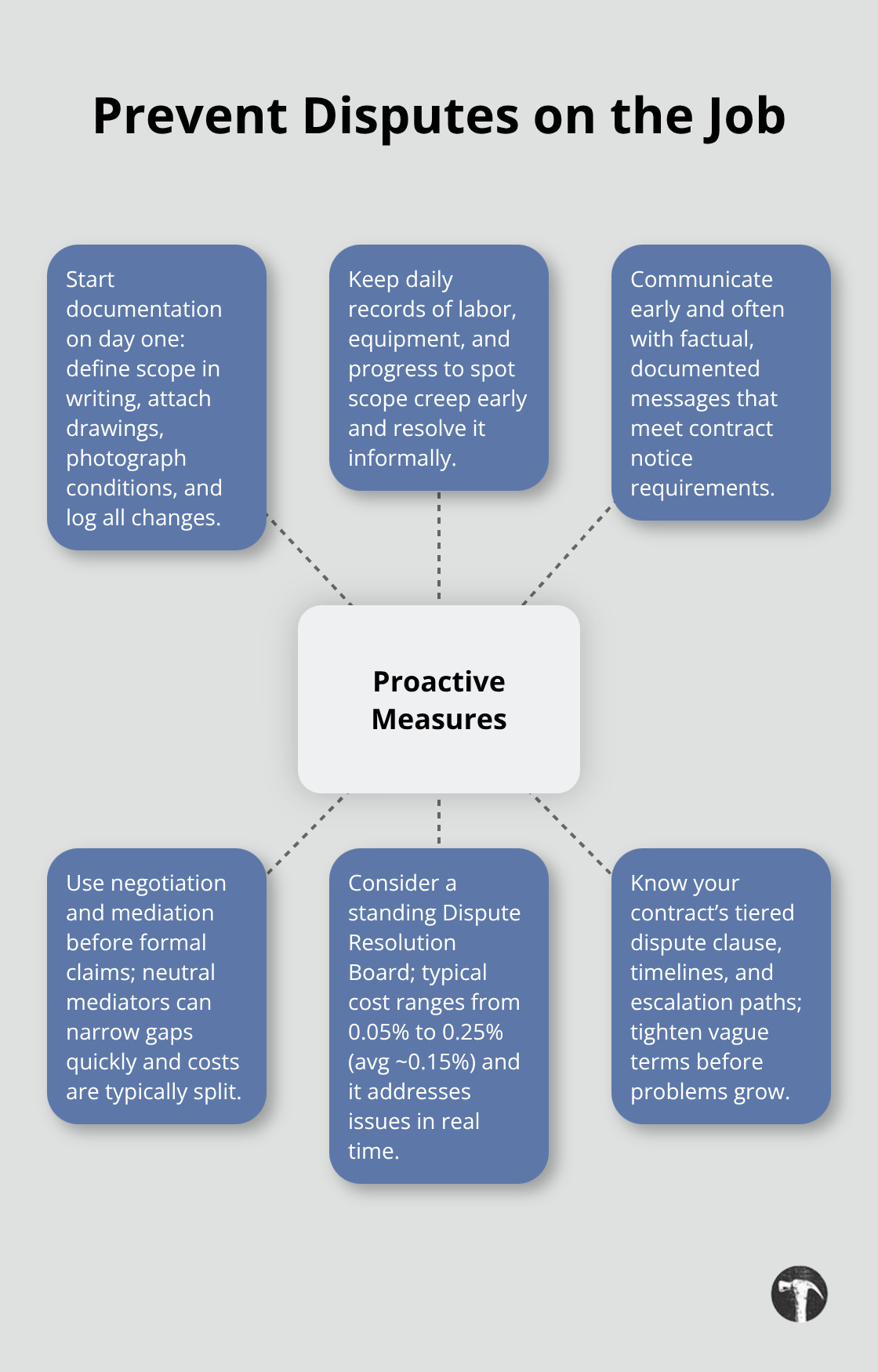
Documentation forms your first line of defense, and it must start before work begins. Contractors and subcontractors who establish a paper trail from day one achieve measurably better outcomes when disputes arise. Write down scope agreements, attach detailed drawings, photograph existing conditions, and maintain a live record of all changes. When communication happens via email or text with attached photos and specifications, you create evidence that holds up under scrutiny.
The SCL Delay and Disruption Protocol stresses that daily records of labor, equipment, and progress are essential-not just for defense, but for identifying problems while they’re still small. A subcontractor who notices scope creep early and documents it in writing can resolve it informally. One who waits until the project ends faces an uphill battle proving what work fell outside the original agreement.
Communicate Early and Often
Site visits and regular check-ins between general contractors and subcontractors catch misunderstandings before they become formal disputes. Communication should be factual, attached with supporting documents, and compliant with any notice requirements in your contract. Emotional language and accusations poison relationships and make settlement harder.
Owners and contractors who respond to concerns within days rather than weeks signal that they take issues seriously and want to resolve them.
Use Mediation Before Formal Claims
California Civil Code Section 8850 now mandates mediation as the next step if informal resolution fails, but smart contractors use negotiation and mediation voluntarily before disputes become formal claims. Mediation costs are typically split between parties, and a neutral mediator with construction experience can narrow disagreements and identify settlement value much faster than litigation. The AAA Construction Division and other providers offer streamlined mediation for construction disputes, often resolving cases in a single session.
Consider a Standing Dispute Resolution Board
Larger or more complex projects benefit from a standing Dispute Resolution Board, which meets regularly to address issues in real time. Cost estimates for a standing DRB typically range from 0.05 percent to 0.25 percent of final construction cost according to the Dispute Resolution Board Foundation, with an average around 0.15 percent for projects in the $50 million to $100 million range (these boards prevent disputes from festering by addressing problems while work continues).
Know Your Contract’s Dispute Resolution Clause
Understanding your contract’s dispute resolution clause before a conflict arises is critical. Many contracts now include tiered processes with an Initial Decision Maker who can issue quick rulings to keep the project moving, followed by mediation and then arbitration or litigation if needed. Know what your contract says about timelines, notice requirements, and escalation paths. If your contract lacks these provisions or is vague, we at The Law Offices of Alan J. Carnegies, APC can review the language and advise whether amendments or clarifications are needed before disputes take hold. Once you’ve built these preventive systems into your project, you’re ready to understand the legal remedies available when disputes still arise despite your best efforts.
What Legal Options Exist When Disputes Escalate in Calabasas, California
When mediation fails and a subcontractor or general contractor faces unpaid invoices or unresolved scope conflicts, California law provides several enforcement mechanisms. The path you choose depends on the dispute amount, contract terms, and how quickly you need resolution. Under California Civil Code Section 8850, if an owner refuses to pay undisputed amounts after the mandatory four-step process, you can suspend work and accrue interest at 2 percent per month on overdue sums.
Mechanics Liens and Bond Claims Protect Subcontractors
For disputes involving liens and payment claims, mechanics liens remain one of the most powerful tools available to subcontractors across Los Angeles County. A mechanics lien creates a legal claim against the property itself, giving you leverage that far exceeds a standard contract claim. To preserve your lien rights, you must provide preliminary notice to the property owner within 20 days of first furnishing labor or materials, then file the lien within 90 days of last providing work or materials.
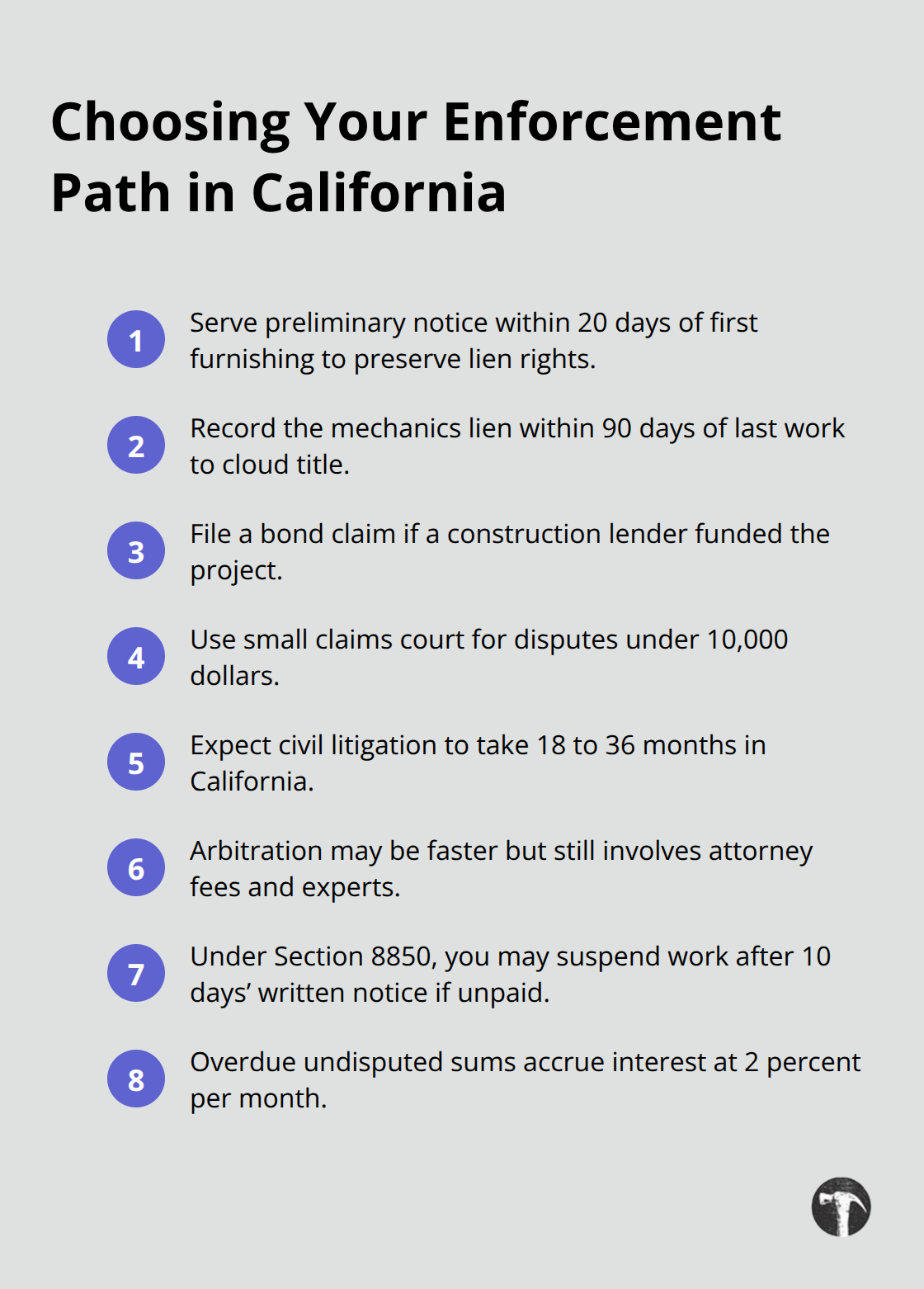
The lien clouds the title and prevents the owner from selling or refinancing without addressing your claim. Many property owners settle lien claims quickly rather than face the cost and delay of clearing title. If the property was funded by a construction lender, you may also file a bond claim against the construction loan, which creates an additional pressure point for payment. These remedies are available only if you follow strict timing requirements, so documenting your first day on site and final day of work is essential.
Breach of Contract Claims Require Solid Evidence
When a dispute involves contract interpretation or quality standards, a breach of contract claim becomes necessary. These claims require proving that the other party failed to perform obligations under the written agreement and that you suffered damages as a result. In Los Angeles County, breach claims can be filed in civil court and typically require showing the scope of work, the failure to perform, causation, and quantified losses. If your contract includes an arbitration clause, the dispute will be resolved through private arbitration rather than court litigation, which is often faster but still involves substantial attorney fees and expert testimony.
Small Claims Court vs. Civil Litigation
Small claims court offers a faster, lower-cost alternative for disputes under 10,000 dollars, with no attorneys allowed and streamlined procedures that resolve cases in weeks rather than months. However, small claims judgments are difficult to enforce if the defendant lacks assets or refuses to pay voluntarily. For larger disputes or those requiring complex evidence such as delay analysis or defect documentation, civil litigation in superior court is necessary. Civil litigation in California typically takes 18 to 36 months from filing to trial, with discovery, motion practice, and settlement negotiations consuming significant time and expense.
Choosing the Right Path Forward
The Law Offices of Alan J. Carnegies, APC represents contractors, subcontractors, and property owners in construction disputes throughout Los Angeles County and can advise whether a lien, bond claim, breach of contract action, or settlement through arbitration offers the best path forward for your specific situation.
Final Thoughts
Subcontractor dispute resolution works best when you build prevention into your project from day one. Document everything in writing, communicate facts without emotion, and respond quickly to concerns before they harden into formal disputes. California Civil Code Section 8850 now requires owners and contractors to follow a structured four-step process for payment claims, with mandatory mediation if informal resolution fails, and this statute shifts leverage toward contractors and subcontractors who follow the rules and meet all deadlines.
When disputes still arise despite your best efforts, you need legal guidance tailored to your specific situation. A mechanics lien, bond claim, breach of contract action, or settlement through mediation each serve different purposes depending on the dispute amount, contract terms, and timeline (small claims court works for disputes under 10,000 dollars, but larger or complex disputes require civil litigation or arbitration with experienced counsel). Protecting your project timeline and budget means acting fast when disputes emerge and having a clear legal strategy in place before conflicts spiral into costly litigation.
We at The Law Offices of Alan J. Carnegies, APC represent contractors, subcontractors, and property owners in construction litigation throughout Los Angeles County and can advise whether a lien, bond claim, or other remedy offers the best path forward for your situation.