

Arbitration clauses in Calabasas, California construction and business contracts often decide where a dispute will be heard long before anyone imagines there will be a dispute. A single paragraph buried in a construction agreement, a purchase contract, or a partnership document can move a conflict out of the Los Angeles County Superior Court and into a private hearing in front of an arbitrator. Understanding how California enforces these clauses gives you real control over your options when a project or business relationship goes wrong.
We at The Law Offices of Alan J. Carnegies, APC help property owners, contractors, developers, and businesses across Los Angeles County navigate these questions. This guide explains what an arbitration clause actually does under California law, how courts decide whether a dispute must be arbitrated, and the mistakes that can quietly waive important rights.
What an Arbitration Clause Actually Does Under California Law
California’s arbitration statutes are found in Title 9 of Part 3 of the Code of Civil Procedure, beginning with Section 1280. These rules apply to many of the contracts that drive construction and business activity in Calabasas and throughout Los Angeles County, from prime contracts and subcontracts to purchase agreements and operating agreements. Knowing the basic framework helps you evaluate a clause before you sign it and respond quickly if a dispute arises.
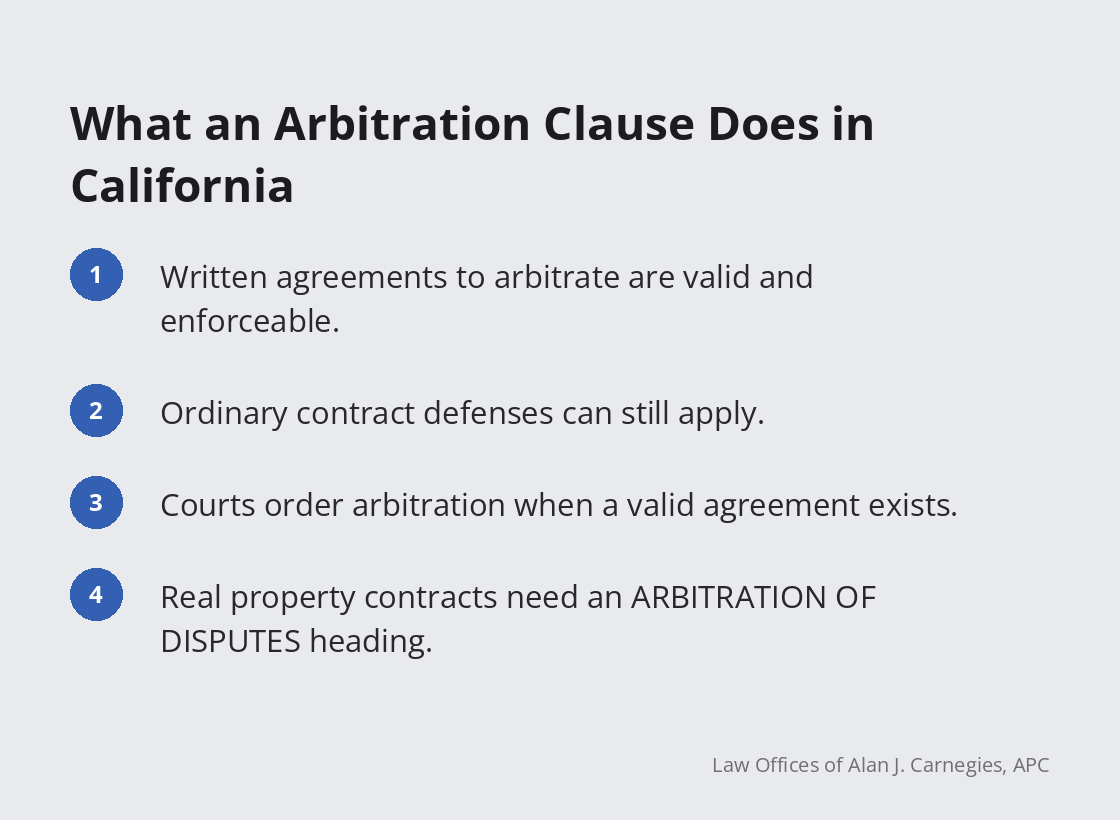
Three ideas form the foundation: written agreements to arbitrate are generally enforceable, courts have a defined role in compelling arbitration, and special rules apply to some real property contracts.
Written Agreements Are Generally Enforceable
Code of Civil Procedure Section 1281 provides that a written agreement to submit to arbitration an existing controversy or a controversy thereafter arising is valid, enforceable, and irrevocable, save upon such grounds as exist for the revocation of any contract. In other words, an arbitration clause is treated much like any other contract term, and the usual contract defenses, such as fraud in its formation, can still apply.
That principle covers both disputes that already exist and disputes that may arise in the future. Most construction and business contracts use the second approach, agreeing in advance that any later disagreement will be arbitrated.
Courts Can Order Arbitration
When one party refuses to arbitrate, the other can ask the court to step in. Under Code of Civil Procedure Section 1281.2, on a petition alleging a written agreement to arbitrate and a refusal to arbitrate, the court shall order arbitration if it determines that an agreement to arbitrate the controversy exists, unless it finds that the petitioner waived the right, that grounds exist to rescind the agreement, or that another statutory exception applies.
Importantly, Section 1281.2 provides that if the court determines a written agreement to arbitrate exists, an order to arbitrate may not be refused on the ground that the petitioner’s contentions lack substantive merit. The court’s job at that stage is to decide whether the dispute belongs in arbitration, not who should win.
Special Rules for Real Property Contracts
Some real estate contracts must follow specific formatting rules. Code of Civil Procedure Section 1298 provides that when a contract to convey real property, including certain purchase contracts and leases with options to purchase, contains a provision for binding arbitration of disputes between the principals, that provision must be clearly titled “ARBITRATION OF DISPUTES.” In a printed contract, it must appear in at least 8-point bold type or in contrasting red in at least 8-point type, and in a typed contract it must appear in capital letters.
Section 1298 also requires a specific notice explaining that by initialing, the parties agree to neutral arbitration and give up rights to have the dispute litigated in court or by jury trial. Under Section 1298.7, such an arbitration provision does not preclude or limit any right of action for bodily injury or wrongful death, or any right of action to which the construction defect statutes in Code of Civil Procedure Sections 337.1 or 337.15 apply.
How Courts Decide Whether Your Dispute Goes to Arbitration
Even with a clear arbitration clause, the path to arbitration is not always automatic. Construction disputes often involve owners, general contractors, subcontractors, suppliers, and design professionals, and not all of them may have signed the same agreement. California law gives courts tools to manage these multi-party situations.
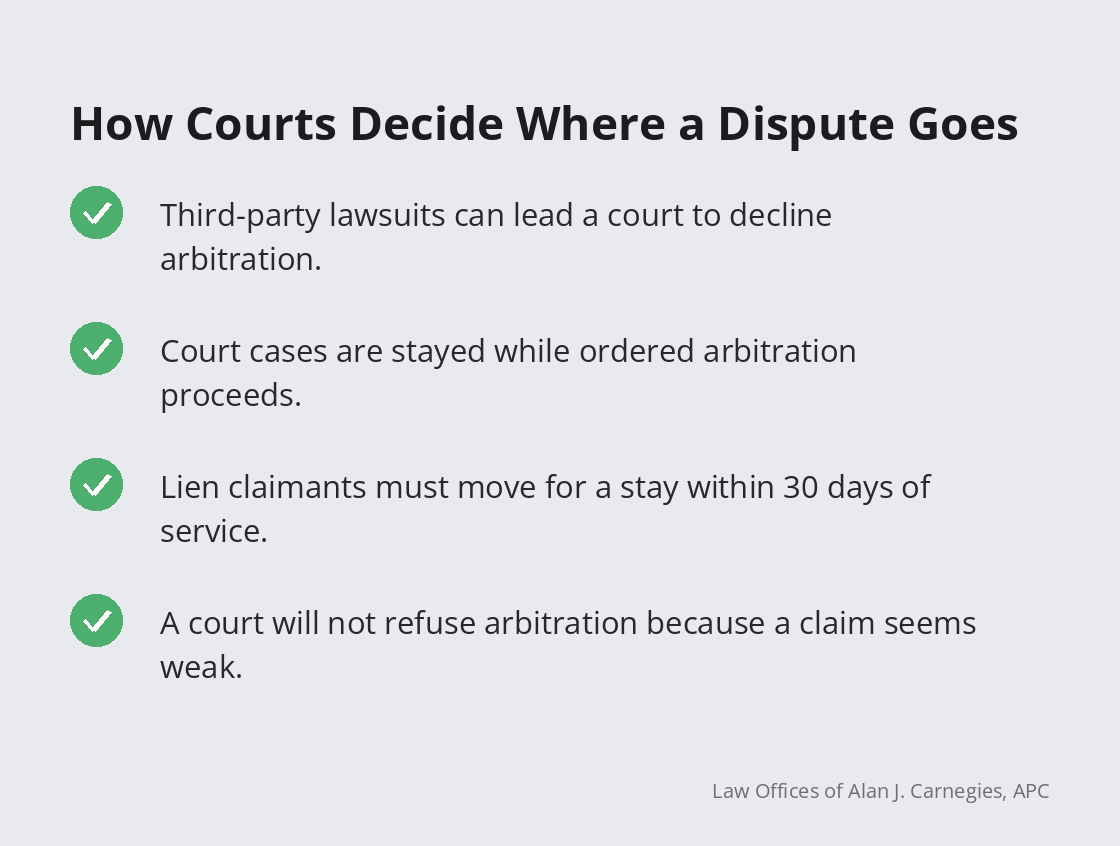
The rules below explain how courts handle third parties, pending lawsuits, and mechanic’s lien claims when arbitration is in play.
Disputes Involving Third Parties
Code of Civil Procedure Section 1281.2(c) allows a court to decline to order arbitration where a party to the arbitration agreement is also a party to a pending court action with a third party arising out of the same transaction or series of related transactions, and there is a possibility of conflicting rulings on a common issue of law or fact. This situation comes up often on construction projects, where an owner may have an arbitration clause with the general contractor but not with a subcontractor or design professional.
When that exception applies, Section 1281.2 gives the court several options. It may refuse to enforce the arbitration agreement and order joinder of all parties in a single action, order joinder as to certain issues, order arbitration among the parties who agreed to it while staying the court action, or stay the arbitration pending the outcome of the court action.
Stays of Court Proceedings
When arbitration is ordered, the related court case usually pauses. Code of Civil Procedure Section 1281.4 provides that if a court has ordered arbitration of a controversy that is an issue in a pending action, the court where that action is pending shall, on motion of a party, stay the action until the arbitration is had or until an earlier time the court specifies. A stay is also available while a petition to compel arbitration is pending.
If the arbitrable issue is severable, the stay may apply to that issue only. This allows other parts of a case to move forward when they are not subject to arbitration.
Mechanic’s Liens and Arbitration
Contractors and suppliers who record a mechanic’s lien often must file a lawsuit to enforce it within a limited time, even if their contract requires arbitration. Code of Civil Procedure Section 1281.5 addresses this tension. A claimant who files an action to enforce a lien does not waive a right to arbitrate if the complaint states that the claimant does not intend to waive arbitration and intends to move for a stay within 30 days after service of the summons and complaint, or if the claimant files an application for a stay at the same time as the complaint.
Under Section 1281.5(b), the claimant must file and serve a motion to stay the action within 30 days after service of the summons and complaint, and failing to do so is a waiver of the right to compel arbitration. Our article on construction liens in Los Angeles explains the lien process that comes before this step.
Mistakes That Can Waive Rights or Derail an Arbitration
Arbitration can be faster and more private than litigation, but it comes with its own traps. Many problems arise not from the arbitration itself but from how parties act before and after it, often under tight deadlines.
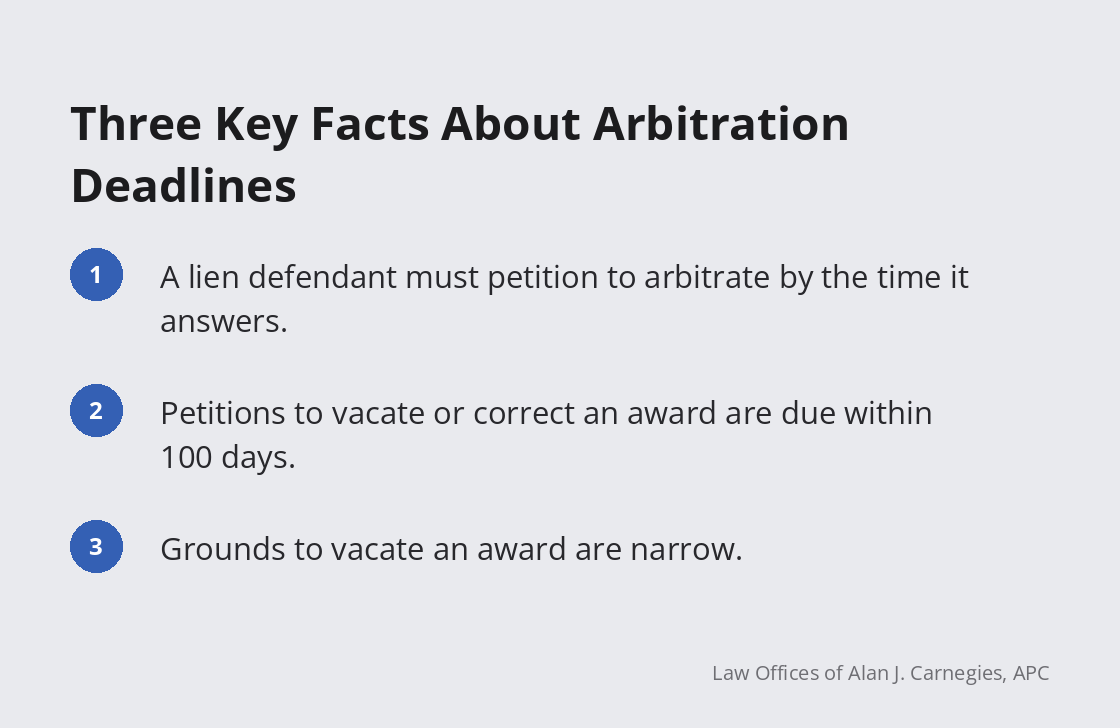
The missteps below are among the most common ways parties lose ground.
Answering a Lien Lawsuit Without Raising Arbitration
Owners and other defendants sued in a mechanic’s lien action need to act quickly if they want to arbitrate. Code of Civil Procedure Section 1281.5(c) provides that the failure of a defendant to file a petition to compel arbitration at or before the time the defendant answers the complaint is a waiver of the defendant’s right to compel arbitration.
More broadly, Section 1281.2 allows a court to refuse to compel arbitration when the petitioner has waived the right. Actively litigating a case for a long period before asking for arbitration can create that risk, so the decision whether to arbitrate should be made early.
Missing the Window to Challenge an Award
Arbitration awards are difficult to overturn, and the time to try is short. Code of Civil Procedure Section 1288 provides that a petition to vacate or correct an award shall be served and filed not later than 100 days after the date of service of a signed copy of the award on the petitioner. A petition to confirm an award has a longer window of four years after service of the signed award.
Calendaring the service date of the award as soon as it arrives is one of the most important steps after an arbitration ends. Our guide to contract lawsuit deadlines in Calabasas, California covers other time limits that can affect your case.
Expecting a Court to Redo the Arbitration
Many parties assume they can appeal an unfavorable arbitration result the way they would appeal a trial. California’s grounds for vacating an award are narrow. Code of Civil Procedure Section 1286.2 requires the court to vacate an award only on specific grounds, such as an award procured by corruption, fraud, or other undue means, corruption in an arbitrator, substantial prejudice from a neutral arbitrator’s misconduct, arbitrators exceeding their powers, substantial prejudice from a refusal to postpone or hear material evidence, or certain arbitrator disclosure and disqualification failures.
Because of these limits, the time to protect your position is before and during the arbitration. Choosing the right arbitrator, building a complete record, and presenting your evidence carefully matter far more than plans for a later challenge.
Final Thoughts
Arbitration clauses in Calabasas, California contracts can shape how a construction or business dispute unfolds from the very first day. California enforces written agreements to arbitrate, gives courts tools to manage multi-party disputes, and sets firm deadlines for lien claimants, defendants, and anyone hoping to challenge an award.
Reviewing arbitration language before you sign, and acting promptly when a dispute begins, can protect rights that are easy to lose. A careful look at your contract and your timeline is the best place to start.
If you are facing a construction or business dispute involving an arbitration clause, contact The Law Offices of Alan J. Carnegies, APC today to discuss your options. We serve clients in Calabasas and throughout Los Angeles County.